
A dog bed under a table only works if the open height under the lowest rail is taller than the bed plus the way your dog actually lies. Most coffee tables are only 16 to 18 inches to the top, and the apron under that top steals several more inches, so a bolstered bed that looks right in a photo often leaves no room to curl. Dining tables and desks have more vertical room and a different set of problems: chairs, feet, and crumbs.
Why dogs already treat that space as a bed
The search usually starts because the dog picked the spot. Under a table is a ready-made den: a low ceiling, walls on at least two sides, and a view of the room if they want it. Certified trainer Jessika Jake, quoted by the American Kennel Club, calls that kind of hideaway a “fun little fort” and says dogs “like the little den environment.” She also notes that a bed or table stays put, unlike a mat that gets moved, so the location itself feels reliable.
Colorado veterinarian Dr. Joseph Menicucci describes the same pattern under desks: dogs use the space because it feels safe and still keeps them near a person. Florida veterinarian Dr. Nita Patel frames it as an old denning drive that does not switch off in a house with no predators. Temperature plays a part too. A low nook can be cooler than a sunny floor, or warmer if it sits against a sofa or under a desk where the air moves less.
Under a dining table, food is the extra reason. The AKC notes that dogs who “supervise” meals learn that dropped scraps happen there. A bed in that spot can make the habit more comfortable without fixing the begging.
None of that is a problem if the dog comes out for meals, walks, and play, and the habit is long-standing. A new retreat, especially with shaking, hiding from touch, limping, or a skipped meal, is a different story. Both Jake and Menicucci treat a sudden change in hiding as a reason to check for pain, fear, or illness rather than just adding a cushion.
Measure the opening, not the table height
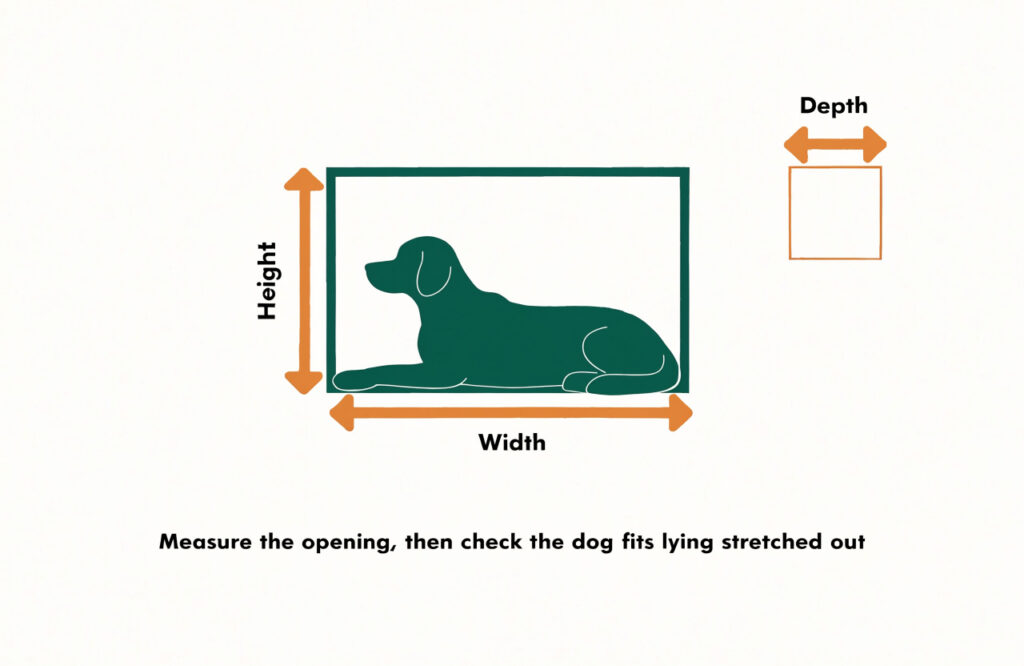
Table height and dog-bed height are not the same number. Measure from the floor to the lowest obstruction: the apron, a stretcher bar between the legs, a shelf, or a cable tray. Then measure the clear width between the legs and the depth from the front edge of that opening to the back. Write those three numbers down before you look at beds.
Coffee tables are the tight case. Furniture guides put a typical coffee table at about 16 to 18 inches from the floor to the top, or level with the sofa seat to 1–2 inches lower, according to a living-room sizing guide from Nepa Furniture. A 1-inch top and a 2-inch apron can drop a “17-inch table” to roughly 14 inches of real clearance. A shelf under the top can cut it again. If your dog’s head, when lying in their usual curl, plus the bed, is taller than that gap, they will not use the bed. They will shove it aside and lie on the floor.
Dining tables look roomier and often are not, once you measure the right surface. Standard dining height is 28 to 30 inches to the top of the table, with 30 inches the figure most makers mean by standard, according to the Cradle & Hearth dining-height guide. The useful gap for legs is smaller: that guide says to leave 10 to 12 inches between the chair seat and the underside of the table, and to measure to the apron, not the top. A dog bed has to share that same apron line with human knees. A thick pad under a pedestal table can also block the footrest ring.
Desks sit in the same general band as dining tables, often around 29 to 30 inches to the top, but the obstacle is the modesty panel, a CPU, or a keyboard tray. Measure the empty rectangle your dog can actually enter, not the desktop.
Then measure the dog, not the breed label. Nose to base of tail while stretched, and the length of their usual curl. Add a few inches so they can turn. A bed sold as “large” can still be too long for the gap between coffee-table legs, or too tall once bolsters are included.
Which bed style survives a low opening
Style matters more than brand under a table. The wrong shape fails even when the foam is good.
| Bed style | Fits a low coffee table? | Main catch |
|---|---|---|
| Flat mat or thin pad | Usually yes | Little joint support; slides on hard floors |
| Low orthopedic pad, about 3–4 inches | Often, if clearance allows | Dog may not be able to sit up under the table |
| Bolster or sofa bed | Rarely | Sides add height and steal interior length |
| Donut or hooded cave | Only for small dogs in a tall opening | Outer diameter is larger than the sleeping circle |
| Raised cot | Poor fit indoors under furniture | Frame height plus mesh still needs sit-up room |
| Table with a built-in bed | Different product | You are buying furniture, not filling a gap |
A flat mat is the default under a coffee table. It stays out of the apron, and a non-slip underside matters because table legs give a dog something to push against. The tradeoff is support. A senior dog with stiff hips may need more foam than the opening allows. In that case a 3-inch pad in the open is often better than a 7-inch “orthopedic” bed that only fits if the dog lies in the aisle.
Bolsters are the usual mistake. They give a headrest and a sense of a wall, which is why den-loving dogs like them in an open room. Under a table the table already is the wall. A bolster that is 4 inches tall can turn a workable pad into a bed the dog has to climb, and three-sided bolsters commonly eat several inches of the advertised length. Measure the flat center, not the outer footprint.
Donut beds have the same problem in round form. The sleeping well is much smaller than the outside diameter, and the plush rim is exactly what catches on a table leg. They suit a small dog beside the sofa more than a dog under it.
Raised cots keep a dog off hot or wet ground outdoors. Under a coffee table the frame is one more thing to bump, and the mesh still needs enough height for the dog to settle without scraping their back.
Coffee table, dining table, and desk are different jobs
Under a coffee table, the limit is height and traffic. The bed should sit fully inside the leg footprint so it is not a trip edge between the sofa and the table. Nepa’s spacing guidance puts the sofa-to-table gap at about 14 to 18 inches and asks for roughly 30 inches where that far side is a walkway. A bed that sticks out into either zone will get kicked, and the table will get nudged. Glass tops are a poor match: a dog standing into the underside can crack a top that was only rated for a book and a mug. If the table wobbles when you lean on a corner, do not put a dog under it until the legs are tightened or the piece is replaced.
Under a dining table, the limit is sharing the room with chairs and meals. A low mat that stops short of the chair legs can work for a dog who already waits there, if you pull chairs out before anyone sits. A thick bed under a chair rail turns every meal into a negotiation. Crumbs, sauce, and a damp nose also mean the cover has to come off. A waterproof liner under a washable cover is more useful here than a plush rim. If the goal is to stop begging, the bed does not do that by itself. The AKC’s practical suggestion is to reward the dog for staying on a mat and ignore the hiding or hovering you do not want, including the version that happens under the table at dinner.
Under a desk, the limit is cables and the person using the desk. A low pad against the wall side of the kneehole keeps the dog near you, which is the reason many of them choose it, without putting paws on a power strip. Leave a clear path for your own feet. A hooded bed in a kneehole traps heat and makes it harder to see whether the dog is settled or stuck. If the dog only uses the desk during storms or fireworks, the bed is a comfort tool, not a fix for the fear. Pair it with the usual distance from the noise, and do not close them into the kneehole.
A table with a built-in bed is a different purchase
Some “dog bed under table” results are not beds at all. They are end tables, nightstands, or round accent tables with a sleeping nook or a crate in the base. That is a reasonable buy when you need a side table and a small or medium dog, and you do not already have a coffee table they have claimed.
Treat the listing like furniture, not like a cushion. Exterior height is the tabletop height. The sleeping box is smaller, and listings often omit the interior height. A three-sided open bed is easier for an older dog to enter than a crate with a raised lip. An enclosed furniture crate can work as a den, but only if the dog already likes a crate and can stand and turn inside it. A flat top that you will set a lamp on needs a stated weight limit; a decorative top is not automatically a nightstand.
These pieces also cost more than a mat because you are paying for a cabinet. They do not solve a coffee-table problem unless you are willing to replace the coffee table. A dog who sleeps under the existing table for the den feel may ignore a new enclosed cube across the room.
DIY versions, usually an old side table with the drawers pulled and a pad dropped in, have the same fit rules. Sand or cap any exposed screw, and do not leave a drawer slide at shin height. The cavity has to be wider than the dog’s curl, and the front opening has to be low enough to step through.
Problems that show up after the first week
The bed slides. Hard floors and a dog turning in a tight box will walk a light mat out from under the table. A rubber backing, or a rug pad cut to the mat, fixes more “he won’t use it” complaints than a thicker foam.
The dog cannot turn around. If the clear width is barely the dog’s shoulder width, they back in and then cannot get out without dragging the bed. Size the pad so they can lie in their real position, not so it touches all four legs.
Chairs become a gate. Tucking dining chairs in after a meal can pin a dog who went under while you were clearing plates. Leave one side open, or skip the dining-table bed if the room is used for long meals.
The table is the weak point. A light coffee table can tip if a dog stands into the apron or hooks a leg. Anything glass, anything on casters, and anything you already steady with a hand when you sit down is a bad roof.
Senior dogs get stuck on the way in. A bolster, a rolled edge, or a cot frame that a young dog hops is a barrier for a dog with weak hind legs. Flat and low beats “supportive” if they cannot enter it.
Heat and hair collect. A cave under a low table in summer can be warmer than the open floor. Washable covers matter more under a dining table than in a bedroom corner, because the bed will collect food whether you plan on that or not.
When the hiding is the thing to solve
A bed under the table is a good idea when the dog already rests there, comes out easily, and looks loose rather than braced. It is a poor idea when the spot is a new bunker.
The AKC lists fear, pain, and illness alongside the harmless den habit. A dog who only dives under the table for fireworks is telling you the noise is the problem; a softer bed helps them stay there, which may be what you want for that hour, but it does not teach them the noise is safe. A dog who starts living under the table and skips walks or meals needs a vet visit before a new cushion. Menicucci notes that shifts in sleeping place have shown up early in cases from arthritis to anxiety, which is why a long-standing fort and a sudden one should not get the same response.
If you want the dog on a different bed, reward that bed and stop arranging the under-table spot. Moving their current mat into the open, then treating them for lying on it, follows the approach Jake describes: reward the place you want, and do not fuss over the place you do not. Filling the gap with a better bed teaches the opposite.
Which setup fits the room you have
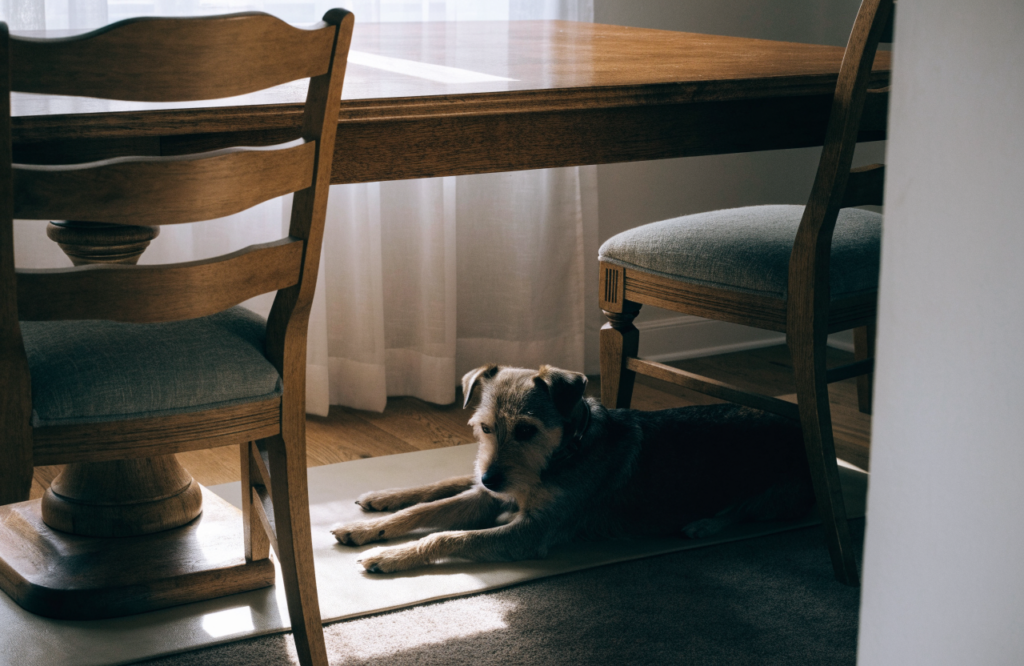
Put a flat or low pad under the table you already own if the measured gap clears the bed and the dog’s resting head, the table is stable, and the dog already chooses that floor. Use a coffee table only for a thin profile. Use a dining table only if chairs and meals still work. Use a desk only if cables and your feet stay clear.
Buy a table with a bed in the base if you need the side table anyway, the dog is small or medium, and you have checked the interior opening rather than the tabletop photo. Skip both if the hiding is new or paired with other changes, and deal with that first.
Questions people ask after they measure
Can a normal dog bed go under a coffee table?
Only a low one. A typical coffee table is 16 to 18 inches to the top, and the apron leaves less than that. A flat mat usually fits. A bolstered or hooded bed usually does not, because the sides use the clearance the dog needed.
Why does my dog sleep under the table instead of the bed I bought?
The table already supplies the den: a ceiling, a side to lean on, and a fixed place near people. A new bed in the middle of the room does not. Dr. Menicucci’s desk example is the same pattern. Matching the bed to the spot they chose works better than buying a larger version of the bed they ignore.
Is an end-table dog bed the same as a dog bed under a table?
No. One is a cushion sized to furniture you own. The other is a piece of furniture with a sleeping space built in. The second can replace a nightstand if the top is strong enough and the opening fits the dog. It does not automatically fit under your coffee table.
Should I block the space instead?
Block it if the dog is getting stuck, tipping a light table, or only hiding there because something is wrong. Leave it, and make it comfortable, if they rest there calmly and can leave on their own. A barrier solves a safety problem. It does not answer a dog who simply wants a fort.