
A dog loft bed is a raised sleeping platform with usable space underneath, not a thicker version of a floor cushion. The useful versions lift a small or medium dog off the floor, give them a defined perch, and free the footprint below for a second bed, a crate, or storage. The ones that fail are too high for the dog, too narrow for how they actually sleep, or open on the sides so a roll becomes a fall.
Most searches for this phrase mix three different products. A furniture loft is a wood or metal frame with a cushioned deck, often stairs or a ramp, and sometimes a lower bunk. An elevated cot is a low mesh platform a few inches off the floor, built for airflow rather than storage. A few brands also use “loft” as a style name on an ordinary nest or travel pad. Buying the wrong one of those three is the usual mistake.
What separates a dog loft bed from a raised cot
A loft-style dog bed works like a human loft bed in miniature. The sleep surface sits high enough that the area underneath can hold a second cushion, a crate, shelves, or a window-side perch. Retail examples include wooden bunk frames with a ramp and furniture-style crate units that pair an enclosed lower den with an open upper lounge and stair storage.
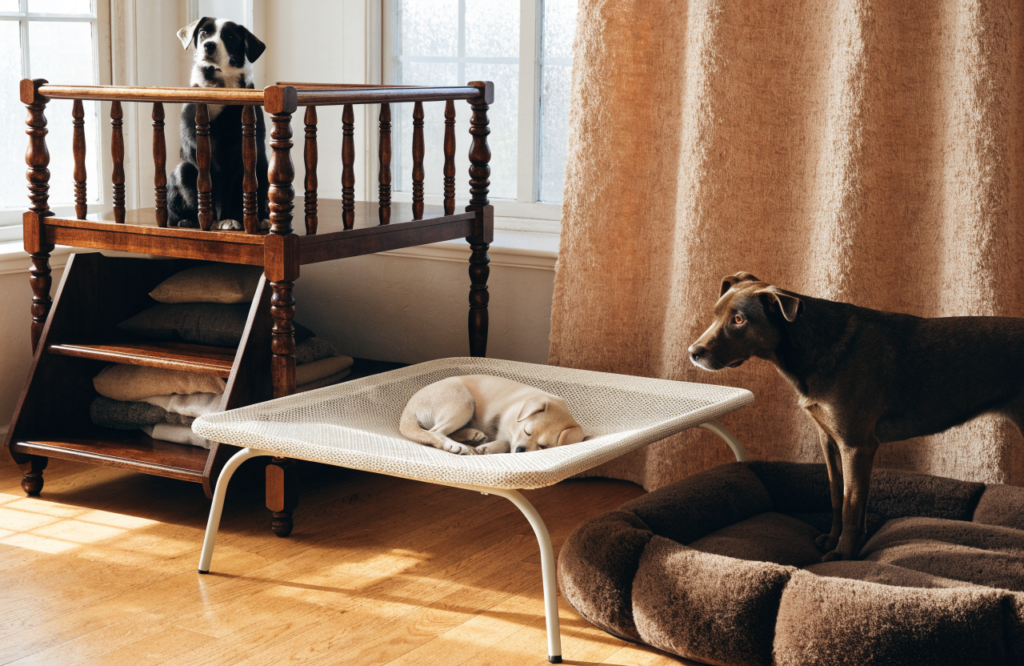
An elevated cot does a different job. The deck is usually taut mesh or fabric on a steel or aluminum frame, often only several inches off the floor. Air moves under and through the surface, which is why cots suit hot sleepers, porches, and dogs that overheat on foam. They do not create a real room underneath, and they offer little cushioning.
A third group is just a name. Kurgo’s Loft Wander is a roll-up travel pad. Bowl & Bone’s LOFT line is a bolster nest with a washable cover. Neither raises the dog onto a frame. If the listing does not show a platform height, an access method, and a weight rating for that exact size, it is not the furniture you are picturing.
Who a loft bed actually suits
The case for a dog loft bed is spatial, not medical. It earns its place when:
- You have one or two small or medium dogs and almost no spare floor.
- You want a window perch so the dog can watch the street without taking the sofa.
- Two pets argue over one floor bed, and separate levels reduce that overlap.
- You would rather vacuum under a frame than around a bulky foam bed.
Commercial multi-level frames are commonly rated around 80 to 100 pounds total, and that limit applies hardest to the upper deck. A 100-pound rating on one GDLF-style perch, for example, is a ceiling for that model, not a target. A Labrador who sprawls, or two medium dogs on the top bunk at once, will exceed what most of these frames are built for. Large dogs are usually better on a wide cot or a floor orthopedic bed than on a tall wooden loft.
When a floor bed or a low cot is the better buy
Skip the loft if the dog is senior, stiff, or a long-backed breed. Dachshunds, corgis, and basset-type dogs already carry more spinal load on steep stairs. A ramp is kinder than a ladder, but a ramp gentle enough for a sore dog also eats the floor space the loft was meant to save. Pet-furniture guidance often cites about 18 to 25 degrees as a workable ramp range, with the shallower end for small or older dogs. That is a design rule of thumb, not a veterinary standard, and it still has to match the individual dog.
Also skip it if the dog chews furniture, if the only open wall is a narrow hallway the ramp would block, or if you need real joint support. A taut mesh cot spreads weight evenly but does not offload bony points the way dense foam does. A loft with a thin sponge pad has the same limit. Dogs with hip dysplasia or clear arthritis usually need a low-entry foam bed they can step onto, not a platform they have to climb.
Measure the dog and the room before the listing

Weight charts are a weak guide. Sleep shape matters more.
- Watch the dog sleep for a few nights. Measure nose to the base of the tail in the position they actually use, usually a side sprawl, not a tight curl.
- Add several inches so they can turn without hanging off the rail. Six to twelve inches of extra length is a practical margin on ordinary beds; on a railed loft, that extra has to be inside the rails, not outside the frame.
- Compare that number with the internal deck, not the overall product size. Listings often include the posts and the stair unit.
- Measure the floor footprint with the ramp or stairs attached, plus a clear path around it. A compact deck with a long ramp can take more room than the floor bed you were trying to replace.
- Check ceiling and window height only if you want a perch. The deck should meet the sill the dog is meant to look over, without forcing them to stand on their hind legs against a low rail.
If the dog is between two sizes, go up. A loft that is too small becomes a launching pad.
Safety details that matter more than the finish
There is no federal standard written for pet loft furniture. Treat the frame the way you would treat any raised platform a dog will jump on half-asleep.
Rails have to match the dog, not the photo
A raised lip stops a casual roll. It does not stop a small dog that stands up, or a dog that startles. Slatted sides with wide gaps can catch a paw or let a toy-sized dog slip through. Look for a continuous raised edge on the open sides, gaps narrower than the dog’s head, and a rail high enough that the dog cannot roll over it while lying down. The open side should be the side with the ramp, not the side facing a drop.
Stairs and ramps are the real decision
Carpeted or grooved treads beat bare wood. Stairs should be wide enough for the dog’s shoulders and shallow enough that they do not have to hop. A ramp needs traction and side edges so a paw cannot slide off. Detachable steps are useful only if they lock in place. A ramp that walks away when the dog pushes off is worse than no ramp.
Jumping down is the injury most people underestimate. A dog that climbs up willingly may still launch off the front. Block that route until they use the ramp in both directions.
The rating has to survive movement
A listed capacity is usually a static figure. Dogs do not lie still. Rock the empty frame. If it twists, if the legs splay, or if casters roll when unlocked, it is the wrong bed for any dog that jumps. Lock casters. Put rubber feet on hard floors. Do not place it on a rug that can bunch under one leg.
Assume the dog will chew something
Solid wood, powder-coated metal, and finished composites all get mouthed. Avoid loose staples, exposed screw tips, and strong-smelling fresh finishes in the first days. A removable, washable cover matters more than the fabric name. Foam that cannot be removed will hold urine odor. Mesh cots can be hosed; loft cushions usually cannot.
How the three bed types compare
| Decision | Dog loft bed | Elevated cot | Floor orthopedic bed |
|---|---|---|---|
| Main job | Raised perch plus storage or a second level | Airflow and easy cleaning | Pressure relief and easy entry |
| Typical height | High enough for a bunk, crate, or shelves | Often a few inches | On the floor |
| Best dog | Small or medium, mobile, curious | Hot sleeper, outdoor or porch dog, chewer on a reinforced model | Senior, large, stiff, or joint-sore |
| Weak point | Falls, steep access, weight limit on the top deck | Little cushion, can feel like a hammock if the fabric sags | Holds heat, bulky, harder to clean under |
| Space effect | Frees floor only if the ramp fits | Small footprint, nothing usable below | Uses the full sleep area on the floor |
Setup choices that decide whether the dog uses it
Place the loft where the dog already wants to be: by the window they guard, beside the bed, or in the room you occupy at night. A stylish frame in a spare room becomes furniture the dog ignores.
Keep the first week boring. Leave the ramp attached, reward the climb, and do not let visitors lift the dog on and off. Lifting teaches them the platform is a place they get stranded. If they freeze halfway, the steps are too tall or the surface is too slick.
Use the lower level on purpose. A second cushion, a crate pad, or closed storage stops the underside from becoming a dust pocket or a place a second pet gets cornered. If two dogs will share it, give each a level they can reach without passing through the other’s body space.
Recheck fasteners after the first week of real use. Wood frames loosen at the bolts. Mesh decks stretch. A sagging cot deck drops the dog onto the crossbar. A loose loft rail is a fall waiting for a deep sleep.
Frequently asked questions
Can a dog sleep on a human loft bed? Only if that specific frame is rated for the combined load, the ladder or stairs are safe for the dog, and there is a real barrier at the open edge. Many human loft ladders are too steep, and the listed capacity rarely includes a pet plus people. A floor bed in the same room is usually safer than modifying a rental loft.
Is a dog loft bed better for joints? Not by itself. Being off a cold floor can help, and a firm deck avoids the sag of a worn cushion. Joint support still depends on the pad. Thin foam on a high frame does not replace a thick, dense orthopedic bed with a low step-in.
What if my dog will not climb the ramp? Lower the challenge before you abandon the bed. Check tread grip, shorten the rise if the steps come apart, and practice with the dog fresh rather than at bedtime. If they still refuse, the height is wrong for them. A low cot or a floor bed will get used. An unused loft will not.
How do I clean it? Wash the cover on the cycle the label allows, and dry the foam fully before it goes back in. Wipe wood and metal, and check corners for trapped hair. Outdoor mesh cots can be rinsed. A furniture loft left damp underneath will smell before the cushion looks dirty.