
An ottoman dog bed is a piece of furniture that looks like a footstool or storage bench and is meant to double as a place for a dog to sleep. The versions worth buying do one of two jobs well: they give a small or medium dog a cushioned den that disappears into the living room, or they give a dog a raised, upholstered bed that does not read as pet gear. The weaker versions are ordinary storage ottomans with a pet label and a cushion too thin to sleep on.
The choice is not mainly about fabric color. It depends on whether the interior, or the top cushion, matches how your dog actually rests, whether the entry is low enough for their joints, and whether the cover and foam can be cleaned before the bed becomes a smell trap. Those three details decide whether the piece earns a place next to the sofa or becomes furniture the dog ignores.
Three Products Share the Same Name
Search results mix three different pieces. Buying the wrong one is the most common reason these beds fail.
Den-style ottomans, where the dog sleeps inside
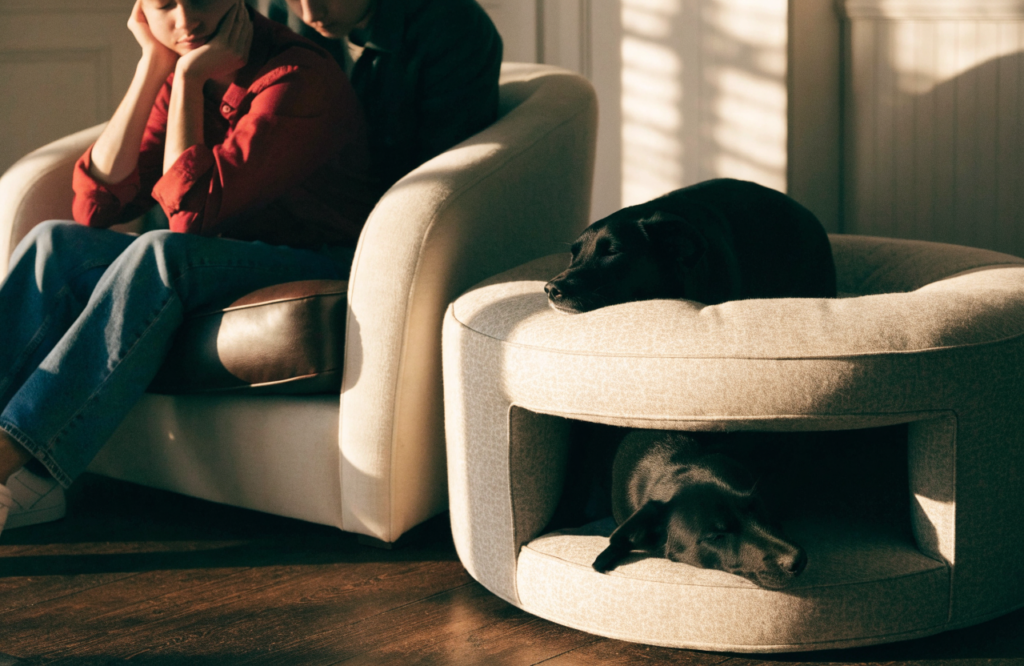
The outer shell looks like a closed ottoman. A side opening, or a soft flap, leads into a cushioned cavity. Many dogs that like to sleep under tables, behind sofas, or under a blanket take to this shape because it feels enclosed. The tradeoff is heat and odor. A closed box holds warmth and traps the oils, dander, and saliva a dog leaves behind. Ventilation slots, a removable inner pad, and a cover that actually comes off matter more here than on an open bed.
Interior dimensions are the real size. A product photo can look roomy while the usable cavity is several inches smaller once the walls and cushion are counted. If your dog cannot turn around and lie fully curled without touching both sides, the bed is too small even if the exterior matches the sofa.
Top-cushion furniture beds, where the dog sleeps on the ottoman
Here the dog rests on a padded lid or raised platform, and storage, if any, sits underneath for toys, leashes, or a spare blanket. This suits dogs that sprawl, want to see the room, or overheat in enclosed spaces. It also suits households that want the bed beside the sofa without a plush pet bed on the floor.
The cushion has to be a real sleeping surface, not a thin seat pad. A footstool cushion that feels fine for ten minutes of human sitting often bottoms out under a dog that lies there for hours. Look for a thick foam pad, a non-slip top if the dog is a senior, and a base that does not rock when the dog jumps off.
Storage ottomans sold for pet gear, not for sleeping
Some “pet ottomans” are storage benches with a lift-off lid, rated for a person to sit on, and intended for toys, treats, and grooming tools. That is a fair use. It is not a dog bed unless the top is built as one. Check the product description for a stated sleeping area and foam depth. If the only specs are overall size and a human weight limit, treat it as storage.
When an Ottoman Dog Bed Is the Right Call
It earns the money in a few specific situations.
The living room is the dog’s real hangout, and a standard bed looks out of place or gets shoved into a corner the dog will not use. A furniture-shaped bed stays where the family is, which is usually where the dog wants to be.
The dog already nests. Curlers, burrowers, and dogs that push into tight spaces often prefer a den ottoman to a flat mat. Anxious dogs sometimes settle faster with walls around them, though a cave bed or a covered crate can do the same job for less money if looks are not the point.
Floor space is tight. A den ottoman or a storage ottoman uses one footprint for rest and for the leash, the spare cover, and the toy pile. That only helps if you will actually open it. Storage you never reach is just a heavier dog bed.
You need a low step up to the sofa for a small or older dog, and a separate ramp will not stay in the room. A few ottomans unfold into a short ramp, then fold back into a footstool. Those are a mobility tool first and a bed second. Check the stated ramp weight limit, which is often lower than the limit for sitting on the closed ottoman.
When a Regular Dog Bed Is the Better Buy
Skip the ottoman if the dog stretches out on their side. A rectangular orthopedic mattress gives them length a round or square den cannot. Measure from nose to the base of the tail while they are fully stretched, then add roughly 8 to 12 inches (about 20 to 30 cm). That length is the governing dimension for an open bed. An ottoman sized to the curled body will feel fine until they try to sprawl and hang off the edge.
Skip it for large and giant breeds unless the listing gives an interior or top surface big enough for that stretched length and a foam core thick enough not to collapse. Many ottoman dog beds stop at small and medium dogs. A 70-pound dog on a bed built for 25 pounds is not a style choice. It is a support problem.
Skip a fully enclosed design for dogs that run hot, for thick double coats, and for rooms that already overheat. Enclosed beds hold heat. A raised cot or an open mattress moves air. The same logic applies to brachycephalic breeds that already work harder to cool themselves.
Skip it for determined chewers and unsupervised puppies. Hinges, flaps, piping, and zipper pulls are grab points. No fabric bed is chew-proof. A rigid-frame bed with a taut surface, or a crate pad with no exposed zipper, survives teething better than an upholstered box.
Skip a high-entry den for seniors, dogs with hip or elbow pain, and short-legged breeds that already struggle with the sofa. The opening should be low enough that they step in rather than hop. A low-profile orthopedic bed is usually the kinder primary bed, with the ottoman as a secondary spot if they still want it.
Size the Sleeping Surface, Not the Catalog Photo

Ignore the outer footprint until the sleeping area is right.
Watch the dog for a few nights. Note whether they curl, sprawl, lean on a bolster, or dig a nest. Match the shape to that habit. A curler can use a round or square den. A sprawler needs a rectangle on top of the ottoman, or a different bed entirely.
Then measure. For a den, measure the dog curled, from the outside of the back to the outside of the paws, and add a few inches so they are not jammed against both walls. For a top-cushion bed, use the stretched nose-to-tail-base length plus 8 to 12 inches, and a width that covers them when they lie on their side.
Weight ranges are only a starting point. A lean sighthound and a stocky bulldog at the same weight need different shapes.
| Dog | Typical weight | What usually fits | What to verify |
|---|---|---|---|
| Toy and small (Chihuahua, Yorkie, Pug) | Under about 20 lb | Most den ottomans | Interior cavity, not exterior size |
| Small–medium (French Bulldog, Cocker, Beagle) | About 20–40 lb | Larger dens and small top-cushion beds | Entry height and foam thickness |
| Medium–large (Border Collie, Bulldog, smaller Lab) | About 40–70 lb | Rectangular furniture beds, rarely a den | Stretched length and stated weight rating |
| Large and giant | Over about 70 lb | Purpose-built orthopedic bed more often than an ottoman | Foam depth and edge support |
If you are between sizes, size up. A spare blanket fills extra space. Nothing fixes a bed the dog cannot turn around in.
Construction Details That Decide Whether It Lasts
Price and a velvet photo do not tell you if the bed will still support the dog in a year. Check these before you buy.
Foam, not fill marketing. Solid foam holds shape longer than loose polyester stuffing for a dog that lies in one spot for hours. Orthopedic-style beds often use several inches of foam. A thin seat cushion is fine for a person perched for a minute and poor for a dog parked all evening. If the listing does not state foam type and thickness, assume it is a thin pad. CertiPUR-US certification on the foam means the foam has been tested for certain harmful chemicals and low emissions. It is a useful screen, not proof the bed is comfortable.
A cover that leaves the bed. The cover should unzip fully and go in the machine. Spot-clean-only upholstery belongs on a human ottoman, not under a dog. A separate waterproof or water-resistant liner between cover and foam saves the core from accidents. Memory foam and most solid foam inserts should not go in the washing machine. Agitation and soaking can break down the structure. Spot-clean the foam and let it dry completely.
Entry and exit. Step-in height matters more than bolster height. Older dogs, dogs with arthritis, and dogs with long backs and short legs need a low front. High walls that look cozy in a photo can turn the bed into something they stop using.
Ventilation on any enclosed model. Look for mesh panels or gaps that move air. A sealed box with a plush interior will smell faster and sleep hotter.
Base and hardware. The ottoman should not slide on hard floors when the dog jumps off. Rubber feet or a grippy base help. On lift-lid models, hinges should hold the lid open on their own. A lid that falls shut is a poor storage design and a risk if a dog or child is near it. Human sit-weight ratings on storage ottomans are often in the 200-pound range. That number is for a person sitting, not proof a dog can sleep on a thin lid every night.
Fabric vs. real use. Boucle and velvet look right in a living room and collect hair. Performance weave and a removable cover beat a delicate upholstery fabric you cannot wash. Darker neutrals hide wear better than white, which is a practical point, not a style rule.
Where to Put It So the Dog Uses It
Dogs reuse a bed that is stable, quiet enough to sleep in, and close to the people they track. Put the ottoman beside the sofa or at the foot of the bed, not in a hallway they only pass through.
Keep the path clear. A den opening blocked by a coffee table will be ignored. On hard floors, add a rug under the feet if the base still creeps.
Do not force the lid shut on a dog that is inside a den-style bed. These are open-sided resting spots, not crates. A dog should be able to leave without help. If you need a secure enclosure for training or for time alone, use a crate rated for that job.
If the dog already has a bed they like, set the ottoman next to it for a few days with an unwashed blanket from the old bed on the new surface. Most dogs investigate a new bed. Few abandon a known spot on the first night because the new one matches the sofa.
Cleaning Before the Smell Sets In
Dog beds collect saliva, skin oil, dander, and whatever came in from outside. An enclosed ottoman concentrates that.
Wash the removable cover on a gentle, cool cycle about every one to two weeks for an average indoor dog, and weekly for heavy shedders, dogs that go outside and then straight onto the bed, or households with allergies. Puppies and incontinent seniors need it more often. Skip bleach. High heat can shrink covers and damage a waterproof backing, so air dry or use low heat.
Spot-clean the foam with a small amount of mild detergent or an enzyme cleaner made for pet stains, rinse the soap out with a damp cloth, press out water, and let it dry fully. Thick foam can take a day or two. Reassembling it damp is how mildew starts.
Vacuum hair from seams and the entrance weekly. Check the liner for cracks. A waterproof layer that has split no longer protects the foam.
Replace the bed when the foam stays compressed after you press it, when a musty smell survives a full wash, or when the dog has outgrown the cavity. Flattened foam is no longer support. It is a mat.
Problems Worth Anticipating
The dog will not go in. The cavity is too small, the opening is too high, the room is too warm, or the dog is a sprawler. Offer the top surface if the lid is padded, or switch to an open bed. Do not block the exit to “teach” them to stay.
It smells within weeks. The cover is not fully removable, the liner is missing, or the foam was put back while damp. This is a construction limit, not a detergent problem.
The lid or flap becomes a toy. Zipper pulls and loose piping are invitations. Choose hidden zippers, trim loose threads, and do not leave a chewer alone with a new upholstered bed.
People sit on it and the dog stops using it. If the top is also human seating, the dog may treat it as off-limits or get displaced every evening. Decide which job is primary. A storage ottoman for people and a separate dog bed is often cleaner than one piece doing both badly.
It rocks or slides. Light frames and smooth feet fail when a dog launches off. Stability is a safety issue for seniors. Return anything that tips when you push the top corner.
Frequently Asked Questions
Can a person sit on an ottoman dog bed? Only if the listing gives a human weight rating and the top is built as a seat. Many den-style beds are not. Sitting on a thin lid over a dog’s cushion crushes the foam and teaches the dog the spot is not theirs.
Is it safe for a dog to sleep inside with the lid closed? No. Use open-entry dens. A closed lid cuts off air, blocks the exit, and is not a substitute for a ventilated crate.
Are these a good idea for a puppy? A washable pad inside can work for supervision and naps. Puppies chew edges and have accidents. Plan on a spare cover, and do not expect the upholstery to survive teething unattended.
Do anxious dogs do better in an ottoman? Some do, because the walls mimic a den. Others want to see the door and the family, and settle faster on an open bed in the same room. Try the shape the dog already chooses, under a table or in the middle of the floor, before you buy for anxiety.
How is this different from a dog-crate ottoman? A crate ottoman is an enclosure with a door, meant for containment. An ottoman dog bed is a resting spot the dog can leave. They solve different problems. Ventilation, door hardware, and an escape-proof latch matter on a crate. Foam and a washable sleep surface matter on a bed.
An ottoman dog bed is worth it when the sleeping surface fits the dog you have, the entry suits their joints, and the cover can be washed. It is the wrong tool when you need length, heavy-dog support, or a chew-proof crate. Measure the dog in the pose they actually sleep in, then buy the interior that fits that pose, not the exterior that fits the room.