
A dog bed under the stairs works when the usable floor area is long enough for your dog to stretch out, tall enough to stand and turn, and free of drafts, wires, and stair noise that would keep them awake. The slope is the real constraint: height is generous at the tall end and useless at the low end, so the bed has to sit where the ceiling still clears the dog’s head. The 15 setups below run from a removable mat to a built-in nook, with the conditions that make each one worth building.
Measure the slope before you buy a bed
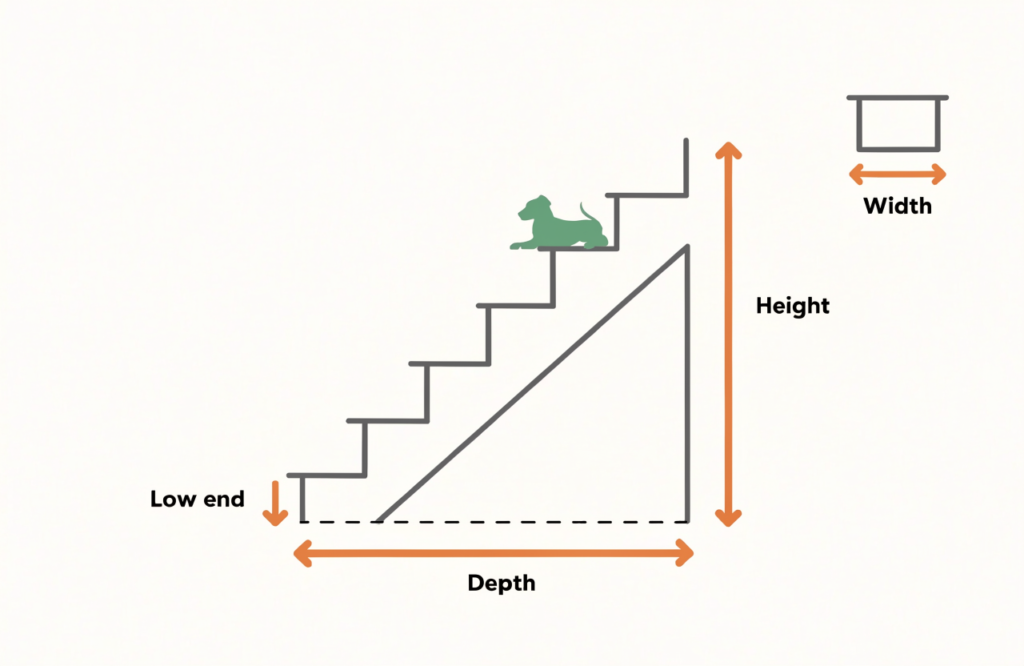
Under-stair space is a wedge, not a rectangle. Measure four things with a tape, not from a photo.
- Width of the opening, from the newel or wall to the opposite side.
- Depth, from the front edge back to the wall or stringer.
- Height at the tall end, where the dog will enter.
- Height at the lowest point you still expect the dog to use.
Then measure the dog: nose to the base of the tail while stretched out, shoulder width, and standing height to the top of the head or ears. A practical bed length is that stretched length plus about 6 to 12 inches. Curl sleepers can live with the lower end of that range. Dogs who sprawl need the higher end, and sometimes a size up.
Standing clearance matters more than people expect. A useful rule is the dog’s standing height plus a few inches, or roughly 15 percent extra above withers height, so they can stand and turn without scraping. If the only floor with that clearance is a narrow strip, a large dog will ignore the nook no matter how good the mattress is.
Bolster and donut beds shrink the sleeping surface. A bed sold as 36 inches may offer closer to 28 to 30 inches of flat interior once the raised rim is counted. In a tight stair cavity, check interior dimensions, not the outer label.
Typical UK domestic stairs often leave something on the order of 2 meters long, about 0.9 meters high, and about 0.8 meters deep under the lower treads, but that is a planning sketch only. Pipe boxing, the bottom newel, and the stringer eat into it. Measure your own cavity.
Check the cavity before you cut anything
The space under a stair is a common route for wiring, plumbing, and ducts. A stud finder, and a small exploratory check if you are opening plasterboard, should come before any framing. Moving a pipe or cable is often more expensive than the dog bed.
Enclosed space under interior stairs is also a fire-separation issue in many residential codes. A common requirement is at least 1/2-inch gypsum board on the enclosure. Local rules differ, and altering stringers or load-bearing studs is not a casual cut. If the plan needs a new opening, a light, or a moved duct, a joiner or electrician is the right call.
Ventilation is the other non-negotiable. A closed cupboard traps heat and moisture. Two small grilles, one low and one high, let air move by convection. A latticed or slatted door does the same job with less hardware. Low-voltage or battery LED lights stay cooler than a standard lamp a dog can knock over.
RSPCA guidance treats a resting place as something that should be comfortable, dry, draught-free, and clean. Dogs Trust has listed under the stairs as a possible safe-space location only when it is appropriately sized, freely accessible, quiet enough, and clear of hazards such as exposed wires. A dog should be able to leave by choice. A locked cupboard is a kennel, not a bed.
15 dog bed under stairs setups
1. Open mat on the existing floor
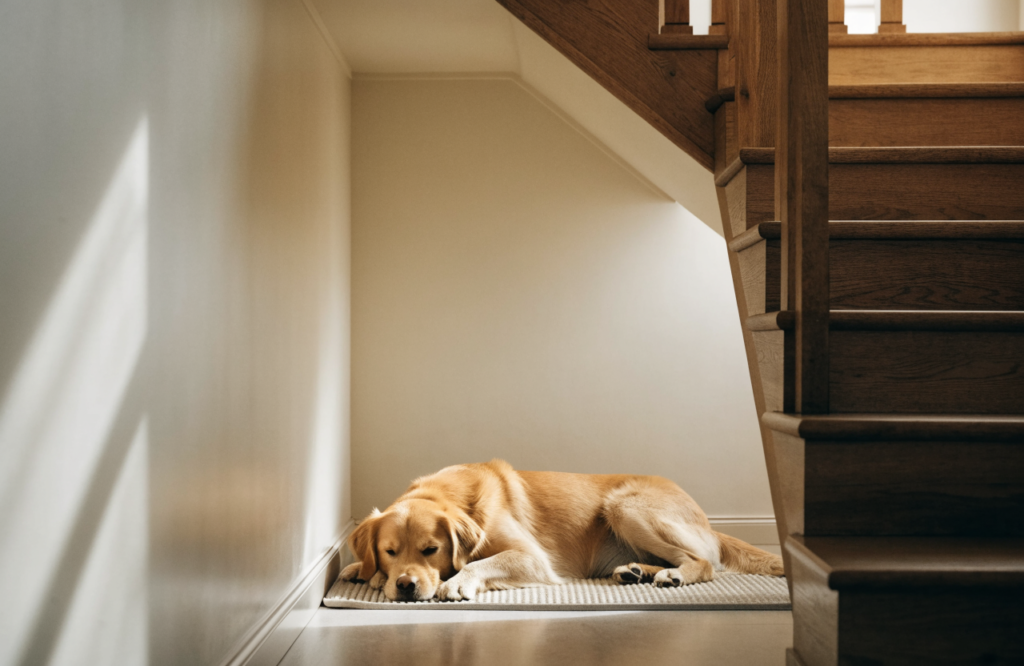
Leave the under-stair closet door off, or leave an already open alcove as it is, and put a flat orthopedic mat on a washable floor. This is the right first test. If the dog will not settle there for a week, a built-in will not fix a drafty, noisy, or too-low space.
It fails when the floor is bare concrete in a cold hallway, or when every trip up the stairs lands beside the dog’s head.
2. Removable orthopedic rectangle
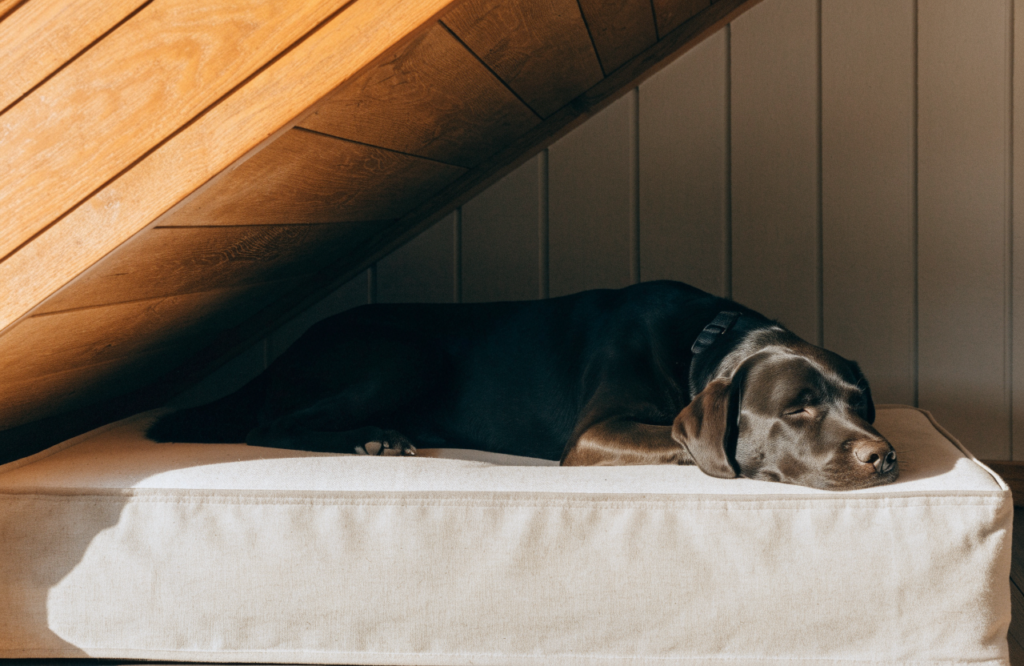
A dense foam rectangle with a waterproof liner and a machine-washable cover is the default bed for this location. Flat foam uses the full footprint, which matters when the slope already steals height. Look for a cover in canvas, heavy cotton, or a tight weave, not a thin plush that mats into a hair trap.
Foam depth should scale with weight: about 3 inches for a small dog, 4 to 5 inches for a medium or large dog, and 6 inches or more for a heavy dog. Thin pads bottom out on a hard subfloor within weeks.
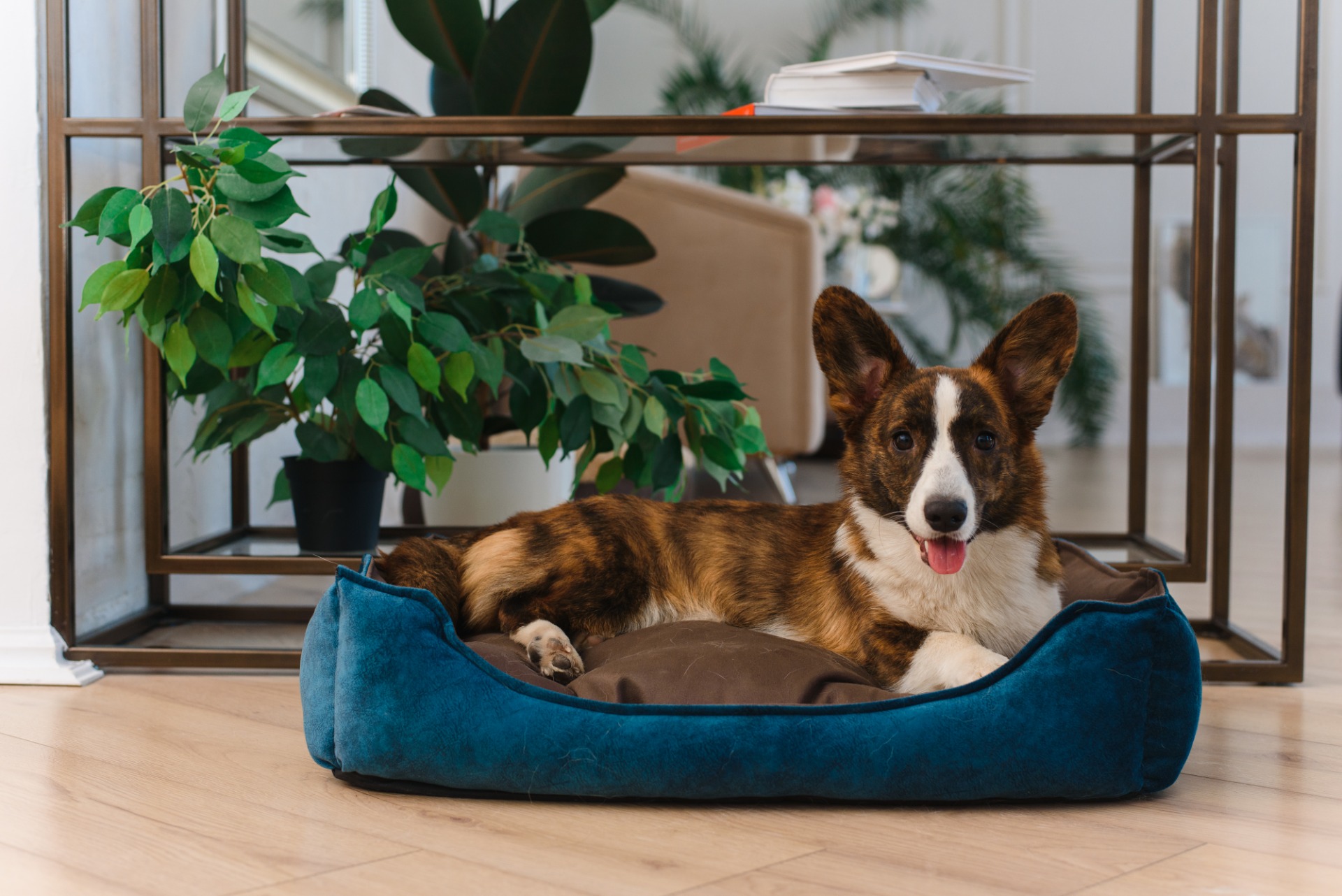
3. Bolster bed against the tall wall
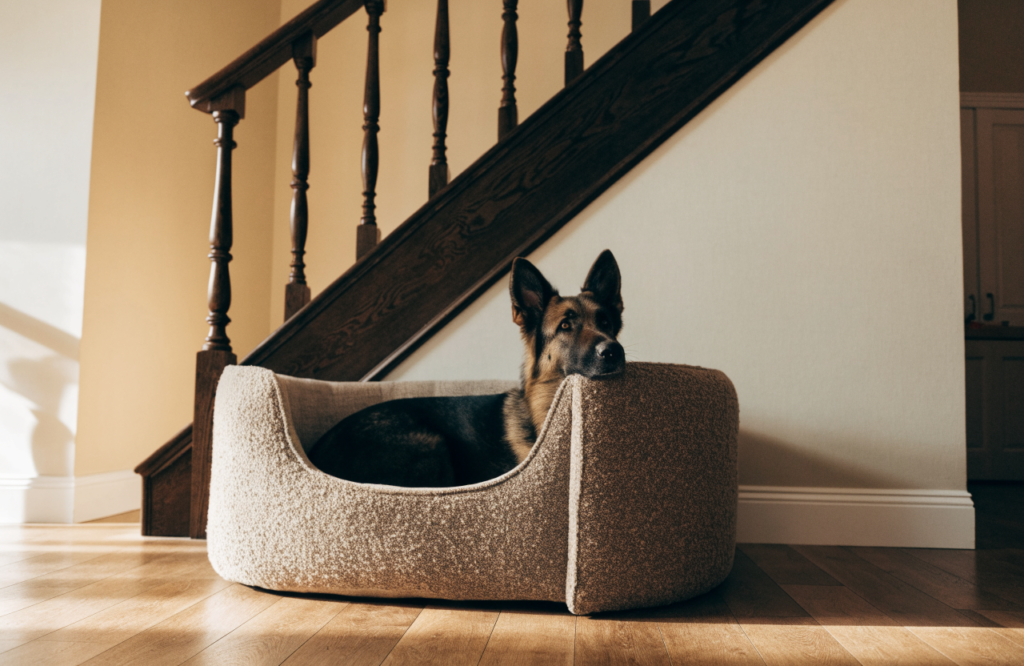
A three-sided bolster gives chin-resters and leaners a boundary without closing the entrance. Place the tall bolster on the high side of the slope so the raised edge is not fighting the ceiling. Size up one step from a flat mat, because the rim steals interior length.
Skip bolsters if the dog is a full sprawler or has trouble stepping over a lip. Seniors usually do better with a low front or no front at all.
4. Donut or cave bed in the low end
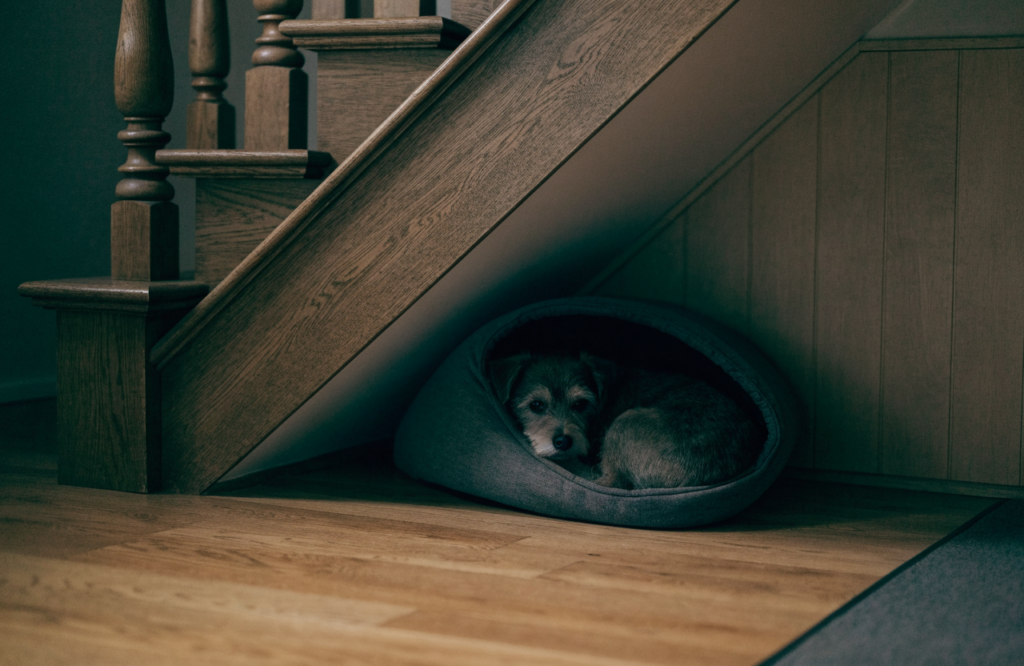
Small curl sleepers and burrowers often prefer the shorter end of the wedge, where the ceiling is closer. A donut or hooded cave bed uses that geometry instead of fighting it. The entrance still needs to clear the shoulders, and the hood must not block airflow.
This is a poor fit for any dog who stretches full length, and for brachycephalic breeds if the cave runs warm. Check that the dog can back out without getting stuck.
5. Raised platform with drawers underneath
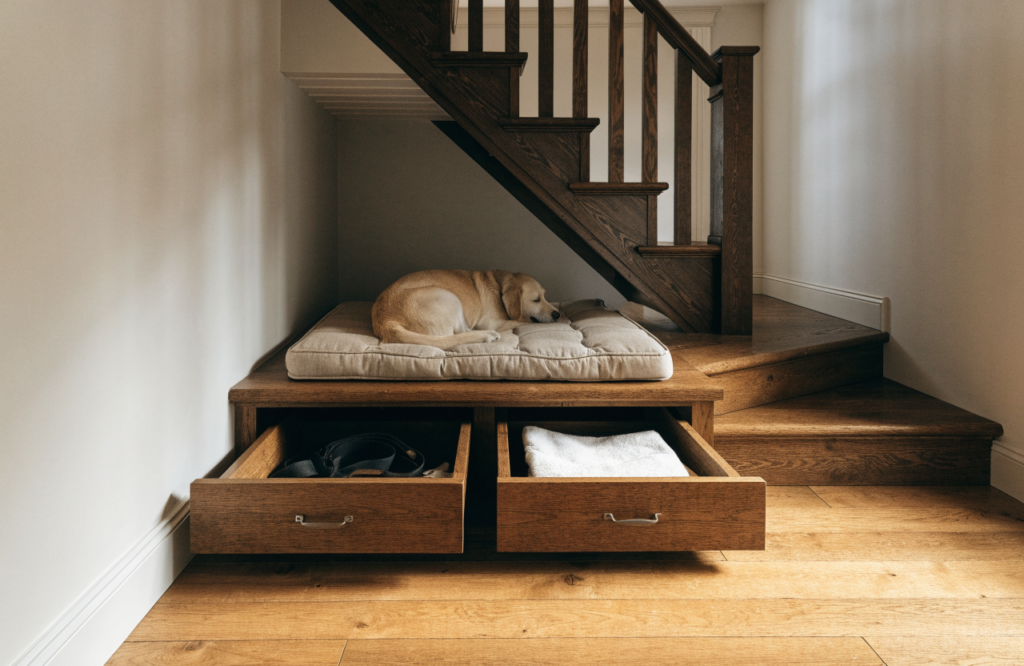
A platform about 12 to 15 inches high holds the mattress and leaves pull-out drawers for food, leads, and spare covers. The platform only works where the remaining headroom still clears the dog after the mattress thickness is added. A 5-inch bed on a 15-inch box needs 20 inches before the dog’s head is counted.
Build the box so the top does not flex. A bouncing platform is worse than the floor. Drawers should not open into the only path past the stairs.
6. Slope-cut built-in frame
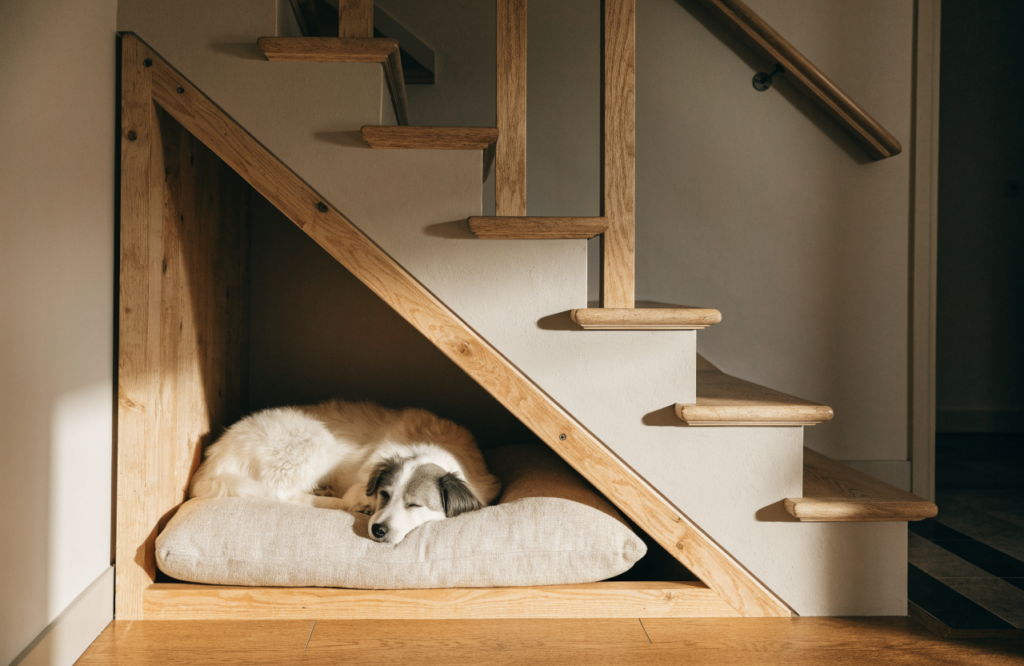
A simple timber box, open at the front, with the back edge cut to the stair angle, keeps the mattress from migrating and gives the nook a finished edge. Size the interior to the mattress, not the other way around. A 24-by-36-inch cushion is a common small-to-medium starting point; a Labrador-sized sprawl needs closer to 36 by 48 inches of clear floor, plus turning room.
Seal the wood with a pet-safe finish. Unsealed pine in a muddy hallway stains and holds odor.
7. Half-door or gate kennel
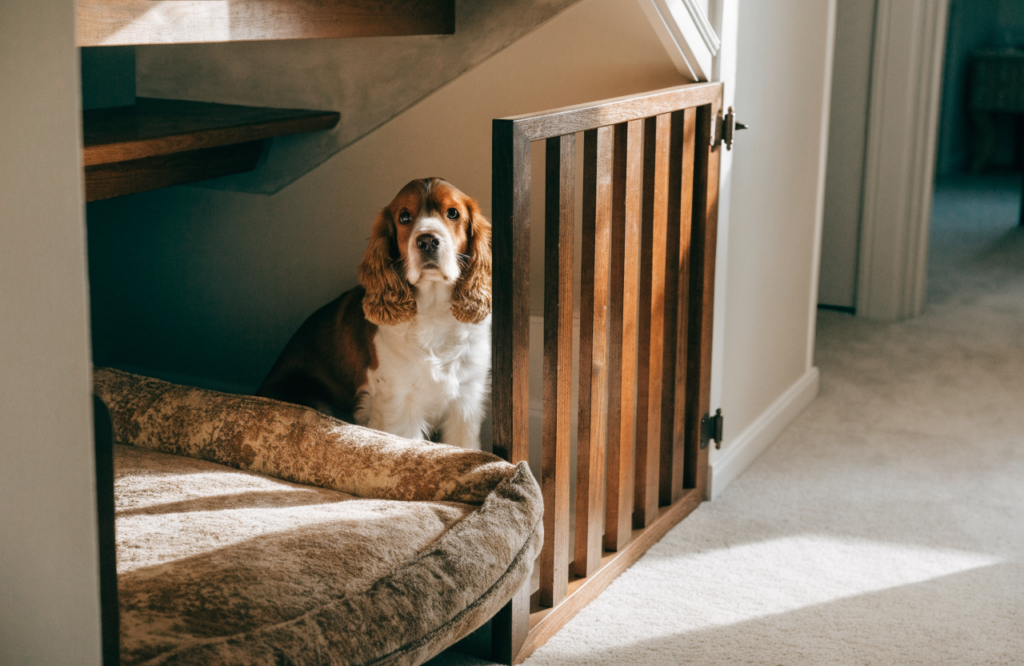
A half-height door or a bar gate turns the cavity into a containable den without the look of a wire crate. Use it for a dog who is trusted in the house but needs a boundary at the door, not as all-day confinement. The bed inside should still meet the stretch-and-turn test, and the gate must latch so a leaning dog cannot open it.
Full-height gates suit large breeds better than a cabinet-style door they have to crouch through.
8. Sliding barn door
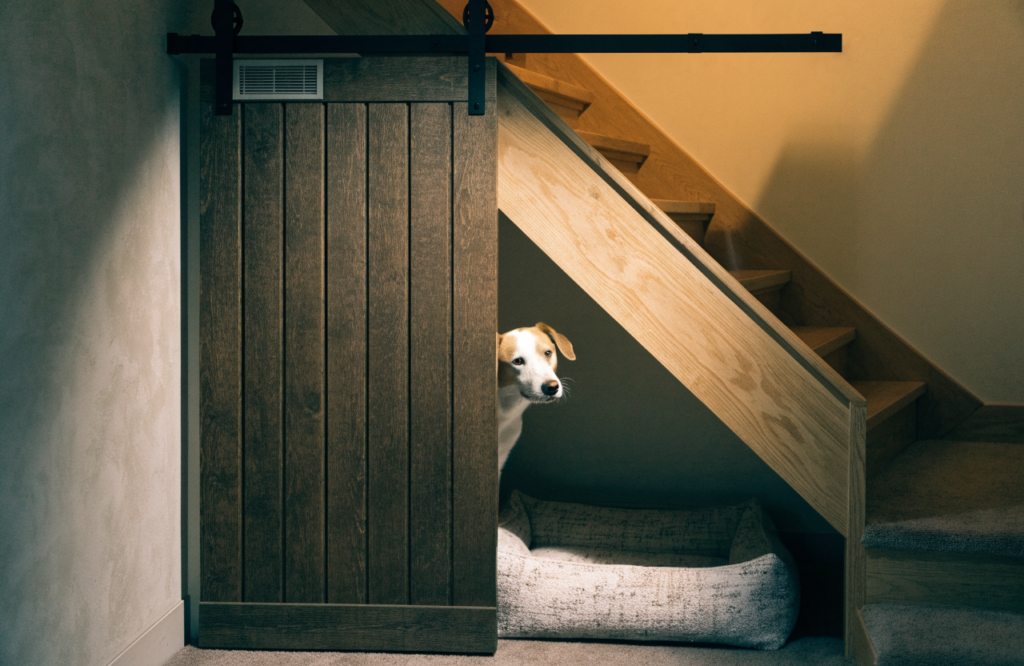
A barn door on an overhead track stays out of the hallway, which matters when the stair opening is already the main traffic route. Leave a gap or a vent panel so the closed door is not airtight. Soft-close hardware reduces the bang that will undo the point of a quiet bed.
This is wasted money on a rental, and unnecessary if the dog never needs the space closed.
9. Converted cupboard with a see-through door
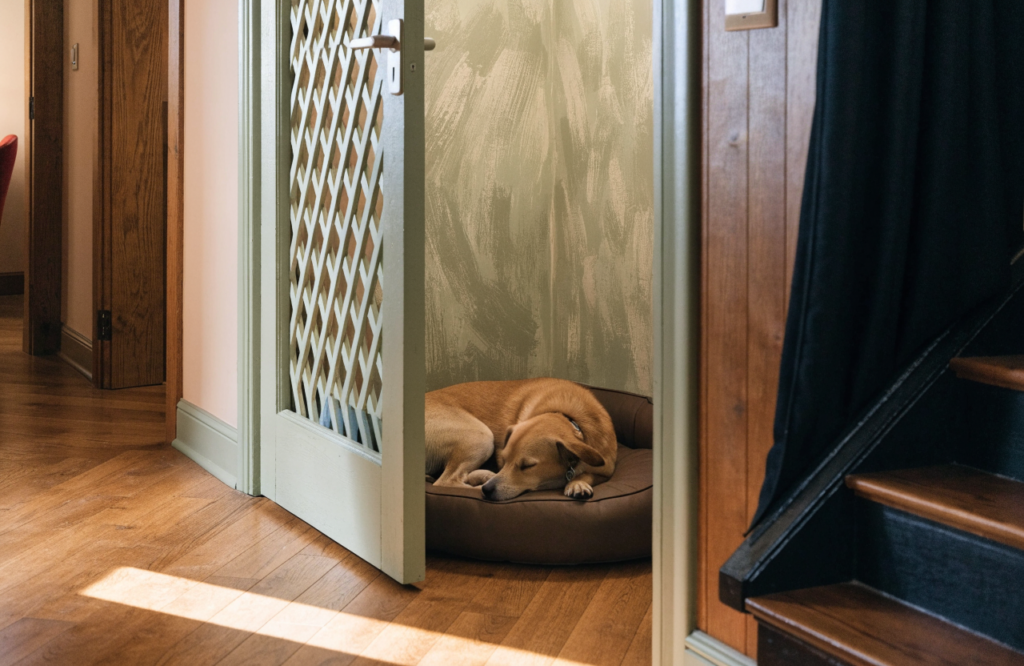
If a cupboard is already there, conversion is usually cheaper than cutting a new opening. One documented home project in Leeds reframed an existing shoe cupboard, added a latticed door, and finished the interior for about £100 in wood, plasterboard, paint, and basic tools. That figure is a modest DIY benchmark, not a quote. Joiners in the UK have quoted roughly £450 to £800 for a turnkey lined nook with a vent, a light, and a fitted bed, depending on access and finish.
Keep one internal wall if you still need coat storage beside the bed. Do not steal the dog’s standing zone to save a shelf.
10. Long mattress in a winder corner
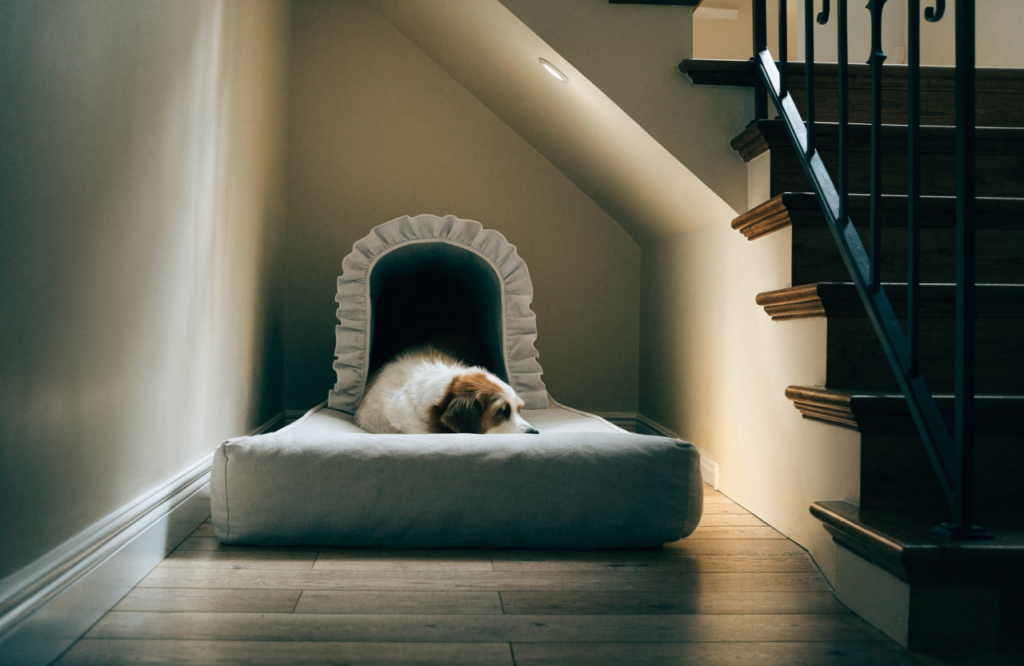
Winder stairs leave a triangle that is deeper than it is wide. A long rectangular mattress run toward the point gives burrowers a tunnel and uses depth that a square bed would waste. The entrance must still be the wide, tall end. Do not ask the dog to crawl into the point to reach the bed.
11. Shared bench over a dog bed
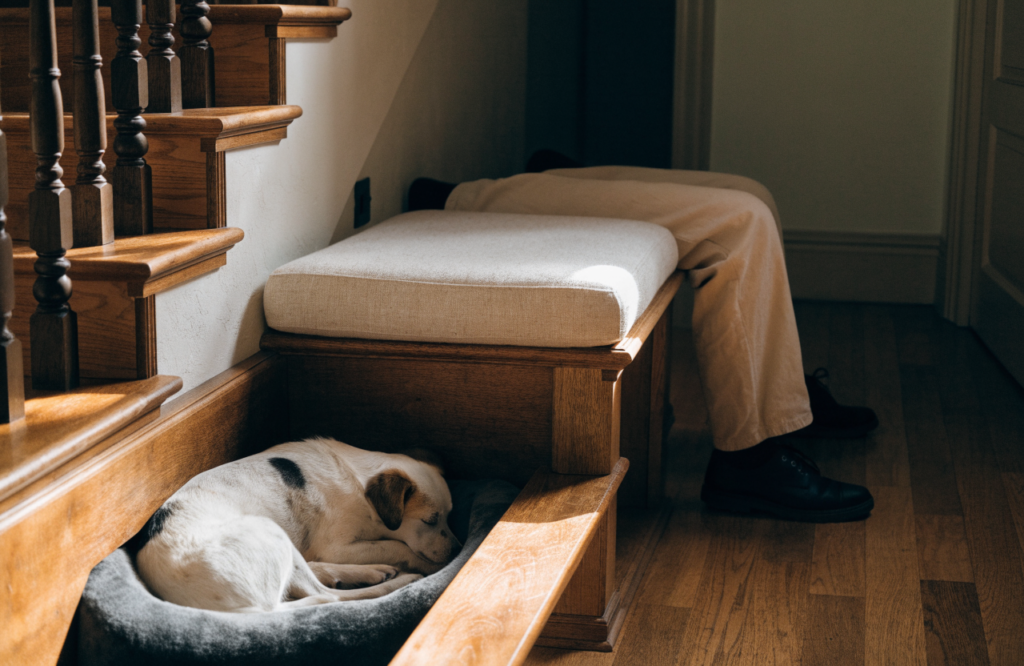
The higher part of the cavity, toward the landing, can be a seat. The lower part stays open for the bed. This only works if the seat framing does not drop the dog’s ceiling below standing height, and if people sitting above are not a constant disturbance. A quiet reader is fine. A shoe-changing bench at the front door often is not.
12. Mudroom bench with the bed behind it
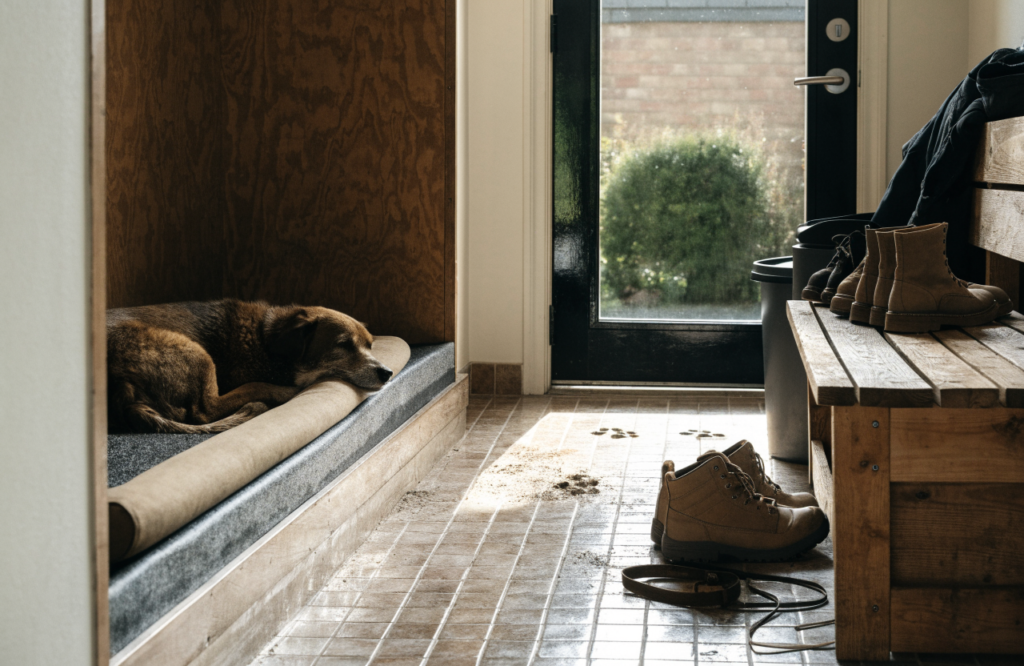
Near an outside door, a human bench with an open bay behind or below keeps the bed off the main floor and next to the place muddy dogs already stop. Use a waterproof liner and a floor you can mop: luxury vinyl, sealed tile, or a removable mat. Carpet here becomes a smell problem after the second wet walk.
13. Curtain-front den
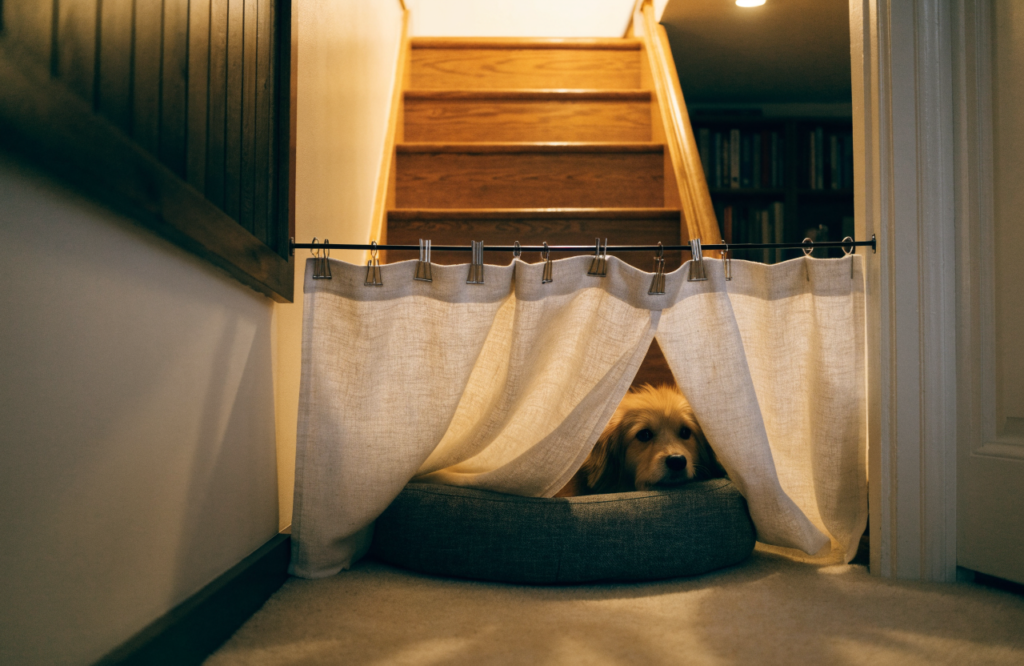
A tension rod and a washable curtain give den-seeking dogs a visual boundary without carpentry. It suits renters and dogs who like to hide but still want to hear the house. Use a short curtain so the entrance stays obvious, and clip it back while you are training the dog to use the spot. A heavy blackout curtain in a small cavity traps heat.
14. Split nook for two dogs
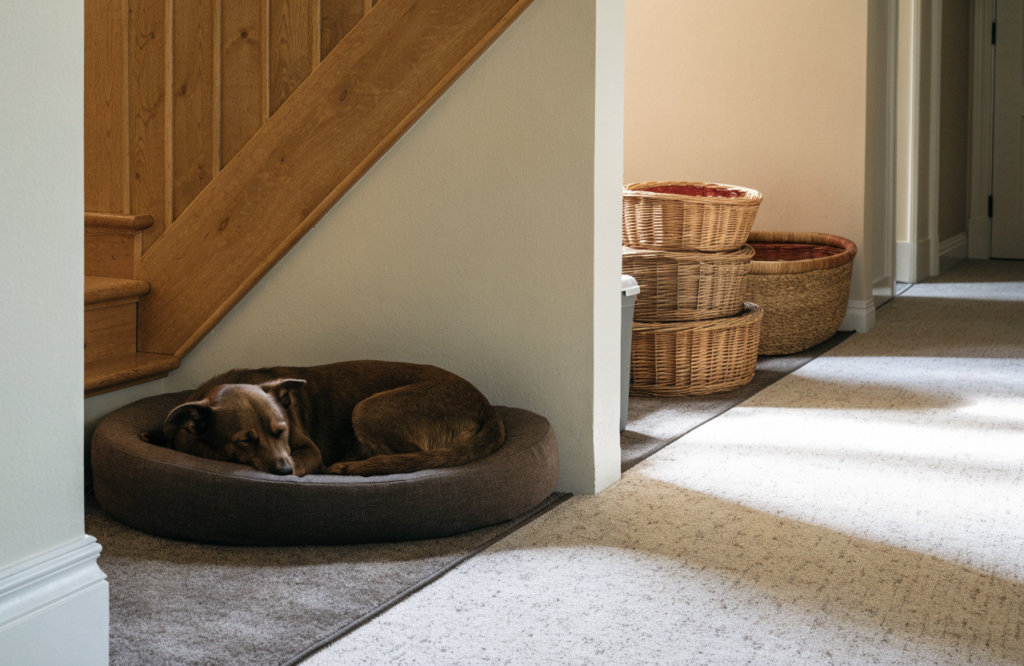
Two beds side by side work only when each dog can stretch without overlapping and each has a clear exit. A better split in a narrow cavity is one bed in the tall zone and storage, not a second dog, in the low zone. Resource guarders should not share a single-entrance cupboard. Give them separate beds in sight of each other, not a dead-end they have to pass through.
15. Renter version with no cutting
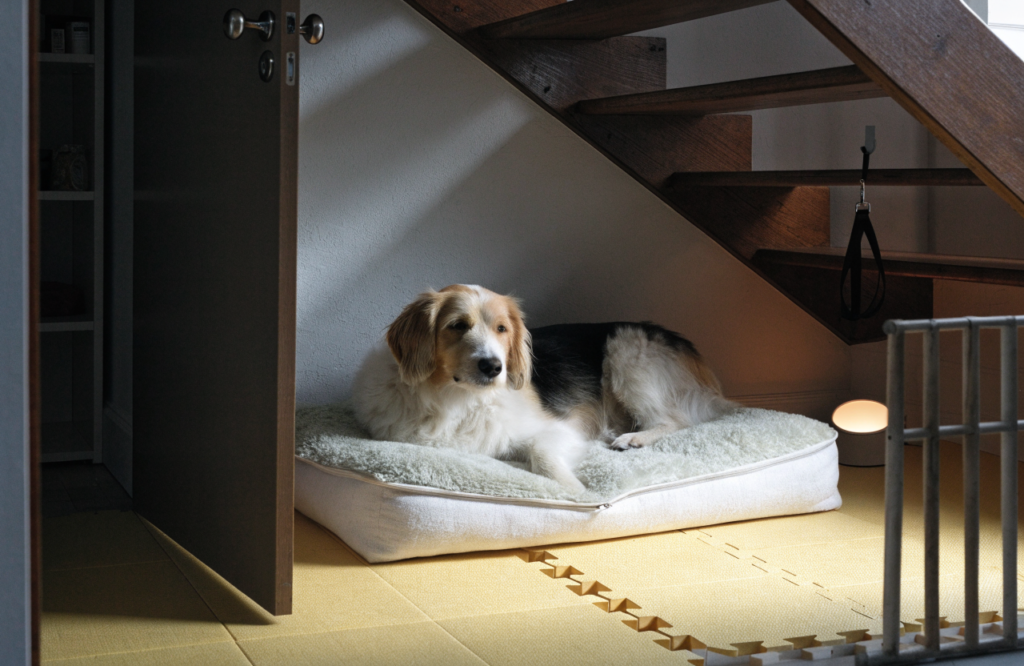
Leave the door on, remove the stored clutter, lay interlocking foam tiles or a washable runner, and use a bed with a removable cover. A freestanding gate can mark the entrance if the lease allows it. Command-style hooks and a battery puck light avoid holes. You lose the custom look and keep the deposit, which is the correct trade if you cannot alter the stair enclosure.
Match the bed to how the dog sleeps
| Sleep style | Bed that fits a stair cavity | What to avoid |
|---|---|---|
| Sprawler | Flat orthopedic rectangle, sized up | Donut rims and high bolsters that steal length |
| Curler | Donut or low cave in the shorter end | A huge flat bed they never use the middle of |
| Chin-rester | Bolster on the tall side only | A bolster under the low ceiling |
| Senior or stiff | Low-front or flat mat, non-slip floor | Lips, platforms, and dark dead-ends |
| Burrower | Cave bed or long mattress into a winder | Sealed doors with no vent |
A non-slip underlay matters on vinyl and tile. Orthopedic foam helps older joints on a hard subfloor, but it does not fix a space the dog refuses because of noise or cold.
Floor, light, and noise
Finish the floor before you spend money on cushions. Vinyl plank, sealed tile, or a fitted mat you can lift out handles hair, mud, and the occasional accident. Wall-to-wall carpet in a closed nook holds odor.
Paint with a low-VOC finish and a matte sheen. Gloss reflects light and shows every scratch; strong chemical smell lingers in a small volume of air. A warm, dim LED is enough. Motion pucks work if you do not want a switch. Avoid a bright downlight aimed at the bed.
Stair traffic is the flaw most idea roundups skip. If the nook sits on the only route to the bedrooms, every late night is a disturbance. Dogs who startle at footsteps do better with the bed set back from the tread line, or with this idea abandoned in favor of a quieter corner.
Mistakes that make the nook unused
- Buying the bed before measuring the low end of the slope.
- Using outer bolster dimensions as if they were sleeping area.
- Closing the space with a solid door and no vent.
- Building a platform that leaves the dog crouching.
- Putting the bed on bare concrete in an exterior wall cavity without a thermal break.
- Treating a locked under-stair cupboard as housing rather than a resting option the dog can leave.
- Cutting into the stair framing or a cable run because a photo online had an arch.
If the dog sniffs the new bed and leaves, change one variable at a time: move it a foot toward the room, drop the bolster, add a familiar blanket, or block the draft. A week of voluntary use is a better test than a single posed photo.
Frequently asked questions
How big should a dog bed under the stairs be?
Long enough for the dog to stretch out, plus 6 to 12 inches, and tall enough to stand and turn in the part of the cavity they will actually use. Add at least a few inches above head height. If those two conditions are not met, the space is storage, not a bed.
Is an under-stairs dog bed safe?
It can be, if the dog can enter and leave freely, the cavity is dry and ventilated, wires and pipes are enclosed, and any new opening respects the stair structure and local fire-separation rules. The location alone does not make it safe.
What if I rent?
Use the open or curtain version. Do not cut plasterboard, move the door frame, or screw into stringers. A washable mat and a removable bed can still give a small or medium dog a defined spot.
Do large dogs fit under the stairs?
Only if the tall end clears standing height and the floor is long enough to stretch. Many domestic stair cavities suit small and medium dogs and fail for tall breeds. Measure the dog standing before you design an entrance around a photo of a terrier.