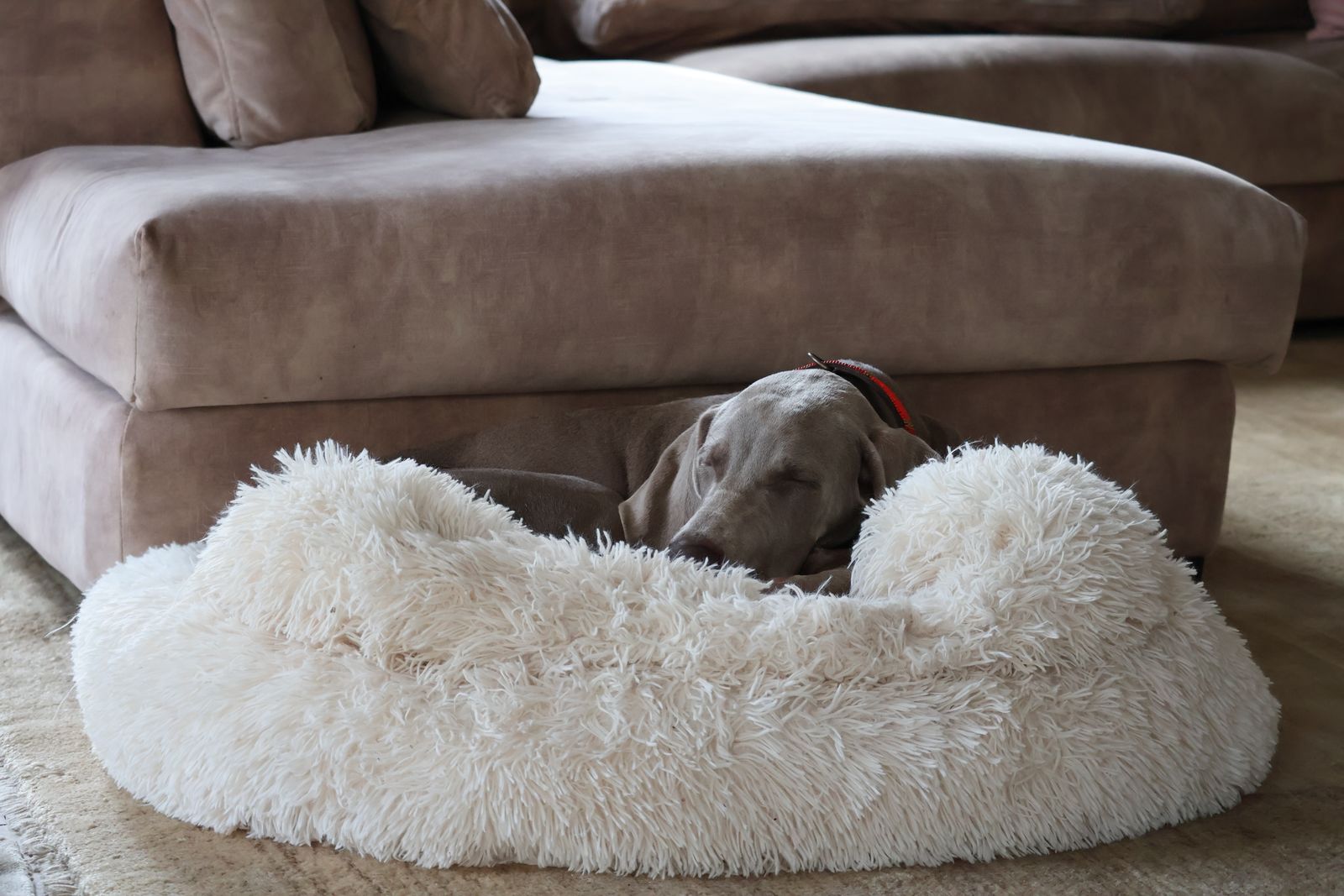

A useful dog bed is the one your dog can stretch out on, step into without a jump, and still use after the cover has been washed a dozen times. The 17 dog bed ideas below are grouped by the problem they solve — stiff joints, a habit of curling, a hot coat, a small floor plan, or a dog that chews — so the pretty version and the practical version are the same choice.
Most unused beds fail for a boring reason: the sleeping surface is smaller than the dog, the rim is too high to step over, or the fill flattens under the dog’s weight. Style comes after those three checks.
Size the sleeping surface before you pick a look

Measure the dog while stretched on one side, nose to the base of the tail, then add about 6 to 12 inches. That length is the minimum sleeping surface, not the outer frame. Bolsters, hoods, and raised rims eat into that space, so a bed labeled 36 by 42 inches may only offer about 32 by 38 inches of flat area. Sizing guides generally favor a slightly larger bed over one the dog has to curl into.
Weight labels are only a starting point, because a long, light sighthound needs more length than a stocky dog of the same weight.
| Dog weight | Typical starting size | What usually changes the choice |
|---|---|---|
| Under 25 lb | About 18–24 by 24–30 in | Curlers can use a snug nest; sprawlers still need length |
| 25–50 lb | About 24–30 by 30–36 in | Check interior size if the bed has bolsters |
| 50–75 lb | About 30–36 by 36–42 in | Thin foam bottoms out; look for more depth |
| 75–100 lb | About 36–42 by 42–48 in | Size up, and favor foam that keeps its shape |
| Over 100 lb | About 48 by 36 in or larger | A twin mattress or clinical-grade foam is often more realistic than a standard “XL” |
Watch the dog for a few nights. Sprawlers need open floor. Chin-resters use a bolster. Burrowers want a hood or a blanket they can rearrange. A dog that sleeps half off the bed is telling you the bed is too small.
Beds built for joints and easy entry
1. A low orthopedic mattress
This is a thick foam slab with a washable cover and little or no rim. It suits senior dogs, large breeds, and any dog that already struggles to stand from a hard floor. The useful details are depth, density, and entry height, not the word “orthopedic” on the label.
Guides aimed at senior dogs commonly suggest roughly 3 inches of decent foam for small dogs, 4 to 5 inches for medium and large dogs, and 6 to 7 inches for heavy or arthritic dogs, so the dog does not press through to the floor. Density matters as much as thickness. Foam under about 2 pounds per cubic foot tends to flatten; denser foam, often discussed in the 2.5 to 4+ lb/ft³ range depending on the dog’s weight, holds shape longer. CertiPUR-US certification speaks to foam content and emissions, not to joint outcomes. A bed is not a treatment for arthritis.
Skip high bolsters on all four sides. One lowered edge, or no rim at all, is easier for a stiff dog. A rubberized bottom matters on wood and tile so the bed does not shoot out when the dog stands up.
2. A sofa-style bolster with one low side
A three-sided bolster gives a headrest without trapping the dog behind a wall of foam. It works for dogs who lean, and for apartments where the bed has to sit against a sofa and still look intentional. Measure the flat interior, not the outer cushion. If the dog is arthritic, the front wall should be low enough to step over, not climb.
3. A heated bolster, used as a layer rather than the only bed
Low-voltage heated beds can help a thin-coated senior who stiffens in a cold room. They are a poor primary bed for a dog who pants at night, and they need a cord route the dog cannot chew. Many owners do better with a warm room, a thicker orthopedic bed, and a blanket the dog can leave. If you use heat, follow the product’s chew and supervision limits, and do not pair it with a dog who already runs hot.
Beds matched to how the dog settles
4. A deep bolster that reads as furniture
Neutral bouclé, linen, or canvas bolsters disappear in a living room better than a bright plush rectangle. The tradeoff is cleaning. Pretty covers that are not removable, or foam with no waterproof liner, fail the first muddy walk. Choose a cover you can actually wash, and a liner under it if the dog is a puppy or an older dog with occasional accidents.
5. A donut or nest bed
Round, high-walled beds suit small and medium dogs who curl and like something to lean on. They are a weak choice for sprawlers, who push the walls flat and sleep on the floor beside them. They also run warm. A thick-coated dog in a plush donut may abandon it in summer and use it again in winter, which is a sleep-style match, not a rejection of the bed.
6. A cave or hooded bed
Hooded beds copy a den: darker, enclosed, and easier for a small dog to guard. They help some noise-sensitive dogs settle. They are a bad fit for dogs who overheat, for dogs who panic when an opening is partly blocked, and for anyone who cannot reach in to wash the hood. Leave an exit the dog can use without backing up, and skip the hood if the dog already pants in a closed crate.
Beds for heat, chewing, and mess
7. An elevated cot
A mesh or fabric bed on a frame lets air move underneath. That is the most reliable “cooling” idea for heavy coats, warm apartments, and covered patios. Cots are also easier to hose off than foam. The limits are real: a tall cot is a step a stiff senior may refuse, thin mesh can sag under a giant breed, and some dogs develop elbow calluses if the surface is the only place they lie. A low frame, or a cot plus a floor orthopedic bed, covers both seasons.
8. A cooling pad on top of a real mattress
Gel pads and pressure-activated cooling mats warm up with body heat and then need time to recover. Owners who use them successfully usually put a crib sheet or cover over the pad so claws do not puncture it, and they keep a normal bed nearby. Treat the pad as a topper, not as joint support. A punctured gel pack is a chewing hazard.
9. A waterproof, fully washable bed
Puppies, incontinent seniors, and dogs who come in wet need a removable cover plus an inner liner, with foam that can be aired rather than soaked. Machine-wash the cover; do not machine-wash the foam core. Spot-clean foam and dry it fully, or trapped moisture turns into odor. This is the bed to buy first if you are still house-training, even if you plan a nicer frame later.
10. A chew-resistant cot or canvas bed
Heavy chewers destroy bolsters, exposed zippers, and polyfill. A raised cot with a simple metal or resin frame, or a bed in ballistic nylon or heavy canvas with hidden zippers, removes the stuffing they can swallow. No fabric is truly chew-proof. If the dog is already shredding beds, supervision and a crate setup matter more than a tougher cover. Avoid loose rope trims and foam the dog can excavate.
Ideas that use the room you already have
11. A window-bench bed
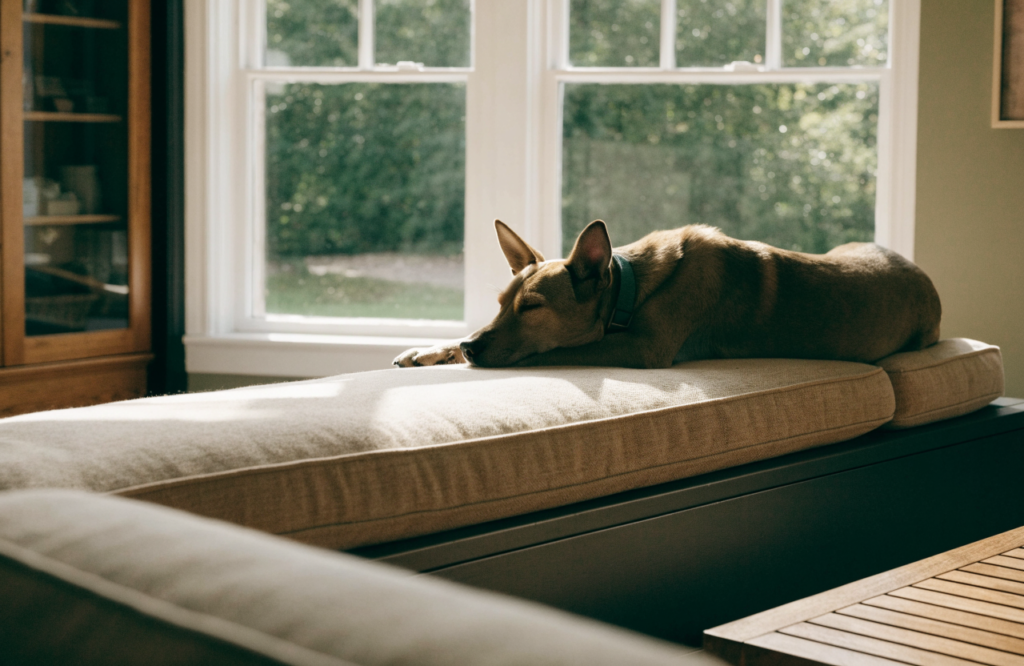
A low bench or wide window seat with a firm cushion gives a lookout and a nap spot in one footprint. It works when the sill is already a favorite place. Use a cushion with a nonslip base, and keep the drop small. A bench the dog has to jump onto is a poor idea for short-backed breeds, seniors, and any dog with back or hip pain.
12. An under-stairs den
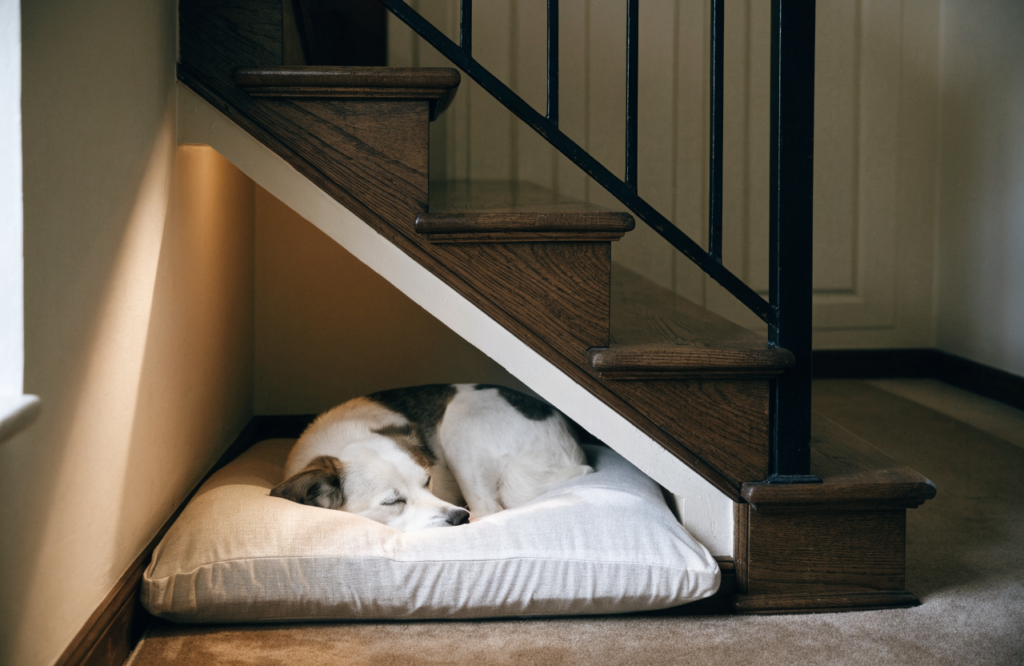
The triangle under a staircase is wasted space that already feels enclosed. A fitted cushion, a low light, and a washable cover turn it into a den without a new piece of furniture. Leave ventilation so the nook does not get stuffy, round or cover any sharp stair edges, and do not close it into a box the dog cannot leave. A crate front can be added if you already crate-train; it is optional.
13. A furniture-style crate with a real cushion
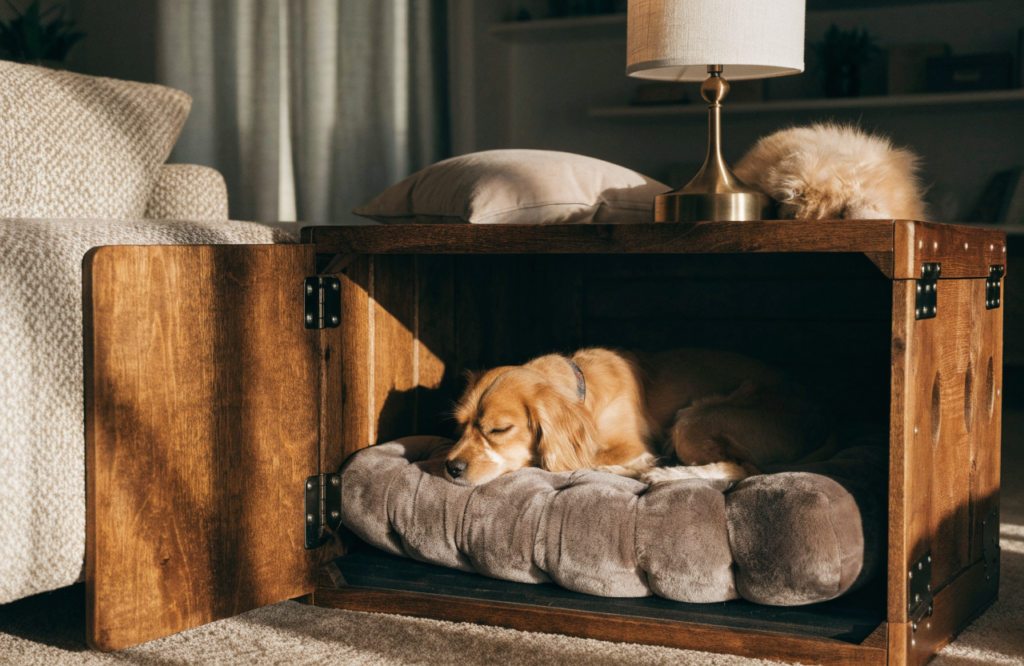
Wooden or cabinet-front crates keep an enclosed bed from looking like equipment. The mistake is styling the outside and skimping on the pad. Use the same interior-size rule as any bed, add a waterproof liner, and make sure the door swing does not block the only path through the room. This is a good apartment idea when the crate has to live in the living room.
14. A platform with storage under the cushion
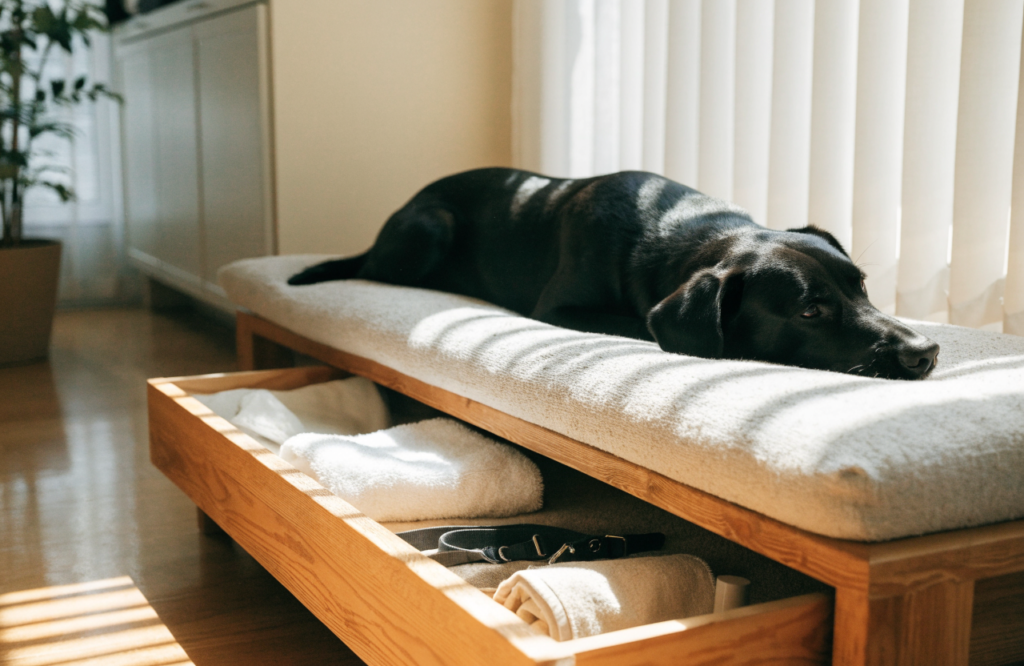
A low wood frame with a drawer or open shelf holds spare covers, towels, and leashes. Build or buy it only as tall as the dog can step onto. Plywood with a veneer can look like solid oak if the edges are finished cleanly. Sand every surface, and use a cured low-VOC or water-based finish; oil-based stains and uncured coatings are a poor idea on something a dog may lick. Keep the dog off the piece until the finish has fully cured, and skip decorative parts that unscrew.
15. A closet or alcove nook
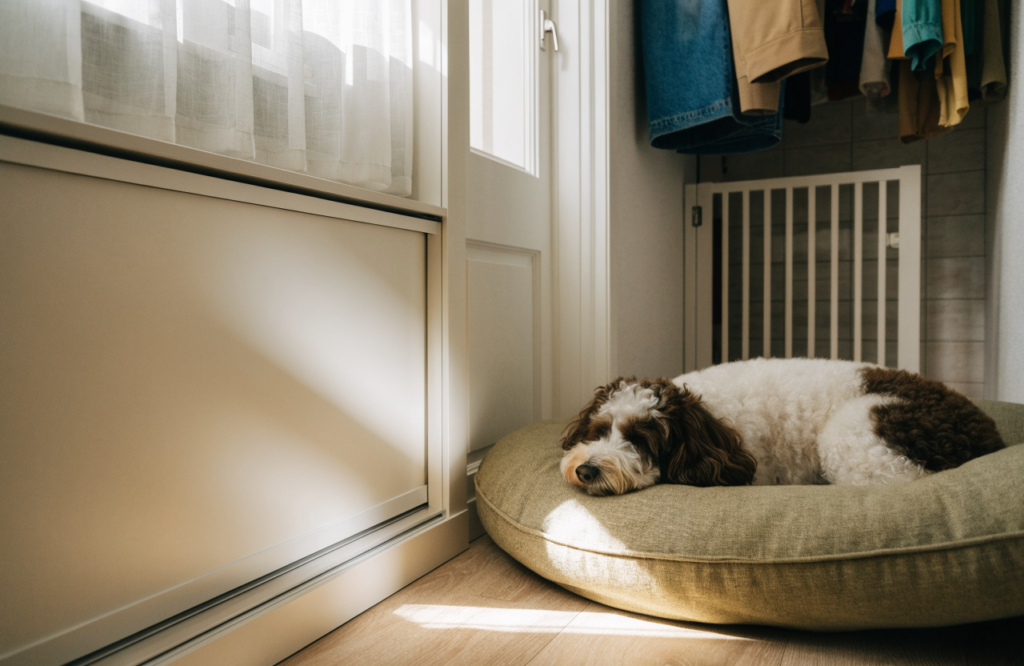
Moving the bed into a closet corner or the end of a hallway frees the main floor and gives the dog a quieter spot. It fails if the closet stays dark, hot, or full of hanging clothes the dog can pull down. A baby gate, a washable rug, and a bed sized to the opening are enough. This is one of the better small-apartment ideas because it spends space you already cannot use for a chair.
Simple builds when a bought bed is the wrong shape
16. A no-sew fleece bed
Two layers of fleece, knotted around a pillow or a piece of firm foam, is a low-cost bed for a gentle small or medium dog. It is a weak idea for chewers: knotted strips loosen, and loose fill is a swallowing risk. Use it as a washable cover system, not as the only support for a senior. If you sew, an envelope cover with a zipper hidden on the short end is more durable than knots.
17. A raised outdoor daybed with a roof, or a twin mattress indoors
These are the two oversized answers, depending on where the dog actually sleeps.
Outside, a cot under a porch roof or a simple covered frame keeps the dog off hot or wet ground. It is not a substitute for shelter in extreme heat or cold, and it should not be the unattended plan for a dog who chews the mesh. Inside, a clean twin foam mattress in a washable cover is often the honest bed for a Great Dane, mastiff, or pair of large dogs. Standard “XL” pet beds run out of length before those dogs do. Put a waterproof liner between mattress and cover, and keep the mattress on a low frame or the floor so getting off is a step, not a drop.
A vintage suitcase or a sanded drawer can work the same way for a toy breed: rigid sides, a removable cushion, no loose hardware. It is a container, not a joint solution, and it is the wrong scale for any dog who cannot turn around inside it.
Mistakes that make a good idea fail
- Buying the outer dimension. Always subtract bolsters and compare the flat interior with the dog’s stretched length.
- Choosing plush over support for a heavy or older dog. Soft fill feels kind on day one and bottoms out.
- Putting a stiff dog on a tall cot or a high-sided nest. Entry height matters as much as cushioning.
- Treating a gel pad as a cooling bed. Air under a cot does more, for longer, than a pad that warms to body temperature.
- Building a cute enclosed nook with no washable cover and no airflow.
- Using uncured paint, oil stain, or small detachable trims on a DIY frame.
- Owning one bed for every job. A summer cot and a winter orthopedic mattress is a normal setup, not a failed purchase.
Frequently asked questions
How many beds does one dog need?
One well-sized bed is enough if the dog uses it. A second bed earns its place when the first fails a condition: heat, a different floor in the room where you work, or outdoor time. Matching sleep style beats collecting styles.
Are elevated beds better for arthritis?
They can reduce contact with hot or hard floors and spread weight if the mesh is supportive, but the step up is a problem for many seniors. A low, dense-foam mattress is the safer default when standing up is already hard. Some dogs do well with both.
What if my dog ignores every bed?
Check size first, then surface. Dogs who sleep on tile are often avoiding heat or a bed that slides. Try a larger flat mattress, a cot, and a nonslip pad before assuming the dog “prefers the floor.” A bed that is too small trains the dog to sleep beside it.
Can a DIY bed be safe for a chewer?
Only if there is nothing to shred and swallow: no polyfill, no knotted fleece strips, no exposed foam, no loose screws. A simple cot or a canvas cover over a solid cushion is more realistic than a decorated wooden bed. Supervision still matters.
When is a dog bed the wrong project?
If the dog is suddenly stiff, reluctant to lie down, or painful when getting up, the next step is a veterinary visit, not a thicker cushion. A better bed can make rest easier. It does not diagnose the reason rest became hard.