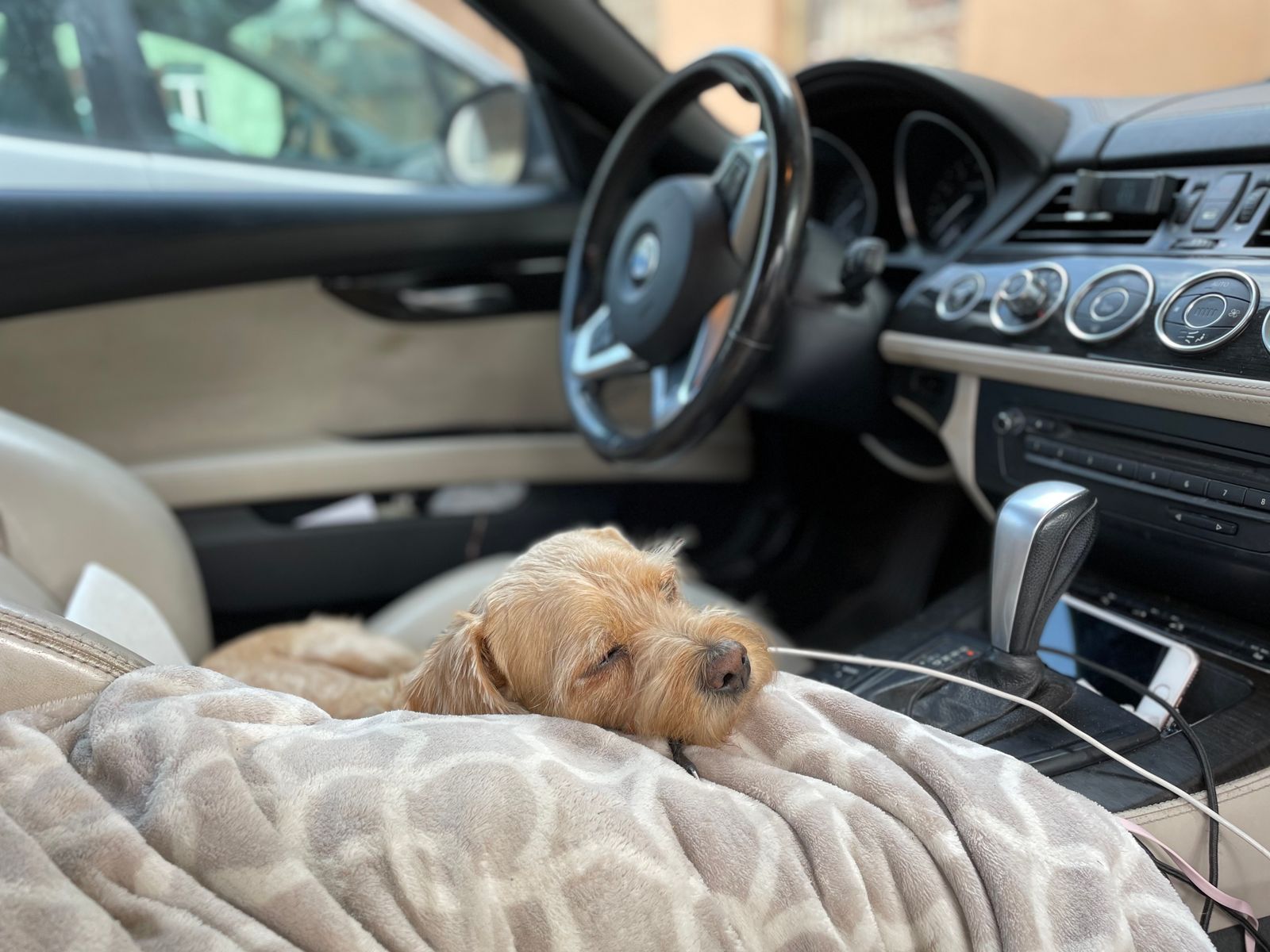

A car dog bed is a cushioned place for a dog to sit or lie in the car. It is not, by itself, a crash restraint. The useful version depends on the dog’s weight, whether they need to see out, and whether the real problem is a hard seat, a footwell gap, or fur and mud on the upholstery.
Most searches for a car dog bed mix three different products: a raised booster for a small dog, a flat pad or hammock for the back bench, and a hard-bottom extender that bridges the gap between the seat and the front seatbacks. Buying the wrong one is the usual failure. A booster rated for 25 pounds will collapse under a Labrador. A flat cover will not stop a dog from stepping into the footwell on a hard brake. And none of these replace a proper harness or a secured crate.
The American Veterinary Medical Association’s position is that a loose pet in a moving vehicle is unsafe, and that the preferred setup is a species-appropriate enclosure of the right size or a properly designed safety harness. A bed can sit under that system. It should not stand in for it.
Match the bed to the job, not the product photo
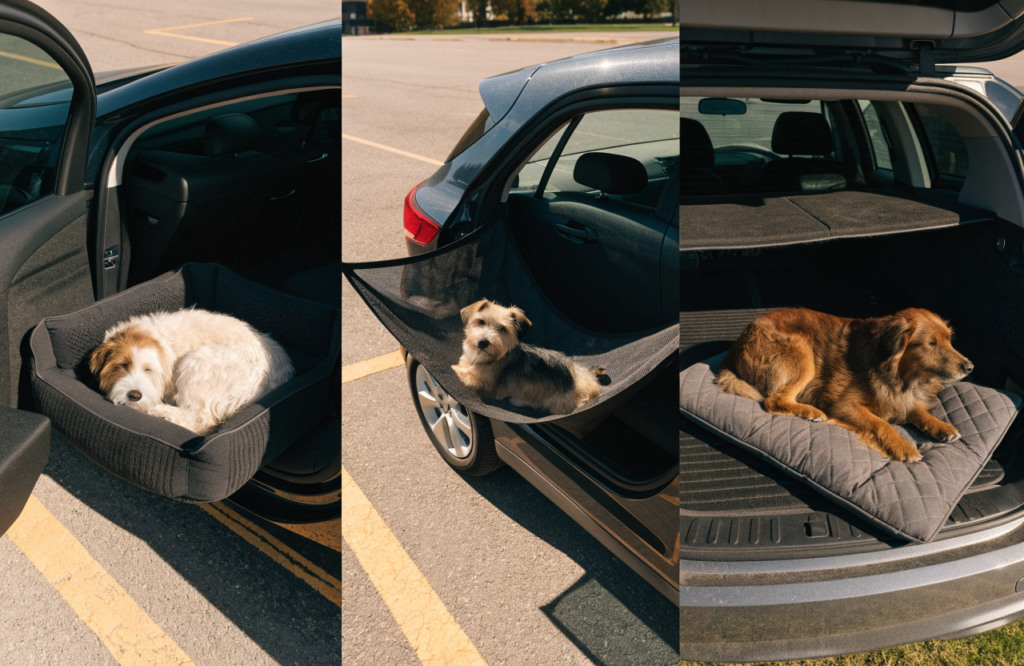
Start with what goes wrong on a normal drive, then pick the format.
| Type | Works best for | What it solves | What it does not do |
|---|---|---|---|
| Booster or elevated car bed | Small dogs, often under about 25–35 lb depending on the model | Lifts the dog to window height, adds walls, gives a tether point | Hold a medium or large dog; act as a crash seat |
| Flat bench pad or seat cover | Calm dogs of almost any size | Cushions the seat and catches fur, mud, and drool | Stop a dog falling into the footwell |
| Hammock | Medium and large dogs who move around | Spans the bench and blocks the footwell gap | Restrain the dog in a crash |
| Hard-bottom extender | Heavy dogs, long trips, sagging seats | Gives a flat platform so the dog does not sink into the seat split | Replace a harness |
| Cargo cot or pad | SUVs and wagons with a flat load floor | Keeps the dog off a hot or dirty cargo floor | Work on a passenger bench |
Booster seats for dogs who cannot see out
A small dog on the floor of the back seat rides blind. The motion is harder to interpret, and many of these dogs pace, whine, or get carsick. A booster is a walled box with a cushion, strapped to the seat, often with a short clip inside for a harness.
Weight limits on these products commonly fall around 15 to 35 pounds. Treat the listed limit as a maximum, not a target. A dog who fills the box cannot turn around or lie down, and the walls become a launch point if the straps are only elastic loops over the headrest. Use the booster in the back seat, run the vehicle seat belt through the bed if the design allows it, and clip the dog’s harness to a short tether. The bed keeps them in one place. The harness is what holds them if you stop hard.
The Center for Pet Safety’s pilot tests of pet booster seats found failures that matter here: anchor straps releasing, seats rotating, and in one case a booster becoming unrestrained on impact. Those tests are a reason to treat the booster as comfort and containment, not as certified crash equipment.
Flat pads when the only problem is the upholstery
A quilted cover or thin bolstered pad is enough when the dog already lies still and you mainly want fur, nails, and wet paws off the leather or cloth. It is the lightest option to install and the easiest to wash.
It fails when the dog stands up on corners, digs, or slides toward the door on a turn. Fabric-backed pads with no grip shift under anything heavier than a small dog. If that is the pattern on your drives, a pad is the wrong category.
Hammocks when the footwell is the problem
On a bench seat there is a gap between the cushion and the back of the front seats. Dogs step into it, scramble, and drag mud down the seat edge. A hammock hangs from the headrests and fills that gap, so the dog has one continuous surface.
Check two things before buying. The hammock should reach the full width of your bench, or slightly past it, so the sides do not leave an open channel to the door. And the headrest straps should be adjustable webbing with solid hardware, not thin elastic. Elastic stretches after months of a dog climbing in, and the cover then sags into the footwell it was meant to close.
A hammock still lets a dog move across the seat. Pair it with a harness clipped to the seat belt on a short tether so the dog cannot reach the driver.
Hard bottoms for heavy dogs and long trips
Soft hammocks sag between the seat cushions. A 50- or 70-pound dog then rests in a trench, and some dogs sway enough on winding roads to get nauseated. A hard-bottom extender uses a rigid panel under the pad so the surface stays flat and bridges the seat gap.
These are the right call for large breeds on road trips and for crew-cab trucks where the dog needs a stable platform. They are bulkier to store and can block seat-belt buckles unless the cover has a zip or a flap at the buckle. Confirm that opening before you buy if anyone else rides in the back.
Cargo areas are a different product
In an SUV or wagon, a cot or thick pad on the load floor keeps a dog off carpet and off a floor that heats up in sun. It only works if the cargo area is enclosed. The AVMA states that transporting a pet loose or merely tethered in an open cargo area is not safe. An open truck bed needs a secured, ventilated enclosure sized for that dog, not a bed.
Size the bed to the dog and the seat, in that order
Measure the dog first. Length from nose to the base of the tail, plus enough width to lie on a hip, is the minimum sleeping surface. A dog who can only sit upright in the bed will not settle on a long drive.
Then measure the car.
- Bench width from door panel to door panel, at cushion height.
- Cushion depth from the seatback to the front edge.
- For a hammock or extender, the distance from the back-seat headrests to the front-seat headrests, because that is the span the straps must cover.
- For a booster, the footwell depth in front of the cushion, so the box does not tip forward.
A bed that is wider than the cushion will bunch over the bolsters and block buckles. A bed that is much narrower than the dog will be pushed aside the first time they turn around. Bucket seats and 60/40 split benches rarely take a “universal” full-bench hammock without gaps at the center armrest. If the armrest folds down, look for a cover with a split or a pass-through.
Weight ratings are not interchangeable with length. Two dogs of the same breed can differ by 20 pounds, and a booster’s walls are sized for a chest, not a label.
Features that hold up after the first month
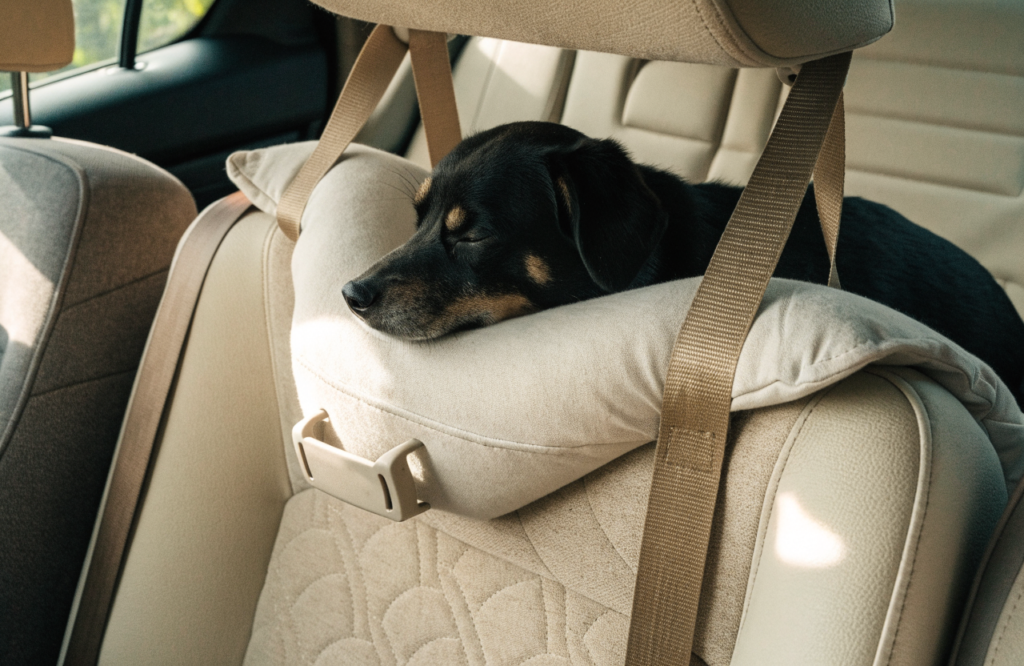
Attachment. Headrest straps plus a seat-belt pass-through beat a non-slip bottom alone. Grip dots help on cloth. On leather they are less reliable, and a heavy dog standing up will still shift a pad that is not strapped.
Cover and fill. A removable, washable cover matters more than plush photos. Waterproof or water-resistant fabric saves the seat from drool, wet fur, and the occasional accident. Memory foam and thick egg-crate fill stay supportive longer than a thin sheet of polyfill, which packs flat. If the listing does not say the foam comes out, assume washing the whole bed will ruin the fill. Foam should be spot-cleaned and air-dried. Submerging it flattens the cells.
Walls and bolsters. Useful on a booster, where they stop a small dog rolling off. On a full-bench bed they mostly keep the dog from pressing into the doors. They are not a substitute for a tether.
Seat-belt access. You will need the buckle for passengers and for the dog’s own tether. A bed that covers the receiver with no opening gets pulled out of place on every trip.
Hardware against leather. Dark non-slip coatings and some dyed fabrics have transferred color onto light leather. If the seats are new or pale, put a light-colored towel down for the first few warm days and check for marks before you commit to leaving the bed in full sun.
Set it up so the dog and the bed both stay put
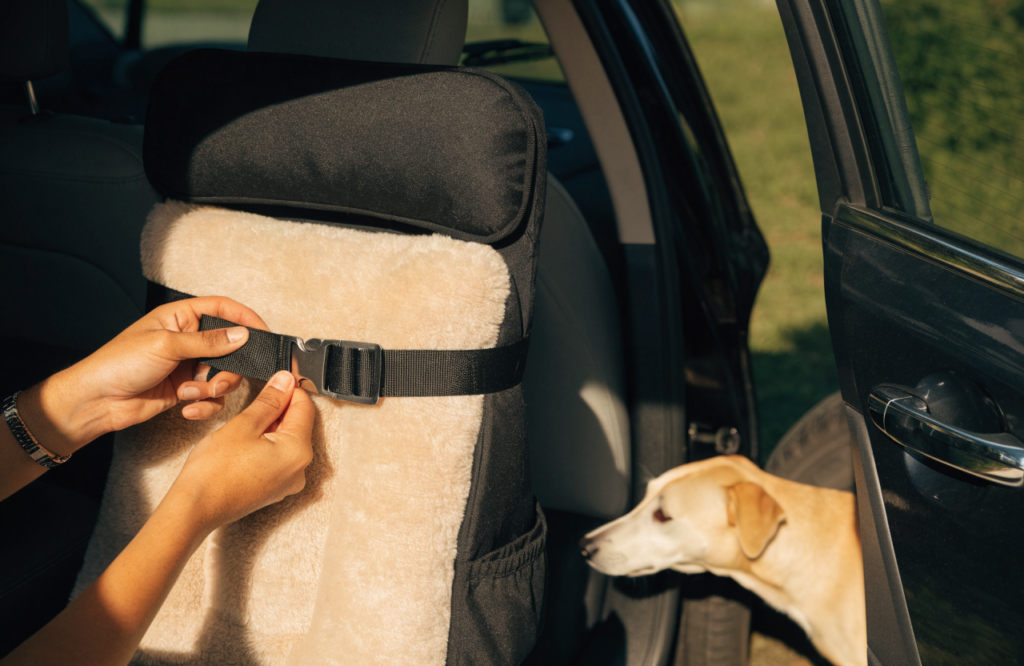
- Install the bed with the car parked and no dog in the way. Feed straps over the headrest posts, not around the whole seatback if the instructions say otherwise, and tighten until the pad cannot be lifted at a corner.
- Confirm every buckle you still need is reachable.
- Put the dog in a car harness, not a collar. A collar loads the neck in a sudden stop. Fit the harness so it will not pull over the head, with about two fingers of room at the chest, and size it by girth behind the front legs rather than by weight alone.
- Clip the harness to the seat belt or to the bed’s tether point with a short connection. The Center for Pet Safety has warned that long extension tethers and zipline-style leads give the dog room to build momentum and to reach the driver. Short is the point.
- Do the first rides as short trips to a rewarding place. A new bed plus a new harness on a two-hour highway run is how dogs decide the car is a fight.
Keep the dog in the back seat. A front passenger airbag is a bad match for a dog in a bed or a harness, and a dog on a lap is a distraction as well as an unrestrained body in a crash.
The bed is not the safety product
Crash testing of pet travel gear is not a federal requirement in the United States. The AVMA has noted that scientific evidence on individual products is limited, and it encourages real crash testing of enclosures and harnesses. The Center for Pet Safety, which runs an independent program, is explicit that a “crash tested” label does not mean a product passed. Manufacturer tests use their own criteria.
In practice that splits the shopping list:
- The bed, hammock, or booster handles comfort, mess, and ordinary containment.
- A harness designed for the car, correctly fitted and attached to the seat belt, is what current veterinary guidance points to for a dog riding on a seat. Check that the exact model appears on any independent certification list the brand cites, not just a similar product from the same company.
- A hard-sided crate, anchored to rated tie-down points and sized so the dog cannot be thrown around inside it, is the stronger option for medium and large dogs in an SUV or wagon, and for dogs who panic in open seats. Too much empty space inside a crate lets the dog accelerate before the wall stops them.
A walking harness and a standard leash clipped to a collar are not this system. Neither is the bed’s own strap around a headrest.
Problems that show up after the return window
The cover creeps. Usually the straps were left loose, or the elastic has stretched. Retighten after the first week. If the only anchor is a rubberized back, add straps or return it.
The dog still falls forward. The hammock is too short for the car, or it is a flat pad pretending to be a hammock. Measure the span again.
Smell. Drool and damp fur in foam will not wash out if the fill cannot be removed. Zip-off covers and a waterproof liner are the fix, not another spray.
Nails through the fabric. A thin cover on leather loses this fight. Look for a tighter weave or a canvas-like face, and keep nails trimmed. Seat covers exist because claws reach stitching.
Chewed straps. A dog who is bored and loosely tethered will mouth the webbing. Shorten the tether, give a safe chew on the first rides, and do not leave the dog in the parked car with the bed as entertainment.
Heat. A dark bed in a closed car heats with the cabin. Do not leave a dog in a parked vehicle. Crack-the-windows advice does not make that safe.
A simple way to decide
Choose a booster if the dog is small, rides better with a view, and the product’s weight limit clears their actual weight with room to lie down. Choose a hammock or hard-bottom extender if the dog is medium or large and either falls into the footwell or sinks into the seat split. Choose a flat cover only if they already stay put and the goal is a cleaner seat.
Then buy the restraint separately, fit it before the first real trip, and put both in the back seat. The bed is there so the ride is tolerable. The harness or crate is there so a sudden stop does not turn the dog into something loose in the cabin.
Frequently asked questions
Can I use my dog’s regular bed in the car? Only if it cannot slide and you still restrain the dog. House beds have no straps, no waterproof shell, and no tether point. A moving seat will walk them into the footwell.
Is a booster safer than a hammock? They solve different problems. A booster lifts a small dog and limits where they can go. A hammock blocks the footwell for a larger dog. In a crash, neither has a strong independent record as a restraint. The harness or crate does that job.
Will a car dog bed work with a child seat in the same row? Often yes, if the bed is a single-seat booster or a cover with buckle openings, and it does not sit under or against the child restraint. Do not route pet straps through a child-seat belt path.
How often should I wash it? Shake out hair after muddy trips. Wash the cover when it smells or looks soiled, with the foam removed. A waterproof liner means you are washing fabric, not a soaked cushion.
What about two dogs? Two boosters only work if both dogs are small and the bench has two flat cushions. Otherwise one hammock or extender across the bench, with each dog on their own short tether, keeps them from crowding the driver and from using each other as a step into the front.