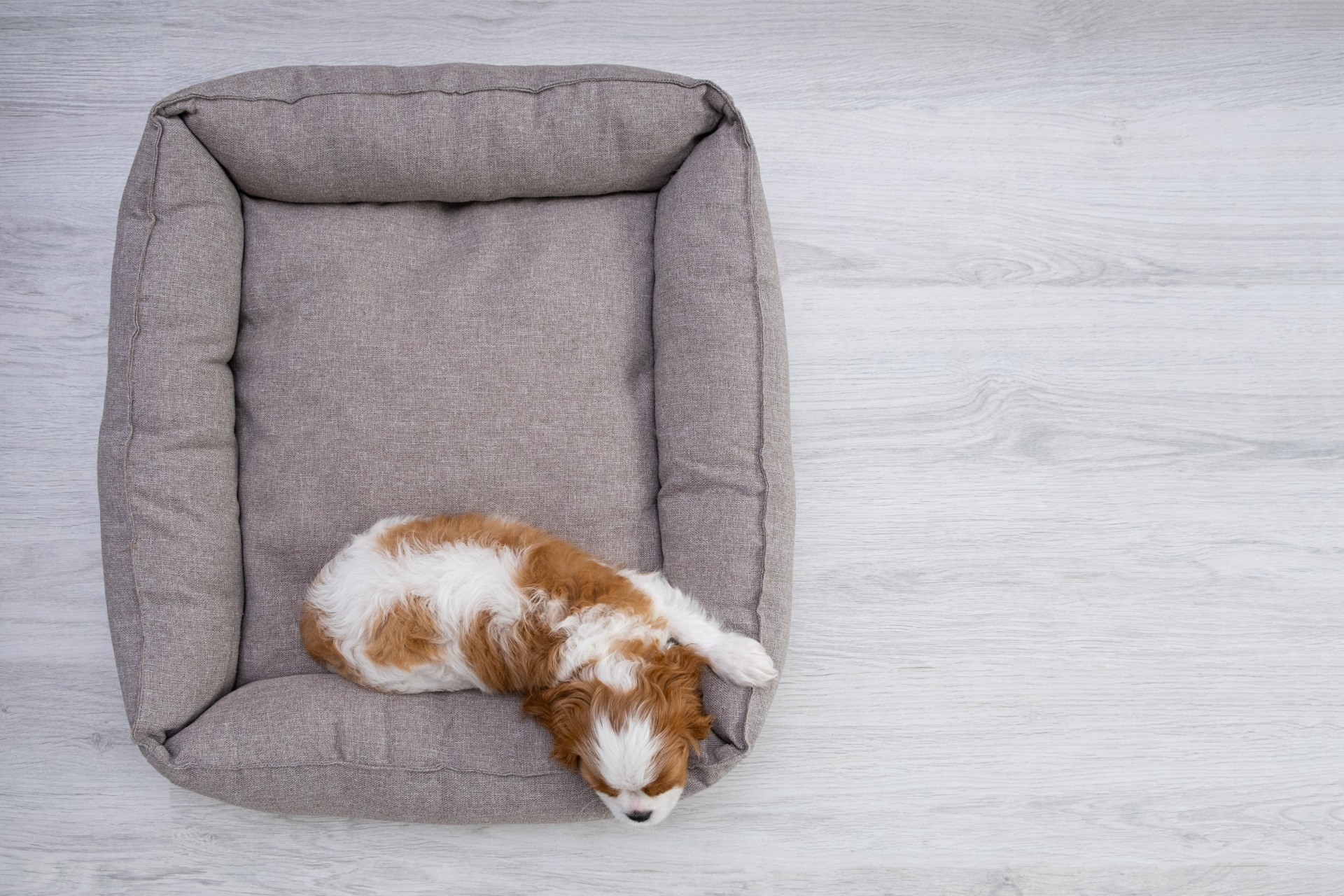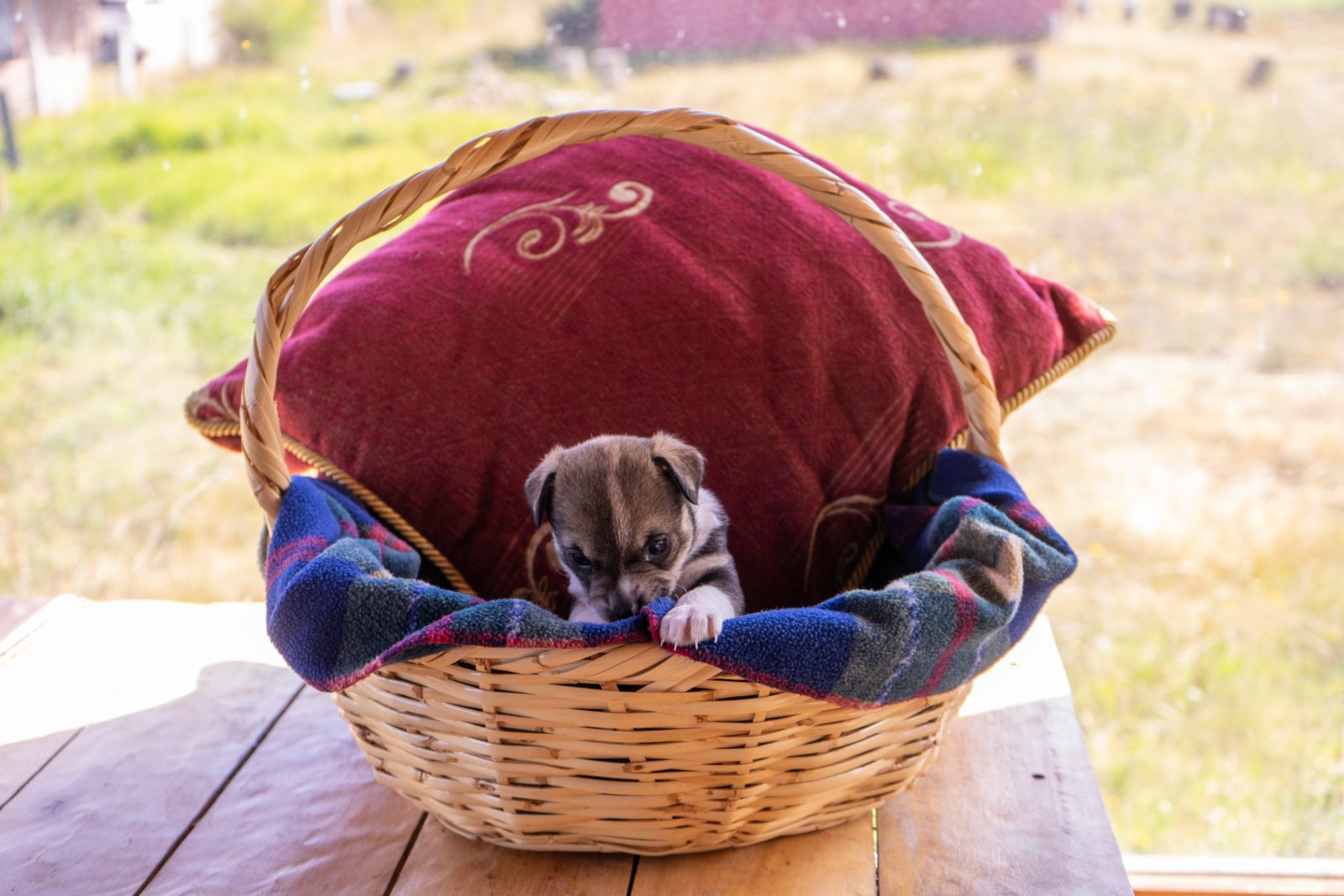

A useful DIY dog bed is a correctly sized cushion your dog can stretch out on, with a cover you can pull off and wash. The frame, bolster, and fabric pattern are optional. Most beds fail because they are too small, stuffed with fill that flattens, or built so the foam has to go in the washing machine.
Three builds cover almost every household: a no-sew fleece pillow for a small or temporary bed, a foam slab with a removable cover for everyday use, and a raised cot when the floor is cold, damp, or hard. Pick from how the dog sleeps and how hard they are on gear, not from the project that photographs best.
Size the bed from the sleeping dog, not the standing one

Measure while the dog is lying down and stretched, not sitting. Length is the tip of the nose to the base of the tail, where the tail meets the body, not the end of the tail. Width is the broadest point across the shoulders, or from the back to the front paws if the dog sleeps on its side. Add about 6 inches for a dog that curls into a tight ball, and 10 to 12 inches for a dog that sprawls. That sum is the minimum interior size of the sleeping surface.
Weight charts are only a starting point when you cannot measure:
| Dog weight | Typical sleeping length to aim for | Starting footprint |
|---|---|---|
| Under 25 lb | Nose-to-tail-base plus 6 in | About 24 × 18 in |
| 25–50 lb | Plus 6–10 in | About 30 × 24 to 36 × 28 in |
| 50–75 lb | Plus 10–12 in | About 38 × 30 to 44 × 34 in |
| 75–110 lb | Plus 12 in | About 46 × 36 to 50 × 40 in |
| Over 110 lb | Plus 12 in, and check sprawl | 52 × 42 in or larger |
A 26-inch retriever that sleeps on its side often needs close to 36–40 inches of usable length. A bed labeled “large” can still be too short if the usable area stops at the inside of the bolsters.
For a crate, ignore the crate’s advertised size and measure the floor pan inside edge to inside edge. Take the smallest of three readings along each side, then subtract about a quarter-inch so the pad slides out. Leave enough headroom that the dog can stand; a thick orthopedic slab in a small crate often forces a crouch.
Two dogs sharing one bed need the combined sprawl, not the larger dog’s size plus a few inches. Puppies should be sized for expected adult length if you are cutting foam once.
Match the build to the dog
| Build | Best for | Weak point |
|---|---|---|
| No-sew fleece pillow | Small dogs, guest beds, using scraps | Fill shifts; fleece pills; easy to shred |
| Foam slab + washable cover | Daily bed, seniors, crate pad | Foam is ruined if it gets soaked and cannot dry |
| Raised cot (PVC or wood frame with mesh) | Hot rooms, patios, dogs that overheat | No joint support; mesh sags if underspecified |
| Wood box frame with a lift-out cushion | Chewers of soft edges, a bed that has to look like furniture | Heavier build; finish must be pet-safe and fully cured |
Shape matters less than size. A rectangle fits crates and most sprawlers. A round bed only works if the diameter still clears the nose-to-tail measurement after the dog curls.
The bed worth building: a foam core and a cover that comes off
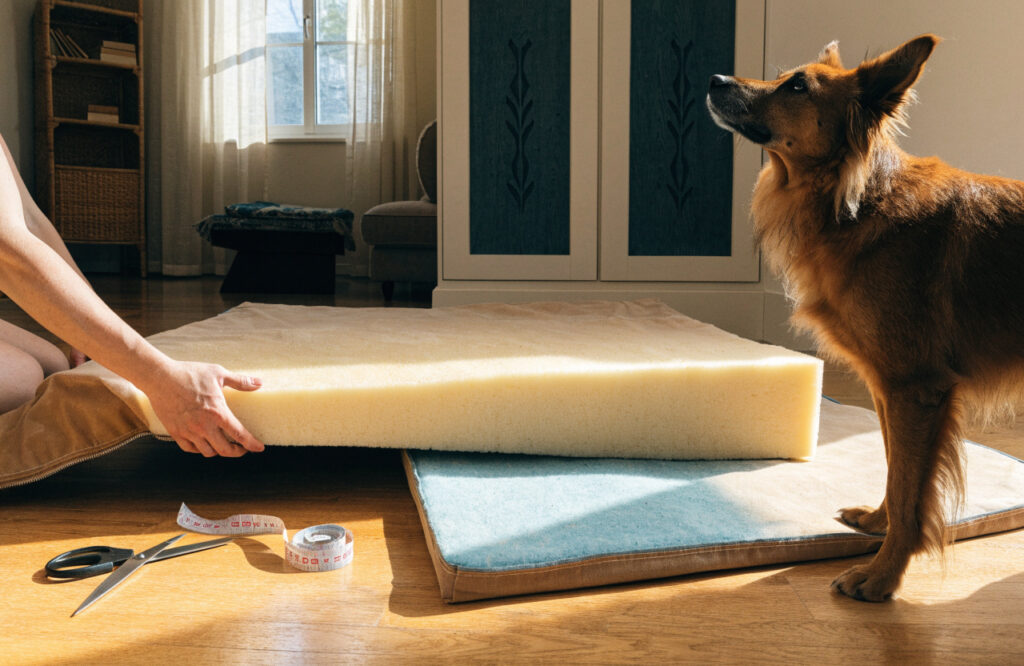
Fiberfill and old pillow stuffing feel soft on day one and compress flat under a medium or large dog. Shredded memory foam shifts into clumps and holds heat. A solid slab of higher-density polyurethane foam keeps a continuous surface. Upholstery suppliers that sell this material commonly point to high-resilience foam around 2.8 lb per cubic foot, and warn that 1.0–1.5 lb foam bottoms out within months under a heavy dog.
Thickness is about load, not luxury:
- Under 25 lb: about 3 inches
- 25–60 lb: 3–4 inches
- 60–100 lb: 4–5 inches
- Over 100 lb: 5–6 inches
Thicker is not automatically better. A senior with weak hind legs needs a low step-in height more than a 6-inch cliff. Egg-crate foam can add pressure relief in a crate if the slab is still dense enough not to collapse. Solid memory foam conforms well for arthritic joints, but it traps heat; thick-coated dogs and hot sleepers often abandon it for the bare floor.
If you buy foam, look for a CertiPUR-US mark on the foam itself. That program tests flexible polyurethane foam for certain heavy metals, specified flame retardants, and volatile organic compound limits in a chamber test. It does not cover the cover fabric, zipper, adhesive, or any finish on the cloth. New foam can still smell for a few days; air it in a ventilated room before the dog sleeps on it.
How to assemble it
- Cut or order the foam to the interior size from the measuring step. An electric carving knife cuts upholstery foam cleaner than scissors.
- Put the foam in an inner cover that stays on. A waterproof crib mattress cover, a zippered mattress protector, or outdoor fabric with a polyurethane laminate works. This layer is what keeps urine, drool, and a washed outer cover from soaking the foam.
- Make or buy the outer cover with a zipper on the long side, extended around the corners if the slab is thick. A short zipper on the end is why covers are miserable to put back on. A slippery inner cover makes the outer one slide on.
- Add a non-slip grip (silicone dots or a strip of shelf liner) on the bottom if the bed sits on hard flooring.
- Keep a second outer cover. The point of the project is that the dirty layer goes in the wash and the foam never does.
A mattress topper is a fair shortcut if the density is decent: stack two thinner pieces to reach the thickness above, wrap them so they cannot slide, and cover them. Do not machine-wash or fully submerge the foam. If liquid gets through, blot it, wash the spot with mild soap, and air-dry completely. Outdoor open-cell “dry fast” foam is the exception when the bed lives outside and needs to drain.
Bolsters are a separate choice. Some dogs lean into them. Seniors and short-legged dogs often refuse a walled bed because getting in is work. If you add bolsters, keep the front entry low or open.
The one-hour no-sew fleece bed
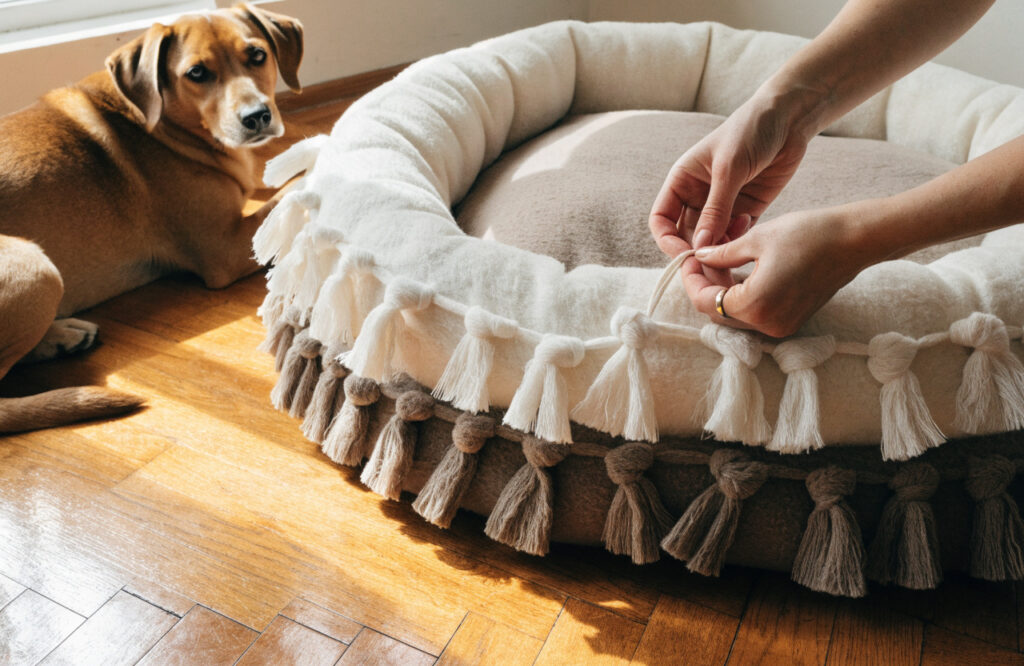
This is the right project when you have no machine, a small dog, and a short timeline. It is a poor project for a determined chewer or a 70-pound sprawler.
Cut two matching pieces of fleece to the finished size. Fleece is more forgiving than thin cotton, which tears at the knots. Stack the pieces, soft sides out. Cut a small square from each corner so the edge strips do not bunch. Cut matching strips around the perimeter, about 1 to 1.5 inches wide and 3 to 4 inches long, through both layers at once. Strips much wider than 1.5 inches make the knots bulky and hard to tighten. Double-knot each pair as you go. Leave one side open, stuff to a firm but not lumpy fill, then knot the opening shut.
Old pillows work as fill for a light dog. They do not replace a foam slab for a heavy one. Overstuffing makes the bed round and unstable. Expect the fleece to pill, and expect the knots to be the first thing a puppy tests.
Raised beds when the floor is the problem
A cot is a frame with mesh or canvas stretched across it, not a cushion. It helps when the dog runs hot, the room is humid, or the patio stays damp. It does not support sore joints the way dense foam does.
PVC pipe and three-way furniture fittings are the common low-cost frame. Standard plumbing elbows from a home center often do not give the flat corner a cot needs, so plans usually specify furniture-grade fittings. Mesh should be outdoor or marine grade, pulled tight, and screwed through washers so it does not tear out at the corners. Size the sleeping surface with the same nose-to-tail rule; the frame can be slightly larger.
A wood box frame is the other raised option: a simple rectangle of boards, sanded, joined with glue and screws, finished, and fitted with a lift-out cushion. Pocket-hole joints have to be aligned or the frame rocks. Any stain or paint needs to cure fully before a dog lies on it. Felt pads on the feet protect floors. For outdoor use, elevate the frame and use a waterproof cushion cover.
Materials that survive washing and chewing
The cover is what you will replace, so make that easy.
- Fleece is soft and easy to knot. It pills and is not chew-proof.
- Canvas, denim, or outdoor furniture fabric holds up to washing and nails better than quilting cotton.
- Cordura or ballistic nylon is the practical choice if the dog digs at edges. Soft minky and faux fur look better and snag, shed, and tear.
- A waterproof liner belongs between foam and outer cover, not as the only surface the dog lies on. Bare vinyl is cold and noisy.
- Loose polyfill is the wrong fill for a dog that unstuffs toys. Solid foam leaves nothing to pull out.
People who sew replacement covers for existing beds repeatedly land on the same pattern: a water-resistant inner cover that stays put, and a zippered outer cover in upholstery or outdoor fabric. Zipper on the long side, extended past the corner, is the detail that makes the cover go back on alone.
Failures that show up in the first month
Measuring a sitting dog produces a bed the dog cannot stretch on. They end up half on the floor and the project looks rejected.
Washing the whole pad, foam included, shifts fill and rips seams. Store-bought “machine washable” beds often do this on the first cycle. The fix is a sacrificial cover, not a tougher seam.
A tall bolstered bed in front of an older dog reads as an obstacle. Flat and firm beats plush and walled.
Memory foam in a warm room or under a double coat is a heat problem, not a training problem. Offer a breathable cot or a firmer open foam before assuming the dog is being difficult.
No spare cover means the bed is out of service every laundry day. Two outer covers cost less than a second foam slab.
Chewing through the bed is often boredom or anxiety, not a fabric failure. A tougher cover helps; it does not replace exercise, a crate routine, or a vet conversation if the destruction is new.
What the project usually costs
A no-sew fleece bed is often the price of two pieces of fleece and stuffing you already own, commonly in the $10–25 range if you buy both. A foam-and-cover bed scales with size: a mattress-topper core and two covers can land well under a premium retail orthopedic bed, while a custom high-density slab for a giant breed can cost as much as a good store bed and then last longer because you only replace the cover. Supplier comparisons put cheap fiberfill beds at a few months of life and denser custom foam at several years, which is why the washable cover is the part that changes the math. Those ranges move with foam prices and dog size. The expensive mistake is rebuilding the core because the first cover could not be removed.
Questions that come up after the first build
Can old clothes or pillows be the whole bed? Yes for a small, light dog in a tied fleece cover. No as the support layer for a heavy or sore dog. Pillows compress and clothes clump. Use them as emergency fill, not as the orthopedic core.
Does the bed have to be orthopedic foam? Only if the dog is heavy, older, or already avoiding hard floors. A thin crate mat is enough for a puppy that is still having accidents, because you will be wiping or swapping it constantly. Upgrade thickness when the joints need it.
How do I keep urine out of the foam? An inner waterproof cover that stays on the slab, plus an outer cover you wash. A shower-curtain liner duct-taped around foam is an ugly but functional puppy stopgap. Replace it once housetraining sticks. Do not rely on the outer fabric alone.
Why won’t the dog use it? Check size first, then height of the entry, then temperature. A bed that is too small, too hot, or too hard to climb into gets abandoned for the tile. Put the bed where the dog already sleeps, not across the room as a test.
Is a DIY crate pad different from a regular bed? Same foam logic, stricter dimensions. It must lie flat without folding up the walls, stay low enough for standing, and come out in one piece for cleaning. A waterproof inner layer matters more here than in an open-floor bed.