
A camper dog bed has to fit a measured floor spot and survive hard vinyl, not just match a weight range on the label. The RSPCA says a bed should let a dog lie in natural positions, including stretched out, not only curled up, but in a camper that stretch is limited by the aisle, the dinette, or the gap under a bunk. Foam that feels fine at home also traps condensation against a cold floor, and a bed that slides while you drive becomes a trip hazard. The useful bed is the one that stays dry, stays put, and still leaves a walkway.
Measure the sleeping spot before the dog
Weight ratings tell you whether a frame will hold. They do not tell you whether the dog can lie down. On the RSPCA’s dog bed guidance, the bed should be large enough for the positions the dog actually uses: stretched on the side, curled, on the back. A bed that only works when the dog is balled up will get ignored, or the dog will abandon it for your mattress.
In a camper, measure the floor first. Tape the outline of the aisle beside the galley, the clear space in front of a slide, or the open rectangle under a fixed bed. Then measure the dog from nose to tail base while lying stretched, and again as a curl. If the stretched length plus a few inches does not fit the taped outline, that spot cannot be the stretch bed. Use it for a curl pad and give the dog a second place, even a folded blanket on the dinette, for sprawling.
Two dogs need two beds if they do not reliably share. The same RSPCA page recommends at least one bed per dog, plus a larger shared bed only if they choose to sleep together. A single oversized cot in a narrow aisle often blocks the door and still leaves one dog on the floor.
Older or bony dogs need the extra depth in whatever footprint you can spare. Joint support matters more than a thick bolster, which eats width you do not have. A low mattress-style pad usually fits under a dinette or beside a slide better than a bolstered sofa bed.
Match the bed to where the dog actually sleeps
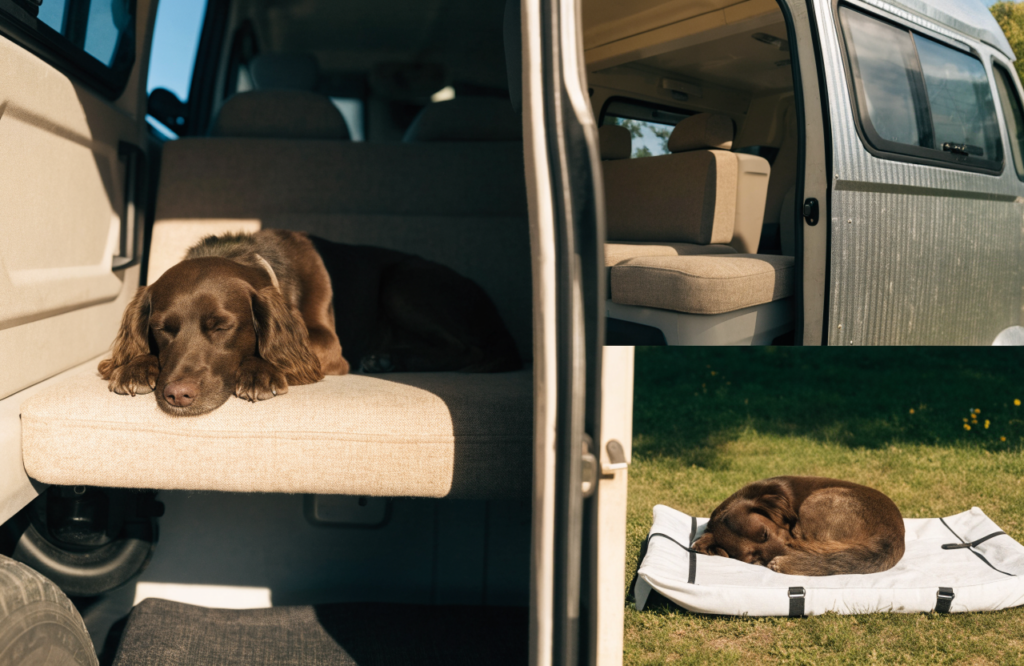
Most “camping dog bed” lists assume a tent floor or a truck bed. A camper has three different surfaces, and one product rarely covers all of them.
Inside, on hard floors
Vinyl, laminate, and linoleum are slick, cold, and close to the outside temperature. A home memory-foam bed with a fabric bottom will slide, hold damp, and smell within a few trips. Look for a waterproof or water-resistant base with a tacky backing, a cover you can remove, and a packed size that fits a cabinet or the space behind a seat.
The Ruffwear Dirtbag is built for this kind of mess. It measures 34 by 28 by 3 inches, uses a recycled polyester air-mesh top, a drainable Qshion cushion, and a 300-denier base with a tacky TPE backing. Ruffwear’s care note is specific: hose it, store it upright to drain, and do not fold it. Retail listings put the weight at about 3.8 pounds. That is a campsite and awning bed more than a stuff-sack pad, and the “do not fold” instruction matters in a camper where people want everything to collapse flat.
The Kurgo Loft Wander is the other end of the same problem. Kurgo lists a medium at 27 by 36 by 2 inches that rolls to 12.5 by 8 inches, and a large at 36 by 48 by 3 inches that rolls to 17 by 9.5 inches. The top is water-resistant ripstop with poly fill; the bottom is a waterproof Rufftex layer with a nonslip finish. Kurgo also names RVs and campsites as intended surfaces. It machine-washes on gentle and should be hung to dry. At the manufacturer’s listed price of $54.36, it is the practical inside pad for dogs that sleep on the floor and travel in the same bed. The large is long enough for many labs; the medium is not.
Outside, under the awning or at the site
Dew comes up through fabric overnight even when the sky is clear. A pad with a coated base keeps that moisture out. An elevated cot does the same job by leaving an air gap, and it also keeps ants and damp grass off the dog.
Cots fail indoors. An 8-inch frame in a 26-foot trailer blocks the path to the bathroom and can tip if a dog jumps on from the side while the rig is level but the site is not. Keep the cot for the awning, the screen room, or the picnic table area. Bring the flat pad inside at night unless the dog is crated outdoors, which many campgrounds restrict.
On the dinette, or on your bed
Some owners convert the dinette and give that platform to the dogs. A dinette mattress is already a patchwork of cushions that slide on one another. Adding a dog bed on top only works if the whole stack is held together, with nonslip matting between cushion and table and a cover the dog cannot bunch into a corner. Two 60-pound dogs on a converted dinette is a common full-time workaround when the main bed is a queen and sharing it means nobody sleeps. It is also a setup you have to undo at breakfast.
Sharing your mattress is the default in small vans. It saves floor space and skips a second bed, and it fails when the dog is wet, sheds heavily, or guards the pillow. A washable pad at the foot still gives the dog a target so the whole mattress is not the bed.
Why the underside goes damp
Cold floor plus a warm dog is a condensation problem, not a leak. On RV and van forums, owners describe the same pattern: the top of a foam bed feels dry, the underside is wet by morning, and the smell shows up after the bed is stored in a closed compartment. A Good Sam pet-owner thread on vinyl floors and large dogs puts it plainly: a furry memory-foam pad draws moisture when the floor is cold. Boat and van dwellers see the same film under human mattresses.
Closed-cell foam and memory foam both trap that moisture if they sit flush on a solid platform. The fix is an air gap, not a thicker cover. Options that owners use include interlocking foam tiles under the bed, a breathable mesh layer, or simply standing the pad on edge after each trip so both faces dry. A waterproof shell stops spills and muddy paws. It does not stop condensation forming between the shell and the floor.
Never store a damp bed in a stuff sack in an exterior compartment. Mildew in the foam is hard to remove and often means the fill is done. If the cover is washable and the foam is not, treat a sour smell in the fill as a replacement signal.
Keep the bed from sliding while you drive
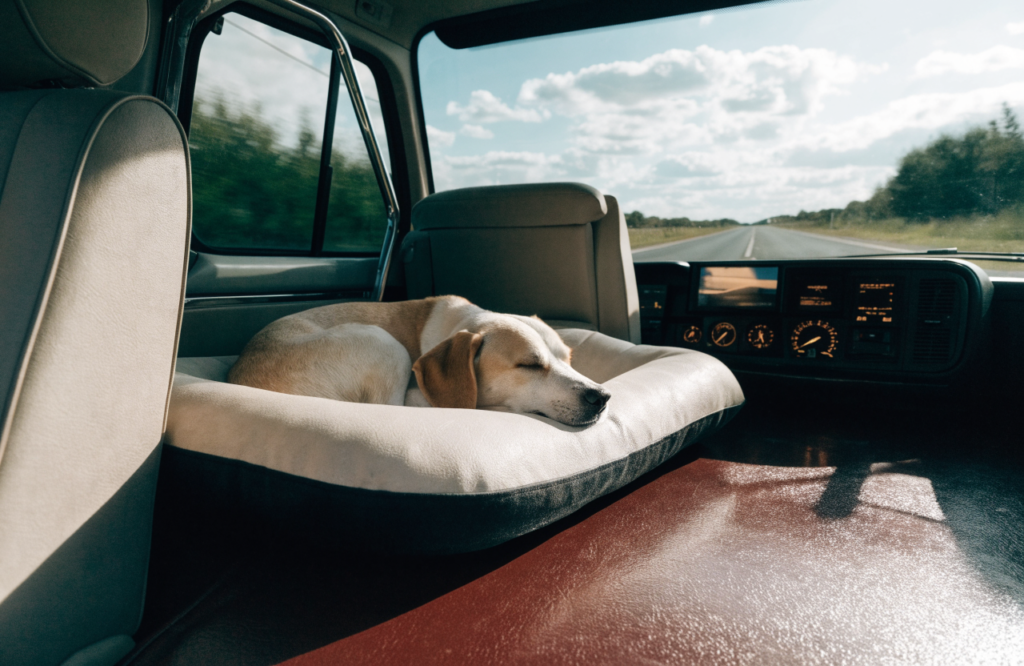
A nonslip bottom is tested on a campsite, not on a braking event. On vinyl, a light pad still migrates unless the grip is continuous, not a few rubber dots. During travel, the better setup is a bed that lives on the floor behind a seat or inside a soft crate, not loose in the aisle. Open water bowls in a moving camper slide with the bed; stop for water instead.
If the dog already likes a bed that slides, a gripper mat under it is usually enough. Choose a pad that is safe on vinyl. Some PVC rug pads can discolor luxury vinyl over time, especially in sun or over heated floors. An open-grid mat also lets air move, which helps the condensation problem above. Velcro between a dinette cushion and the platform is the version of the same fix that RV owners already use for human bedding.
Do not count on the bed as restraint. A nonslip base is not a car harness, and a cot frame is not a crate.
Cleaning when the laundry is a coin machine
Camper cleaning is the constraint product pages skip. You may have a campground washer, a bucket, or nothing until the next town.
Hose-off beds win on muddy trips. The Dirtbag is designed to rinse and stand upright; folding it wet works against the drain ports. Roll-up beds with a removable or fully washable cover, like the Kurgo, fit a gentle machine cycle, then need hanging space. A wet pad draped over a dinette bench will drip onto the floor and restart the moisture cycle.
Elevated cots with mesh usually wipe or rinse and dry fastest, which is why they suit awning use after a swim. Foam pads need a full dry before they go back into a cabinet. If you only have an hour between sites, a mesh cot or a thin coated pad will be ready. A 3-inch foam bed will not.
Hair is the other camper problem. Air mesh and smooth ripstop release hair better than sherpa. Sherpa feels cozier on a cold night and turns into a felt mat by the third trip unless you can vacuum it outside.
When an elevated cot is the better bed
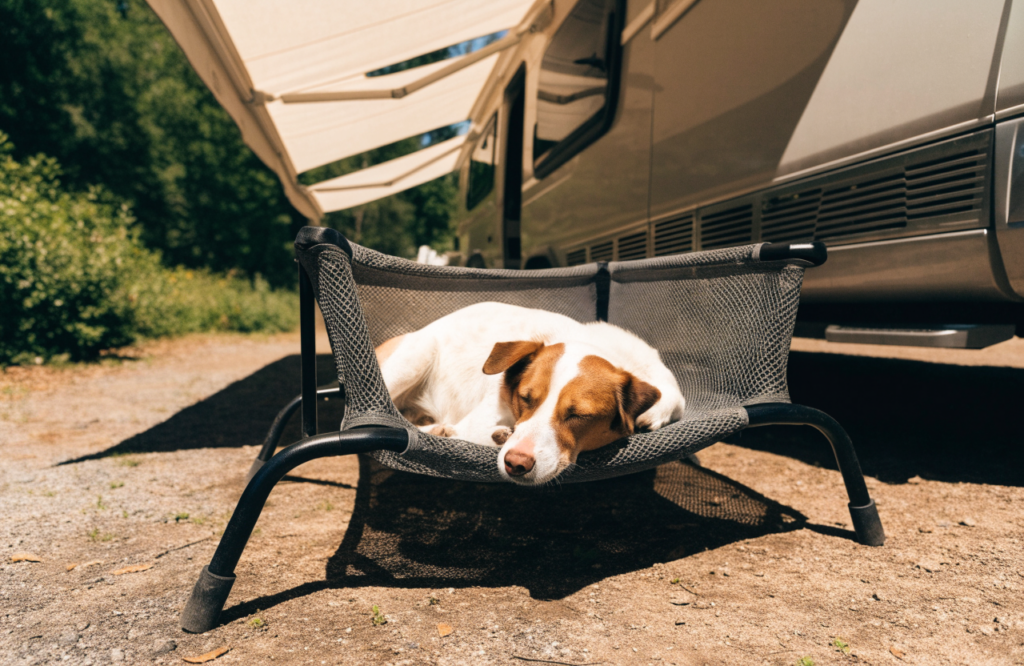
Choose a cot when the dog sleeps outside the rig, the site is hot, or the ground is wet. Air under the fabric is the cooling method. It is also the reason cots feel cooler than a dog expects on a 40-degree morning, so they are a poor only-bed in shoulder season unless you add a pad on top.
The Helinox Elevated Dog Cot shows the size trade in real numbers. The medium assembles to 36 by 24 by 8 inches, packs to about 25 by 5.5 by 5.5 inches, weighs roughly 3.2 pounds assembled and 3.5 pounds packed, and is rated to 132 pounds. The large on the same spec sheet is rated to 154 pounds. That packed length still has to fit a closet or under a bench. Cheaper steel-frame cots often hold similar weight and cost less, and they pack worse. A 20-pound folding cot is a site bed you leave set up, not something you stow every morning.
Skip a cot inside a small trailer. The height that keeps a dog off dew also catches a shin at night, and the frame can mark vinyl if the feet are not covered. A flat pad with a grip bottom does the indoor job with less clearance.
Which setup fits your rig
Use the floor outline you taped, not the product photo. If the only reliable indoor spot is under 30 inches wide, buy the medium roll-up or a custom-cut closed-cell layer and let the dog sprawl on the dinette when you are parked. If the aisle is wide and the dog sleeps inside, a waterproof-base pad in the 34- to 48-inch range is the default, with a gripper mat if the backing still creeps. If most of the rest happens under the awning, spend the bulk and the height on a cot and keep a thin coated pad for rain days inside.
Replace the bed when the fill smells after a full dry, the nonslip backing has worn smooth, or the dog has started sleeping in the aisle instead. A second cheap blanket is not a fix for a damp foam core.
FAQ
Can I use my dog’s regular bed in the camper?
Only if the cover comes off, the bottom grips vinyl, and you can dry the fill completely. Plush home beds soak spills, hold campground dirt, and go musty against a cold floor. A washable travel pad is the better daily bed; bring the home bed only for a short, dry trip if it already fits the spot.
How big should a camper dog bed be?
Large enough for the dog’s usual sleep position, and no larger than the clear floor you measured. A sprawler needs nose-to-tail length plus a small margin. A curler can use less. If those two numbers disagree with the aisle, give the dog two places instead of one oversized bed that blocks the door.
Do camper dog beds need to be waterproof?
The base should be waterproof or fully coated if the bed touches dew, a tent floor, or a cold camper floor. The top can be water-resistant and still breathe. A fully sealed top stays drier after mud and sleeps hotter. In summer, mesh or air-mesh on top is the more comfortable surface.
Is a folding cot safe while the camper is moving?
No. Cots are for parked use outside. On the road, use a flat pad on the floor, a secured seat cover, or a crate. A frame that tips at a campsite will tip harder in a turn.