

A bed sold as large often measures about 36 to 44 inches, which is short for a sprawling Labrador and far short of a Great Dane, and the open strip beside a queen bed is frequently narrower than that. The setups that last borrow dead floor—the corner on your side of the bed, or the foot only if the door still swings—and match the shape to how the dog already lies. A styled platform in the middle of the room looks deliberate until someone trips over it at night.
Measure the dog, then the gap beside the bed
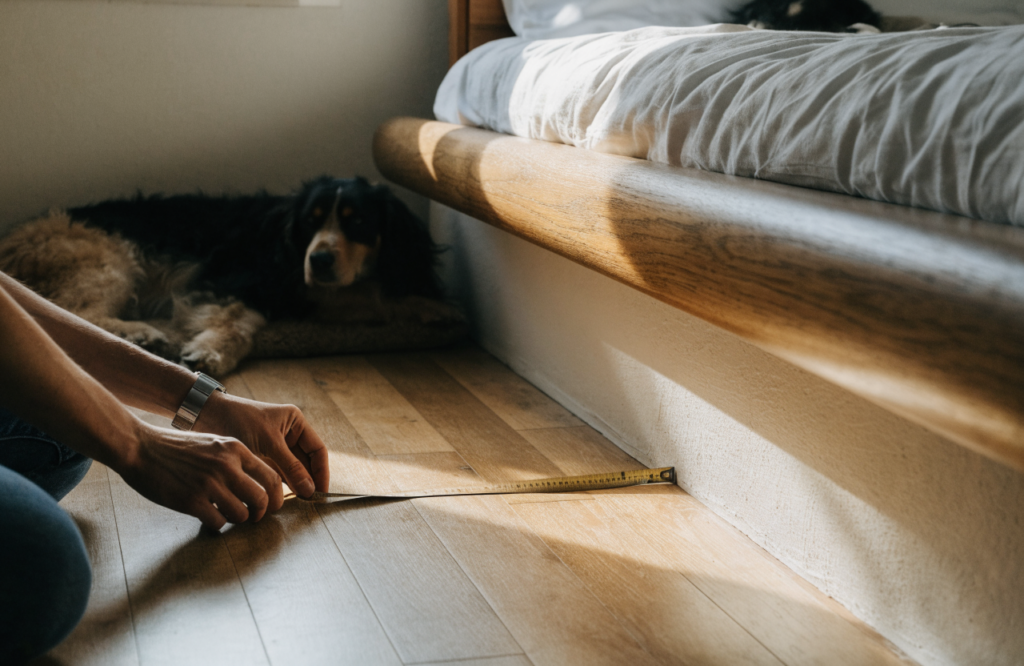
Size labels are not a standard. One brand’s large is another brand’s medium, so inches matter more than the word on the listing. Measure the dog from the tip of the nose to the base of the tail while stretched out, not while curled, and add 6 inches for a dog that sleeps in a ball or 10 to 12 inches for a dog that flings its legs. Then measure shoulder to shoulder, or back to front paw while lying on the side, and add several inches of width. That number is the sleeping surface, not the outside of a bolster.
Weight bands are only a starting point. Guides aimed at large-breed beds commonly put 50 to 75 pounds in a roughly 36-by-44-inch range, 75 to 100 pounds closer to 42 to 54 inches, and dogs over 100 pounds at 48 to 60 inches or more. A lean 70-pound dog and a barrel-chested 70-pound dog do not need the same width. If the dog’s legs hang off every night, the bed is too small. A bed that is vastly larger than the dog can also get ignored, especially by anxious dogs that want a wall to lean on, so size up one step rather than two.
Then measure the room. A useful walkway past the bed is about 24 inches. Subtract nightstands, the door swing, and the path from the bed to the bathroom. What is left is the maximum footprint, and it is often smaller than the “ideal” bed. A 48-inch mat will not fit in a 30-inch gap no matter how orthopedic the foam is. In that case the idea changes: a narrower bed turned lengthwise along the wall, a lower-profile mat that can slide partly under the bed frame by day, or a spot at the foot only if the door clears it.
Bolsters shrink the usable area. A listing of 42 by 36 inches can hide a sleep surface closer to 36 by 30 once the raised sides are counted. If you want bolsters, read the interior dimensions and size up.
Match the shape to how the dog already sleeps
Watch the dog for a few nights before buying. Large dogs often use more than one position, but one usually dominates.
Sprawlers need a flat rectangle. Raised edges waste the inches they use for legs. A thick mat or a low platform with a single cushion is the bedroom version of this: it reads as furniture if the cover matches the duvet, and it does not steal headroom the way a high sofa bed does.
Chin-resters and leaners want an edge. A three-sided bolster, or a bed pushed into a real corner so the wall becomes the fourth side, gives them something to brace against. The front should stay open and low. A fully enclosed donut looks cozy in photos and is usually too small, and too warm, for a 70-pound dog.
Hot sleepers do better off the floor. An elevated cot moves air underneath and can be hosed off, which helps in a bedroom that already holds human bedding, dog hair, and summer heat. The catch is entry. Cots in large-dog tests often sit around 7 inches high and are a poor idea for short-legged or arthritic dogs that have to hop up and down through the night.
Seniors need the opposite of a styled daybed. A low front edge, a nonskid bottom, and foam thick enough that hips do not bottom out matter more than a headboard. Jumping onto an 18-inch window bench every night is a joint problem, not a design win. If you want the bench look, the cushion has to be long enough for the stretch, and the step-up should be low enough that the dog does not hesitate.
Two large dogs rarely share well once both are sprawled. Owners of horse-sized pairs often find a 40-by-48-inch bed becomes a fight for the middle. Separate beds, even if one is a simple mat, usually work better than one double-wide that still is not wide enough. If they insist on touching, put the two beds edge to edge so you can wash one cover without hauling a 60-inch slab.
Bedroom setups that use dead floor
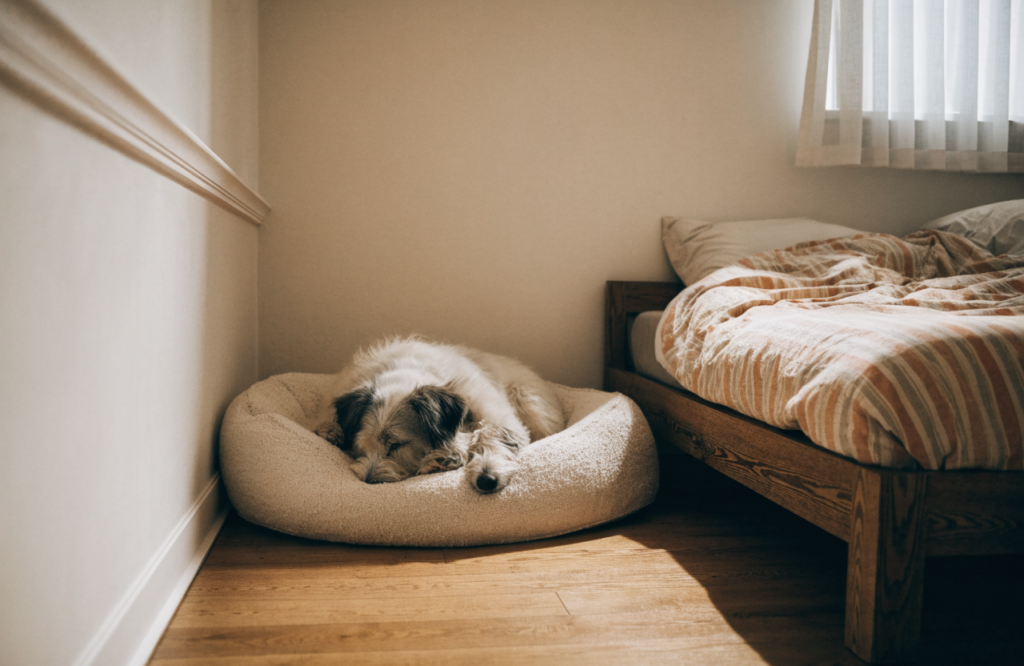
These are ideas with a condition attached. Skip any that fail the walkway test.
Corner nest on your side of the bed. This is the default that works in most rooms. The bed sits against two walls, or against the bed frame and one wall, near the person the dog already follows. Vets quoted by Good Housekeeping describe the same pattern: a corner where the household actually spends time, with an easy way in and out, not a spot that traps the dog. The American Kennel Club’s co-sleeping guidance makes a related point for large dogs that share the human bed: keep a floor bed nearby so they can get down without a fall, and do not start the on-bed habit unless the mattress has room for both of you.
Foot-of-bed mat, only if the door is clear. A flat mat across the foot uses floor that is often empty, and it keeps the dog in sight. It fails when the bedroom door swings into that zone, or when you have to step over the dog to reach the closet. If the mat is wider than the footboard, turn it so the long side runs along the wall instead.
Low platform that matches the bed frame. A simple wood or upholstered platform with a washable cushion looks intentional next to a low platform bed. Keep it one cushion, not a pile of pillows the dog will shove off. Put a low-pile washable rug under and slightly beyond the platform so nails have grip on hardwood. The platform should not add so much height that a stiff dog has to climb.
Crib or twin mattress, for dogs retail beds do not fit. A standard crib mattress is about 28 by 52 inches, and a twin is about 38 or 39 by 75, according to standard mattress charts such as Home Depot’s. The crib length covers many large dogs; the width does not, once they roll onto a side. A twin is the workaround owners of Irish wolfhounds, tall shepherds, and 120-pound Dobermans keep describing when a “giant” pet bed still comes up short. It is a size hack, not a pet product. A used mattress can already hold moisture, and a bare one will smell. Use a waterproof liner under a washable cover, and a nonslip pad so it does not migrate on wood floors. Skip this if you cannot wash the cover or if the twin blocks the only path around the bed.
Window spot, with a height limit. A wide window seat can be bed, perch, and storage if the cushion is the full stretched length and the dog can step onto it. It is a bad idea for a senior who already pauses before jumping onto the couch. Direct afternoon sun also overheats thick-coated dogs; a cot or a cooling mat in that corner is the better version of the same idea.
What the foam has to survive under a heavy dog
Footprint without support is a flat dog on a pancake. Reviewers testing large-dog beds keep landing on the same failure: thin or egg-crate foam feels plush in the listing photo and compresses under 60 to 100 pounds within months. A practical floor for large dogs is several inches of solid foam, closer to 5 inches from 50 pounds up and 6 to 7 inches once the dog is past 75 or 100 pounds. That depth only helps if the foam is dense enough not to bottom out. Brands that publish numbers often cite memory foam around 4 to 5 pounds per cubic foot over a firmer base, while buying guides tell shoppers to walk away if a support layer is under about 1.8 pounds per cubic foot. Those figures describe different layers, and many listings hide both. If the maker will not give density or a warranty against sagging, assume the foam is the cheap kind.
One of the few clinical data points is a University of Pennsylvania pilot, summarized in an August 2020 release from the bed’s maker. Forty large dogs with confirmed osteoarthritis slept on a 7-inch, three-layer foam mattress. At 28 days, owners reported less pain and stiffness and better gait and quality of life. Collar monitors showed that half the dogs had at least a 13 percent drop in nighttime activity, and a quarter had at least a 33 percent drop, which the investigators read as more restful sleep. It was open-label and single-arm: no separate control group, and the company publicized it. Treat it as evidence that a thick supportive surface can change how arthritic dogs sleep, not as proof that one brand is required.
CertiPUR-US, if you see it, only covers the foam’s chemical and emissions checklist, including limits on formaldehyde, certain VOCs, heavy metals, and phthalates. It does not test firmness, cover fabric, or how the bed holds up under a Mastiff. New foam can still smell for a few days. Air it outside the bedroom before the first night.
Price tracks this split. In a December 2025 Business Insider test, a bolstered Furhaven lounger for very large dogs was listed at $138.99, with a 5-inch center and ends rising higher, and it supported a 99-pound Bernese in their trial but lacked a nonskid bottom. A Bedsure orthopedic bed in the same roundup was $39.99, with a spacious extra-large surface and a nonskid base, and a cover that was awkward to wash because the bolsters did not come off. Premium 7-inch beds from makers such as Big Barker are commonly listed around $300 to $450 depending on size. The cheap bed is fine for a young, sound dog if you expect to replace it. It is a poor bet for a senior whose hips already complain.
Covers, traction, and the smell problem
Bedroom beds fail on laundry more often than on looks. Drool, sebum, and the occasional accident soak into foam if the only barrier is a cover. A waterproof inner liner, separate from the decorative cover, is the part that keeps you from throwing the whole bed out. Removable covers that actually fit back on after washing matter more than a linen color story. Darker covers hide the dirt a light bedroom palette will show in a week.
On hardwood or tile, a nonskid bottom is not optional. Testers flagged loungers that walked across the floor when a large dog circled. A low-pile rug under the bed adds grip and marks the dog’s zone so the bed does not visually float in the middle of the room. Skip a thick shag. Nails catch, and it is harder to wash.
If the dog sleeps on your bed part of the night, the floor bed still needs to be the easy option, not a punishment corner. A sheet or washable blanket on your own bed, as the AKC suggests for co-sleeping, keeps paw dirt off the duvet without replacing the dog’s own spot.
When the dog sleeps on the floor anyway
A ignored bed is usually a location problem or a shape problem. Good Housekeeping’s veterinary sources put it plainly: if the dog keeps lying beside the bed, move the bed to that patch of floor. Dogs also push a mat aside to lie on cool hardwood, then rest their head on the cushion. That is not always a failed purchase. A thin cooling mat where they already flop, plus the orthopedic bed for overnight, covers both habits.
Other fixes are simpler. A bed in the traffic lane between door and dresser never feels safe. A bolster the dog has to climb reads as work to a stiff animal. A brand-new foam smell can put them off for days. And some large dogs are floor dogs. Forcing a cave bed on a sprawler wastes the corner you needed for a mat.
Common questions
How big should a large dog’s bed be? Longer than the stretched nose-to-tail-base length, plus 6 to 12 inches, and wider than the dog lying on its side. Check interior inches on bolster beds. When two sizes both fit the gap beside your bed, take the larger one only if the walkway still clears.
Is a human mattress a reasonable dog bed? For giant dogs, a crib or twin mattress is often the only surface long enough that still fits a bedroom budget. Protect it with a liner and a washable cover, and do not block the path around your own bed. It will not have the nonskid base or the sag warranty of a purpose-built orthopedic bed.
Where should it go in the bedroom? Against a wall or in a corner on the side of the bed the dog already chooses, out of the door swing and out of the hallway. Easy in, easy out, and not so enclosed that the dog feels trapped.
Why buy two beds for two big dogs? Because a shared 40-by-48-inch bed is still one sleeping surface once both dogs stretch. Side-by-side mats let each dog brace against a wall and let you wash one cover at a time.
Does the foam need to be memory foam? It needs to be thick and dense enough not to flatten. Memory foam contours and can sleep hot. A firmer high-density base under a thinner comfort layer often holds up longer under dogs over 80 pounds. Either way, a liner beats a soft cover with no barrier.
Which idea fits the room you have
Use the corner by your side of the bed if the gap is under about 30 inches: a flat mat for a sprawler, a bolster only if the interior length still clears the dog. Use the foot of the bed only when the door swing misses it. Move to a lined twin mattress if the dog’s stretched length plus a foot of spare room is past what giant pet beds offer, and only if that twin leaves a path to the door. Skip the high window bench, the shared mega-bed, and the platform in the walkway. The right large dog bed in a bedroom is the one the dog can lie on fully and you can still walk past in the dark.