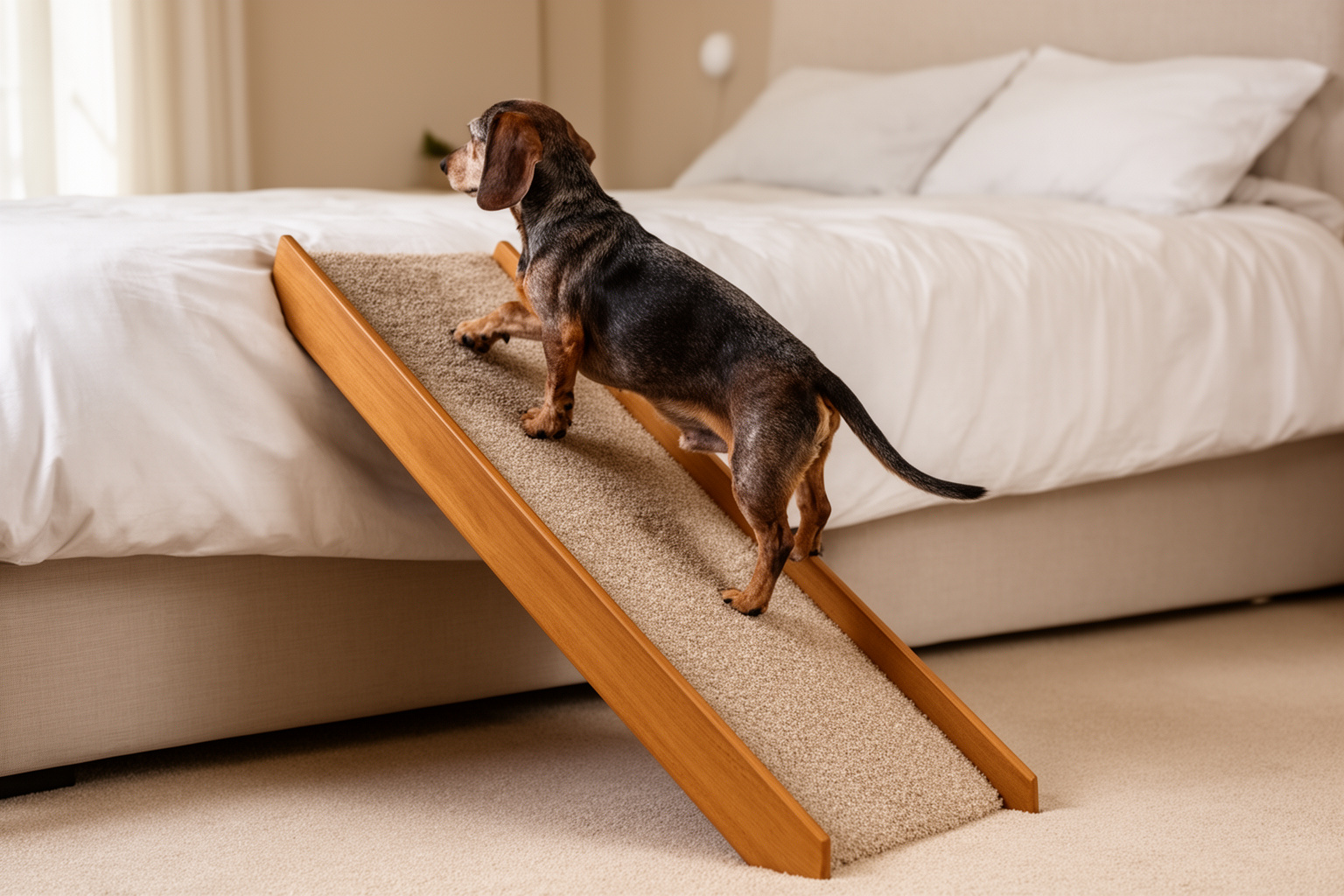

A dog ramp for bed only helps if the dog can walk it without scrambling. For most beds, that means a ramp long enough to keep the slope near 18 to 25 degrees, with a surface that does not slide under the paws and a top that meets the mattress instead of stopping short of it. A short ramp that technically reaches the mattress can still be too steep for a senior dog, a long-backed breed, or any dog that has already slipped once. The useful purchase is the one that matches your mattress height, the floor space beside the bed, and the way your dog moves — not the one that folds the smallest.
Why jumping off the bed is the problem a ramp is meant to fix
A ramp replaces a jump with a walk. That matters most on the way down. Landing from a bed loads the front end and compresses the spine in one impact. Climbing loads the hind end over several steps. A continuous slope spreads both.
This is the usual reason people look for a dog ramp for bed:
- An older dog hesitates, slips, or needs a boost onto the mattress.
- A long-backed or short-legged dog — dachshunds, French bulldogs, corgis, basset hounds, and similar builds — jumps on and off furniture several times a day. Owners and many veterinarians treat that repeated impact as a preventable stress on the back, which is why ramps are commonly preferred to stairs for dogs with intervertebral disc disease (IVDD) risk or a history of back pain.
- A dog is recovering from orthopedic or spinal surgery and has been told to stop jumping.
- A small dog can get up, but the drop down is the part that looks unsafe.
A ramp does not fix pain that is already there. If your dog is suddenly unwilling to jump, crying when lifted, or dragging a foot, that is a veterinary question first. The ramp is the home change that follows.
Measure the bed before you look at products
Measure from the floor to the top of the mattress with the bedding on it. A comforter, topper, or piled duvet can add two to four inches. That extra height is what the dog actually has to clear.
Also note three things the product listing will not know:
- The edge the ramp will meet. A platform bed with an overhanging frame leaves a gap between the ramp and the sleeping surface. A footboard can block the side of the bed entirely, so the ramp has to go at the foot or along an open side.
- The clear floor. A gentle slope for a typical bed needs several feet of open floor. Nightstands, dressers, and the path to the door often decide the ramp more than the dog’s weight does.
- The floor surface. Hardwood and tile let a light ramp creep forward when the dog pushes off. Carpet grips better, but a thick pile can make narrow feet on a foam step feel unstable.
Write down the height, the clear floor length, and the dog’s current weight. Those three numbers eliminate most of the wrong options.
The slope is what makes a bed ramp usable
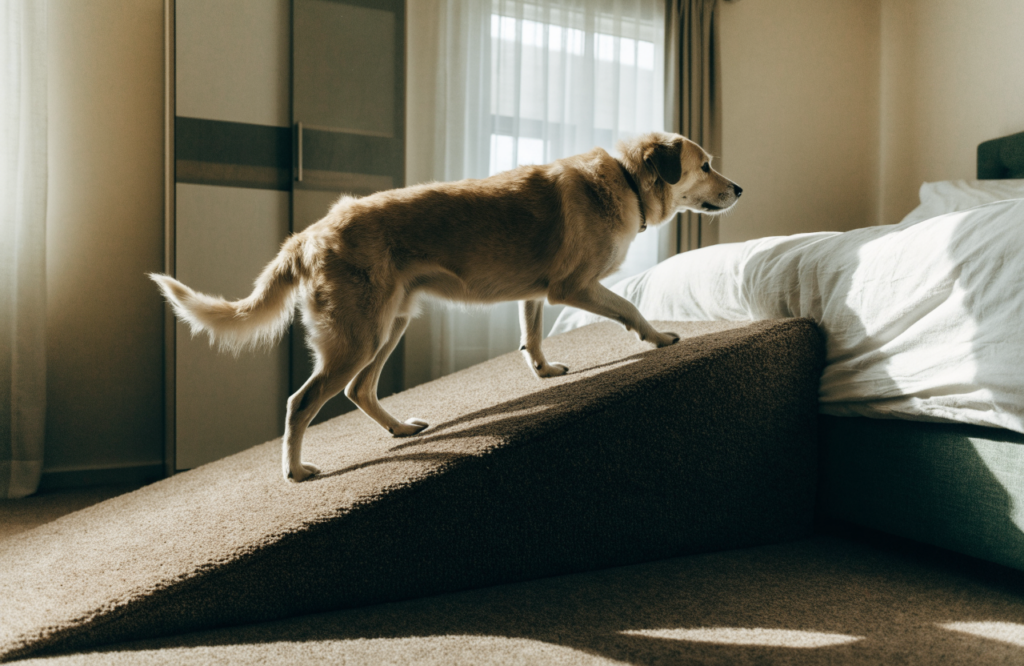
Guides aimed at senior and joint-sensitive dogs commonly aim for about 18 to 25 degrees, with the lower end for weak, painful, or reluctant dogs. Steeper than the mid-20s, many dogs scramble, refuse, or rush the descent. A short ramp that “fits” a tall bed is often the product that ends up in a closet.
The angle comes from simple geometry. If the walking surface is the slope itself, the length you need is the bed height divided by the sine of the angle. At 20 degrees that works out to roughly 3 inches of ramp for every inch of bed height. At 18 degrees, closer to 3.2 inches. At 25 degrees, about 2.4 inches.
| Mattress height with bedding | Length for about 18° | Length for about 20° | Length for about 25° |
|---|---|---|---|
| 18 in (low platform) | 58 in | 53 in | 43 in |
| 22 in | 71 in | 64 in | 52 in |
| 24 in | 78 in | 70 in | 57 in |
| 28 in (common bed) | 91 in | 82 in | 66 in |
| 32 in (tall frame or pillow-top) | 104 in | 94 in | 76 in |
These are walking-surface lengths, not the box length. A 48-inch ramp against a 24-inch mattress is about 30 degrees. That is fine for a confident young dog on a low sofa. It is a poor match for a stiff 28-inch bed.
Floor space is a little shorter than the ramp length, because the ramp is the diagonal, but not by much. A 70-inch ramp at 20 degrees still needs roughly five and a half feet of clear floor, plus room for the dog to line up at the bottom. If that space is not there, a gentler ramp will not fit, no matter how good the reviews are. The honest options are a lower bed, a ramp along the foot of the bed if that side is open, or accepting a steeper slope only for a dog that is still strong and willing.
Ramp or stairs, and when each one fails
Stairs take less floor. A four- or five-step foam or wood stair often fits where a true 20-degree ramp will not. That is their real advantage.
They are a worse match when the goal is to remove impact. Each step is still a small jump, and coming down means repeated flexion of sore joints. Dogs with spinal risk, hind-end weakness, or a habit of launching off the last step do better on a continuous slope. Some small, confident dogs prefer stairs because the tread matches a short stride, and a very long ramp can feel exposed. If that dog is also a high-risk back breed, the preference is not the same thing as the safer surface.
Foam stairs fail in a specific way: they compress. A heavy dog, or a nervous one, feels the step sink and either freezes or hops off the side. Rigid wood or a well-supported plastic ramp does not do that. Foam can still be reasonable for a light dog on a low bed, if the top step sits close to the mattress and the dog does not sink past the point of feeling steady.
Width, grip, rails, and the weight number on the box
Length gets the angle right. These four decide whether the dog trusts it.
Width. The deck should be a few inches wider than the dog at the shoulders and hips, with room for a paw to miss the center line. About 12 to 16 inches is enough for many small and medium dogs. A broad-chested dog, or two dogs using the same ramp, needs something closer to 18 inches. Narrow decks are a common reason a dog walks up once and then jumps from the side.
Traction. Carpet, ridged rubber, and rubberized tread all work. Smooth wood, bare plastic, and thin carpet that packs down do not, especially on the way down or if nails are long. One slip is often enough to make a dog avoid the ramp. Rubber or silicone pads under the feet matter as much as the top surface, because a ramp that shifts feels worse than a steep one.
Side rails. Raised edges of a couple of inches help a wobbly, blind, or newly trained dog stay centered. Full rails are useful for IVDD-prone dogs that might step off halfway. They can also snag a harness or make a wide dog feel cramped. Rails on both sides are the safer default for seniors; a single rail is sometimes enough for a confident small dog if the ramp sits against the bed.
Weight rating. Use a limit comfortably above the dog’s weight, not equal to it. Dogs stop, turn, and push off. A rating 25 to 50 percent above body weight is a practical margin. A 70-pound dog on a 75-pound foam stair is at the edge of what the product was built for. Large-dog ramps are commonly rated around 150 to 200 pounds or more; folding travel ramps are often lower and less stable on a bedroom floor.
Which style fits a bedroom
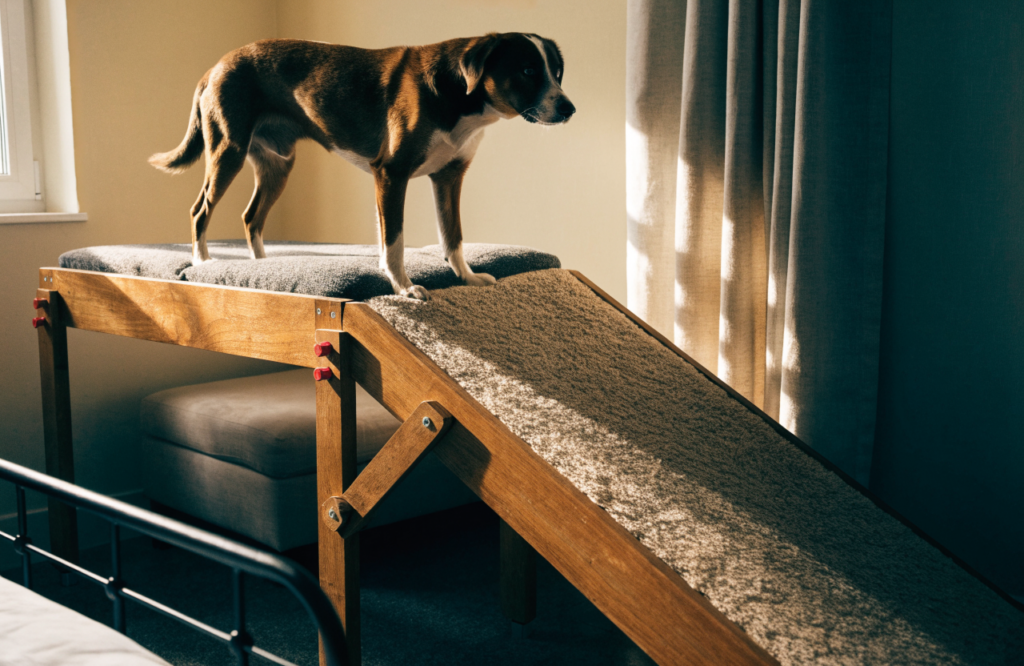
Adjustable wood ramps are the usual indoor answer for a real bed. A long walking surface, several height stops, and a rigid frame keep the angle predictable. Better versions reach the mid-30s in height and include a small top platform so the dog is not stepping off a sharp edge. They are heavy, which is a virtue on slick floors, and they cost more. A 60- to 70-inch wood ramp is a realistic starting point for a bed in the mid-20s, if you can spare the floor.
Folding plastic or metal ramps are built for cars and storage. They work indoors if the length is honestly long enough and the lock does not flex. Short bi-fold ramps are the most common mismatch for beds: they reach the mattress only at a steep setting. If you need the same ramp for the car, buy for the taller of the two heights and accept the bedroom footprint.
Foam steps and ramp-stair hybrids suit low beds, small dogs, and rooms with no space for a long slope. Treat them as stairs, not as a gentle ramp, unless the product is genuinely long. Check that the top is close enough to the mattress that the dog is not jumping the last hand’s width.
Ignore “fits most beds” unless the listing gives a height range and a walking length. Those two numbers are the product.
Set the top so the last step is not a jump
Place the ramp so the top meets the mattress edge, or sits within a small step the dog can walk, not leap. A gap of several inches, or a top that lands on the frame while the mattress sits higher and farther back, puts the impact back into the move you were trying to remove.
Practical setup checks:
- Lock every height pin or knob. A half-set adjustment is what creaks and scares a cautious dog.
- Put rubber feet or a non-slip pad under a light ramp. On hardwood, an anchor strap to the frame is worth using if the product includes one.
- Leave a straight approach at the bottom. A dog that has to turn sharply onto the ramp will step off the side.
- Watch the first few descents. Rushing, splayed hind legs, or a pause and a scramble means the angle is too steep, the surface is too slick, or both. The fix is a longer ramp or a lower bed, not more encouragement to “just try.”
If a footboard forces a gap, a small bridge board or a ramp with a flat top platform is safer than asking the dog to hop it.
Teaching the dog to use it
Start before the dog needs the ramp. A sore dog learning a new surface is slower, and a dog that has already fallen off a wobbly stair may refuse anything that looks similar.
A reliable sequence:
- Lay the ramp flat, or at its lowest stop, on a non-slip floor. Scatter treats on it and let the dog investigate. Reward sniffing and one paw. Keep sessions to a minute or two.
- Lure a full walk across the flat ramp. Reward at the far end, not for hovering in the middle.
- Raise the angle a little at a time. If the ramp adjusts, use the lowest setting before the bed setting. Descending is usually the harder direction, so practice down as often as up.
- Move it to the bed only after the dog walks the lower angle without freezing. Sit on the bed, reward the arrival, and call the dog back down before they jump off the open side.
- For a while, block the jump paths. A ramp next to an easy leap will lose. Baby gates, a closed door, or simply lifting the dog down when they head for the edge are what make the ramp the default.
Do not drag a reluctant dog up by the collar. If they jump off the side, go back to a lower angle and a wider path, and consider rails. Some dogs need many short sessions; a few walk it the first evening. Both are normal.
When a lower bed is the better answer
A 30-inch mattress in a small room cannot have a 20-degree ramp. Forcing a 40-inch ramp into that height produces a slope many senior dogs will not walk down safely. Lowering the frame, switching to a platform, or putting the mattress on a lower foundation often removes more risk than any product in the corner.
Also skip the ramp, or use it only as a supplement, if:
- The dog is too painful to walk a slope. Carrying them, and treating the pain, comes first.
- The only available ramp slides, folds under the dog, or stops well short of the mattress.
- You cannot supervise a dog that still jumps the open side. The ramp does not help on the exits it does not cover.
FAQ
How long should a dog ramp for a bed be? About three inches of walking surface per inch of mattress height for a slope near 20 degrees. A 24-inch bed wants roughly 70 inches of ramp; a 28-inch bed wants closer to 80. Shorter can work for a strong dog. It is a weak choice for a senior or a dog with back risk.
Are stairs safer than a ramp? Stairs are more compact. A ramp is the lower-impact option, which is why it is usually preferred for arthritic dogs and IVDD-prone breeds. Stairs still beat an unassisted jump if a real ramp will not fit.
What weight limit should I buy? Above the dog’s weight, with room for pushing off and turning. Matching the label to the dog’s scale weight leaves no margin.
Do small dogs need side rails? They help if the dog is wobbly, new to the ramp, or likely to step off. A confident small dog on a wide, high-traction deck often manages without them. Rails matter more as the ramp gets longer and higher.
My dog uses the ramp up and jumps down. What now? That is the common failure. Practice the descent with treats from the bed, keep the angle shallow, and block the jump side until walking down is the easier option. A slick surface or a gap at the top will keep the jump in place no matter how many treats you use.