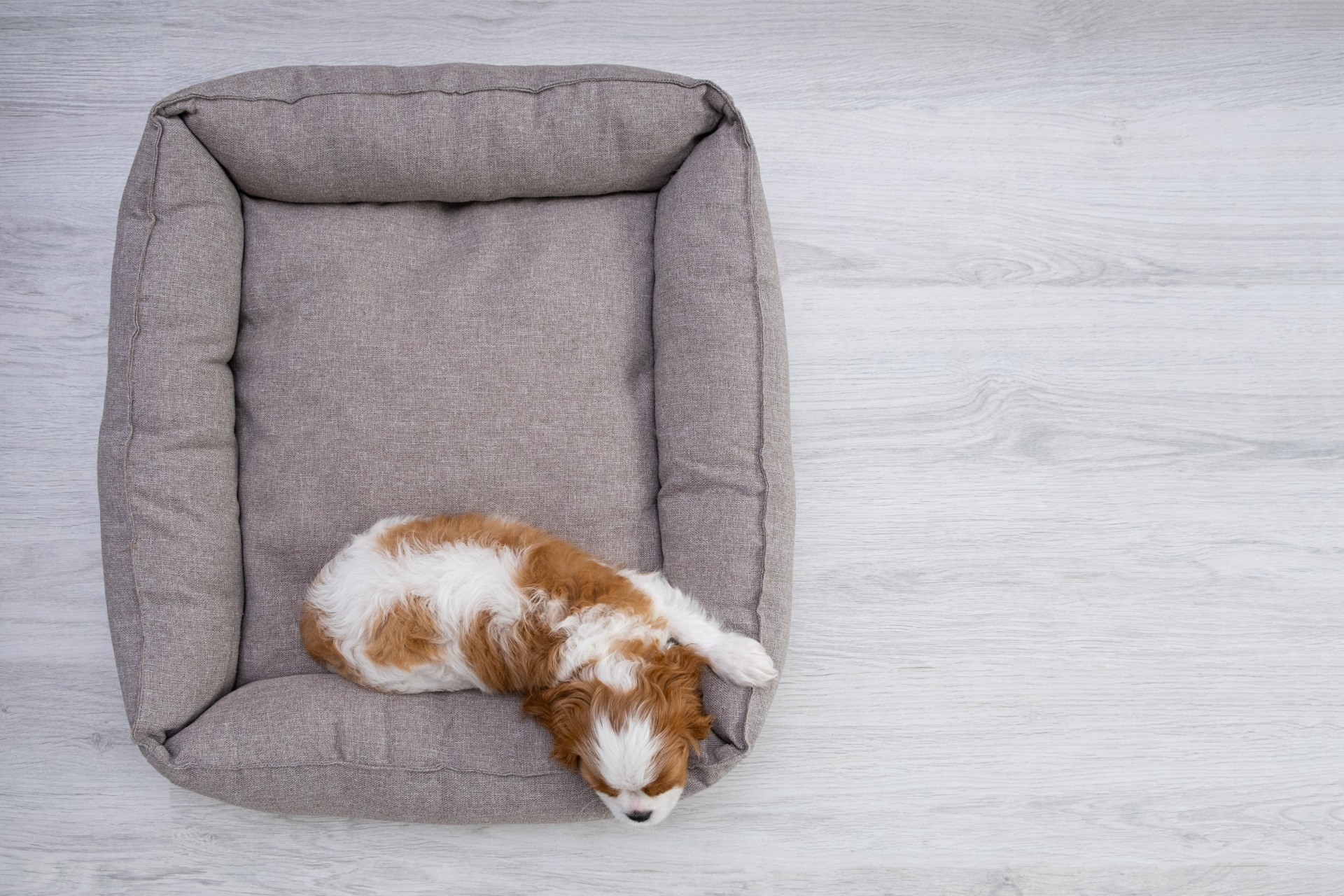
A DIY large dog bed only works if the sleeping surface is long enough for a full stretch and the fill or frame can carry the dog’s weight without collapsing to the floor. Store “XL” beds often miss one of those two things: the label is inconsistent, and cheap fiberfill flattens under a 70- to 150-pound dog within months. Measure the dog stretched out, then pick a build that matches weight, chew habits, and how often the cover has to be washed.
Measure the sleeping surface, not the standing dog

Wait until the dog is asleep in a fully stretched position. Measure from the tip of the nose to the base of the tail, then add 8 to 12 inches. That number is the minimum length of the usable sleeping area, not the outside of a wooden frame or the outer edge of a bolster. Width should clear the shoulders with a few inches to spare on each side so elbows are not hanging off.
Size up when the dog is still growing, sleeps sprawled rather than curled, or shares the bed. A bed that is only large enough for a tight curl forces the hips and elbows onto the edge, which is where support fails first.
| Dog | Typical weight | Practical sleeping area |
|---|---|---|
| Labrador, Golden, Boxer | 55–80 lb | about 42–48 in long by 30–36 in wide |
| German Shepherd, Rottweiler | 70–110 lb | about 48–54 in long by 32–40 in wide |
| Great Dane, Mastiff, Irish Wolfhound | 100–180+ lb | 54–60+ in long; width often 36–48 in |
Length matters more than width for sighthounds and Danes. A 40-by-30-inch bed sold as “large” is often only enough for a Lab if the dog stays curled. Giant-breed owners on forums regularly end up on human mattress toppers or twin-size foam because retail giant beds stop around 52 inches.
Match the build to weight, chew habit, and cleaning
Three builds cover most large-dog situations. The right one depends less on looks than on whether the dog needs joint support, airflow, or a surface that can survive claws.
| Build | Best for | Weak point |
|---|---|---|
| Solid-foam box cushion with a zip cover | Indoor sleep, seniors, joint support | Corners and zippers if the dog chews |
| Wooden platform with a separate cushion | Heavy dogs that jump or plop down; easy cushion swaps | Frame racking if joints are only glued |
| Raised PVC cot with a taut sling | Hot climates, outdoor use, dogs that overheat on foam | Not orthopedic; fabric can sag if it stretches |
A slatted wooden platform keeps the cushion off a cold floor and lets you replace the pad without rebuilding the frame.
A raised cot trades plush support for airflow. That trade is worth it for thick-coated dogs in warm rooms, and a poor choice for an arthritic senior who needs depth under the hips.
Foam that holds a heavy dog off the floor
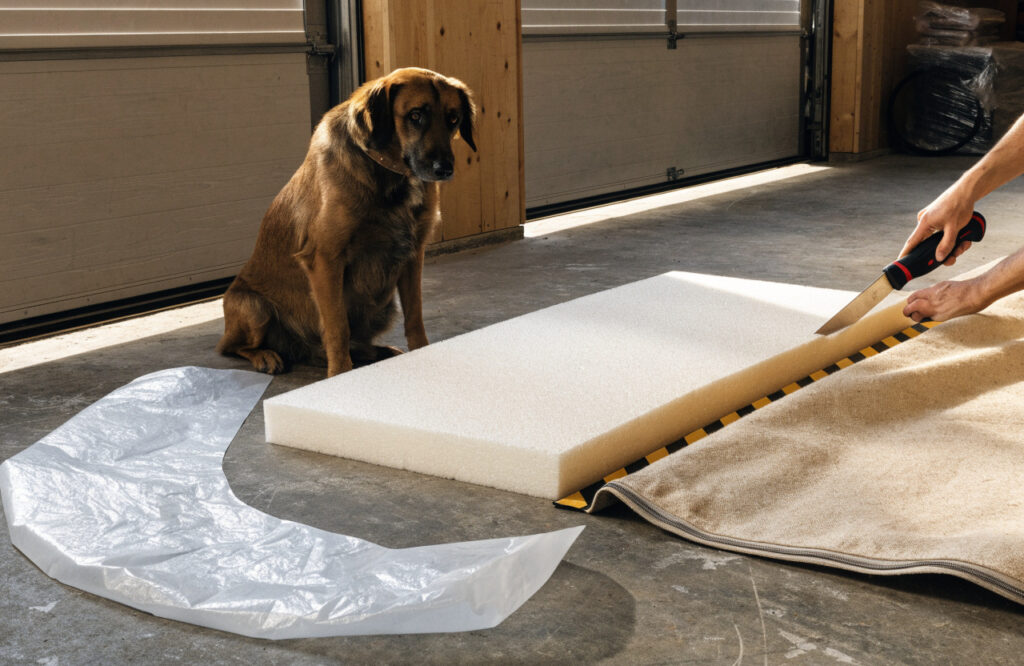
Polyester fiberfill and shredded foam look full in the bag and compress to almost nothing under a large dog. Egg-crate foam has less material in the same thickness, so it breaks down faster. What holds up is a solid slab: one piece, not loose fill.
Thickness and density work together. A thick piece of soft pillow foam still bottoms out. As a working range, dogs around 60 to 100 pounds need at least 4 to 5 inches of firm solid foam; dogs over 100 pounds are better on 5 to 7 inches. A firm high-density base with a thinner comfort layer on top is a common upholstery approach and is more stable than memory foam alone, which can feel hot under a double coat.
Buy the slab from an upholstery supplier and ask for firm furniture foam, not craft foam. Have them cut it to your sleeping-area size. A waterproof mattress encasement or a sewn PUL/vinyl liner between foam and cover saves the foam when there is an accident. Once foam is soaked, it rarely recovers.
Press the heel of your hand into the finished bed. If you feel the floor immediately and the dent stays, the fill is too soft for that dog.
Build a box cushion with a removable cover
This is the most useful indoor DIY large dog bed if you can sew a straight seam or are willing to have an upholstery shop sew the cover.
- Cut the foam to the sleeping size from the measurement section. Do not add seam allowance to the foam; add it to the fabric.
- Cut two panels of outer fabric the size of the foam plus 1 inch on each side for a ½-inch seam allowance. Canvas, denim, outdoor upholstery fabric, or a heavy cotton drop cloth hold up better than fleece or quilting cotton, which tear at claw points.
- Cut four gusset strips the height of the foam plus 1 inch, long enough to wrap the perimeter. A 5-inch foam slab wants about a 6-inch-tall gusset before seams.
- Sew the gusset into a loop, then sew it to the top panel. Install a heavy zipper along most of one long side of the bottom panel before closing the bottom seam, so the cover can come off. A zipper that stops short of the corners is harder for a dog to grab.
- Optional but worth it: sew a simple inner liner from waterproof fabric, also zippered, and put that on the foam first.
- Turn the cover, stuff the foam, and close the zipper. Work the corners out by hand so the slab is not folded inside.
Expect 4 to 6 yards of 54-inch fabric for a true large bed, and more for a 54-by-40-inch giant. Box corners are easier to sew than a round bolster and leave fewer loose edges to chew.
Build a wooden platform that will not rack
A platform is the better project when the dog weighs over about 100 pounds or launches onto the bed. The failure mode is racking: the rectangle twists when a heavy dog steps on one corner. Glue-only butt joints are not enough.
Use 2×2 or 2×4 lumber for the frame and ½-inch or ¾-inch plywood for a full base, or slats set into a dado or on cleats screwed into the rails. A full plywood bottom, or a plywood panel screwed across the underside, is what keeps the frame square. Woodworkers building 52-inch beds for 140- to 160-pound Danes treat that bottom panel as structure, not decoration.
Keep the sleeping height low, roughly 4 to 8 inches off the floor, so seniors do not have to hop. Sand every edge, fill screw holes, and finish with a cured paint or polyurethane so the dog is not lying on raw tannins or wet stain. Set the cushion inside low rails if you want it contained, but leave the front rail lower or open so entry stays easy.
Do not use unfinished pallet wood. It can carry splinters, protruding nails, and unknown chemical treatments.
Build a raised PVC cot when airflow matters more than plush
Schedule 40 PVC and furniture-style elbows make a light cot that hoses off. A common medium-large plan uses 1¼-inch pipe, four three-way corner fittings, short legs, and a panel of outdoor sling fabric screwed to the frame. Standard plumbing PVC from a hardware store is strong enough for many large dogs if the span is not excessive.
For a dog over about 100 pounds, shorten the unsupported span: add a center cross pipe, or step up to a larger diameter, and use mesh that does not stretch. Phifertex-style sling mesh, Sunbrella sling, or marine canvas stays tighter than a bedsheet or cheap nylon. Screw the fabric through washers so the holes do not tear out. Leave a slight tension, not a hammock sag, or the dog ends up sleeping in a pocket with hips lower than shoulders.
This cot is a cooling bed, not a joint bed. Pair it with a separate foam cushion indoors if the dog is arthritic.
Covers, liners, and the corners dogs destroy first
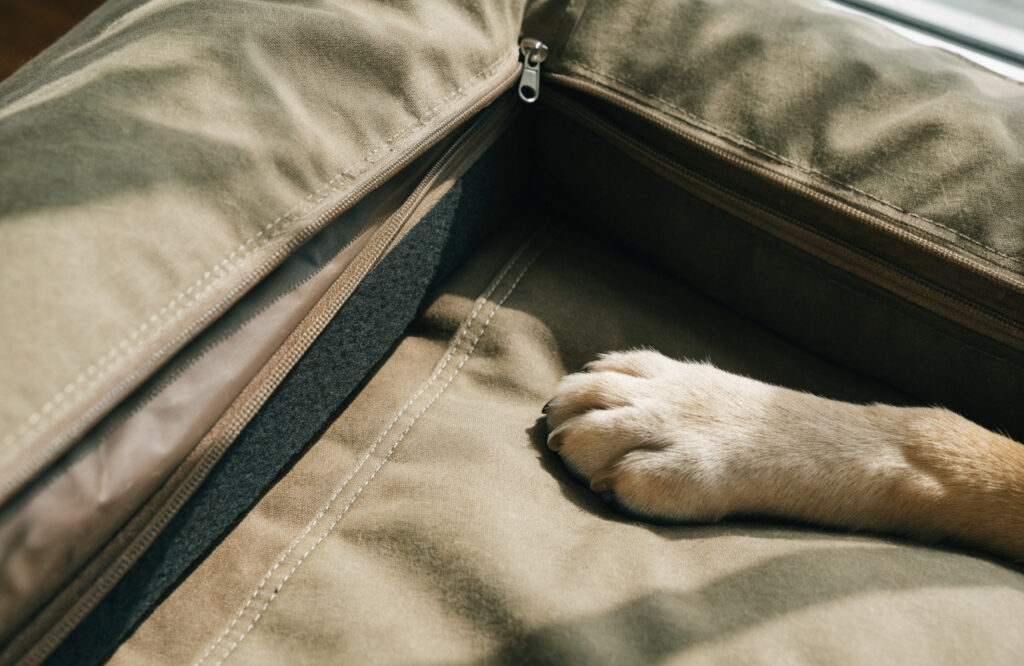
Damage almost always starts at a corner or a seam, not in the middle of the panel. Heavy dogs dig before they lie down, and the fabric sees both claws and shear.
- Prefer tight-weave canvas, denim, or solution-dyed outdoor fabric over minky, fleece, or thin microfiber.
- Put a waterproof layer inside the cover, not only on the floor under the bed.
- Use a zipper long enough to remove the cover without force. Short zippers tear the seam next to them.
- Skip bolsters if the dog already chews edges. Bolsters add head support for some seniors, and they also add four stuffed corners.
- For determined chewers, a taut cot or a locked-down crate pad removes the loose corner entirely. No fabric bed is chew-proof once a dog decides to dismantle it.
Patch early. A small claw hole over foam becomes a shredded core if it is left open. A fabric patch glued or sewn larger than the hole, on the inside, lasts longer than pulling the torn edges together.
Mistakes that make a DIY large dog bed fail in months
- Measuring the dog sitting, or copying a “large” retail size without checking length. The bed is then too short the first night the dog stretches.
- Filling with old pillows or loose polyfill. It feels soft on day one and is flat by week six under a Lab or larger.
- Using one layer of thin egg-crate foam. There is not enough material to recover after repeated compression.
- Building a tall bunk or sofa-height frame for a senior or a giant breed. Entry height matters as much as cushion depth.
- Skipping the waterproof liner. One accident ruins a foam slab that cost more than the fabric.
- Leaving raw screw tips, staple points, or pallet splinters on the sleeping side.
- Making the cover permanent. Large dogs bring in dirt, drool, and seasonal coat. If it cannot be washed, it will smell.
What it typically costs versus buying
A sewn cover and a firm foam slab from an upholstery shop often lands well below a commercial orthopedic bed in the same footprint, which commonly runs from about $150 into the $300–$400 range for giant sizes. PVC cots are the cheapest of the three if you already have a saw and a drill; lumber for a simple platform is usually a hardware-store trip plus the cushion. Sewing time is the real cost on the box cushion: a giant cover is awkward on a domestic machine, and heavy canvas needs a denim or jeans needle.
DIY is the better deal when you need an odd size, a washable cover you can remake, or a frame you can reinforce. It is the worse deal if the dog destroys covers in days. In that case the money goes into chew-resistant commercial fabric or a cot, not another foam slab.
Frequently asked questions
How thick should the foam be for a 100-pound dog? Aim for 5 to 7 inches of solid firm foam, not shredded fill. Thickness alone is not enough if the foam is soft pillow stock.
Can old clothes or pillows work as stuffing? Only as a short-term experiment. Loose fill shifts and packs down under a large dog, and washed clothes hold moisture. A solid slab is the part that makes the bed last.
Is a raised cot better for hips? No. A cot helps with heat, dirt, and airflow. Joint support comes from foam depth and density, or from a firm human mattress topper cut to size.
What fabric survives claws? Canvas, denim, and outdoor furniture fabrics. Fleece and quilt cotton fail at the corners. Even tough fabric loses to a determined chewer, so remove loose corners if chewing is the main problem.
Should the bed have bolsters? Only if the dog uses a raised edge as a headrest and does not chew. Bolsters shrink the sleeping area, so measure the inner surface, not the outside of the roll.