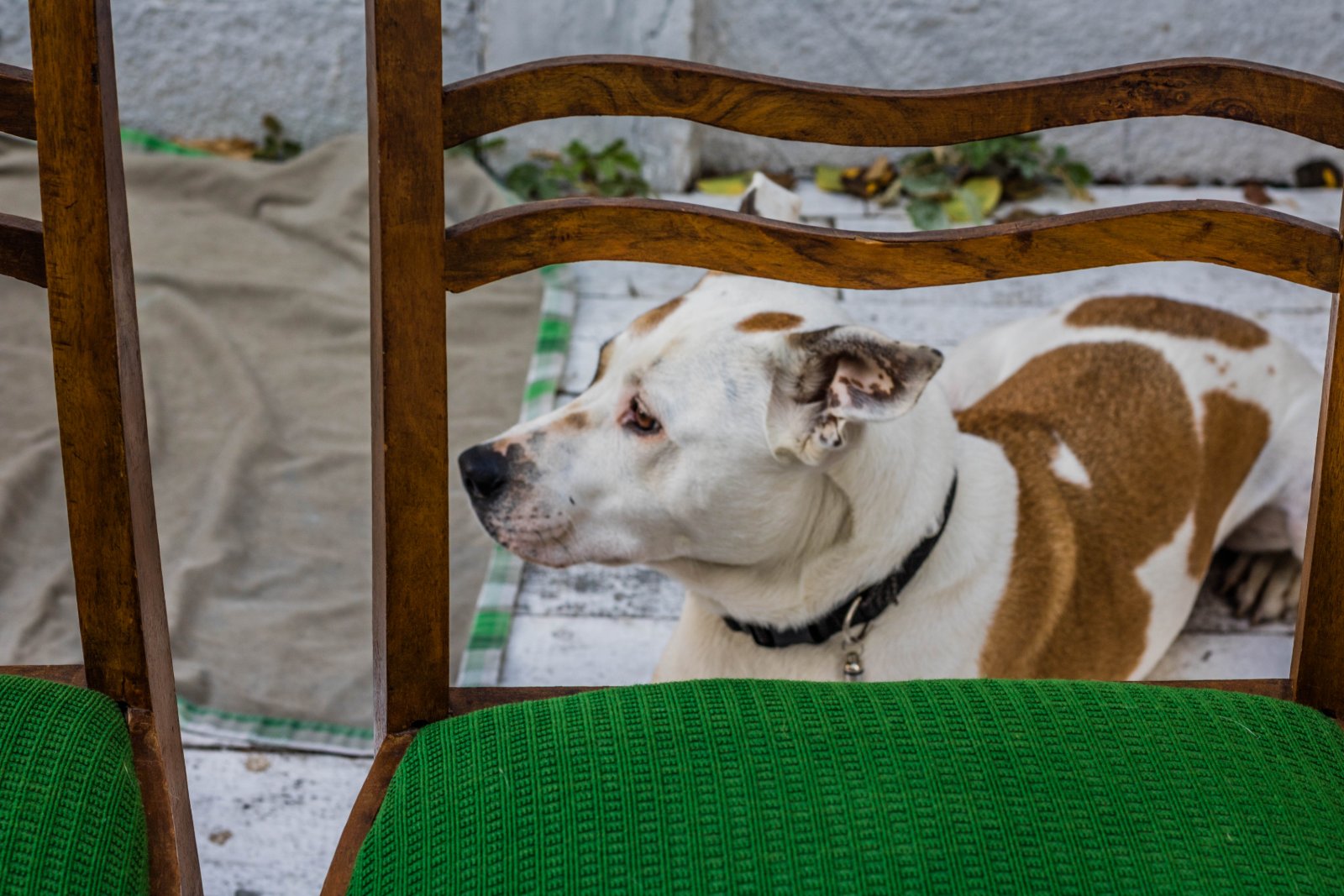

A dog bed next to the human bed is the arrangement that keeps the dog in the room, close enough to settle, without giving up the mattress. It works when the bed is in the spot the dog already wants, sized for how that dog actually sleeps, and taught as the default place rather than a consolation prize.
Most people reach for this setup for one of three reasons: the dog wants to be near them at night, sharing the mattress is wrecking someone’s sleep or a partner’s patience, or a small, young, or stiff dog should not be jumping on and off the bed. The bedside spot can solve all three, but only if the bed is placed and introduced with the dog’s habits in mind.
Why the bedside spot is often the better compromise

Dogs tend to sleep where their people are. Trainers and behavior researchers describe the same pattern: given a choice, many dogs pick proximity and the owner’s scent over a perfectly good bed in another room. A mattress smells like the person. A dog bed across the house does not.
That preference does not require sharing the mattress. A 2017 study in Mayo Clinic Proceedings followed 40 healthy adults and their dogs for seven nights with activity monitors. People with one dog in the bedroom still had good sleep efficiency overall, about 81%. Efficiency was lower, though, when the dog was on the bed than when the dog was only in the room. Both patterns can be compatible with decent sleep. The difference is movement, heat, and space.
A bed beside yours keeps the part of co-sleeping that most owners want — the dog within reach, able to hear and smell them — and drops the part that usually causes trouble. That includes a partner who runs hot, allergies that flare when dander is on the pillow, a sprawler who takes the middle of a queen, and a small or senior dog at risk of falling or being rolled on. Veterinary guidance flags that last risk directly: very small dogs, puppies, and seniors with mobility problems can fall, get trapped in bedding, or be injured by a restless sleeper. A bed next to yours is one of the safer substitutes.
It is also the usual compromise when two people disagree. One person wants the dog close. The other wants clean sheets and an unobstructed side. A bed on the willing person’s side of the mattress is more workable than a fight over who owns the pillows.
Floor bed or raised bedside bed
There are two workable versions. They solve different problems.
A floor bed is a bolster, orthopedic pad, or thick mat placed tight against the bed frame, usually on the side where you sleep. It needs almost no hardware, it cannot tip, and the dog steps on and off. That is the better default for seniors, dogs with arthritis or back pain, giant breeds, and anyone who already sleeps well with the dog on the floor. Joint-friendly beds for older dogs are low-entry on purpose. Jumping down from mattress height is often the painful part of night access, not the lying down.
A raised bedside bed is a platform or frame whose sleeping surface sits near the top of your mattress, sometimes with a rail on the outer sides. Commercial versions often adjust somewhere in the range of about 15 to 38 inches. The point is eye-level contact: the dog can see you, you can reach a hand down without sitting up, and the jump onto your mattress is less tempting because the heights already match. Raised beds also keep the dog off a cold or drafty floor. Cold air pools low in a room, which is one reason some dogs abandon a thin mat on bare wood.
Raised is the wrong choice if the dog is unsteady, very small, or likely to launch off the open side. A platform without a rail, ramp, or partial wall is just a fall waiting for a dream twitch. If you want the height match for a senior, use a model with a ramp or steps and a non-slip surface, and confirm with your vet that climbing is appropriate. For many older dogs, floor level is still the safer call.
Match the shape to the sleep style, not the product photo:
- Curlers and dogs who lean do better with a bolster on at least one side.
- Sprawlers need a flat rectangle long enough for a full stretch.
- Burrowers need a blanket or a covered style, not a bare cot.
- Hot dogs often prefer a mesh cot or a cooling cover over thick foam.
- Heavy or arthritic dogs need foam thick enough that you cannot feel the floor when you press a knee into the middle.
Measure the spot before you buy anything
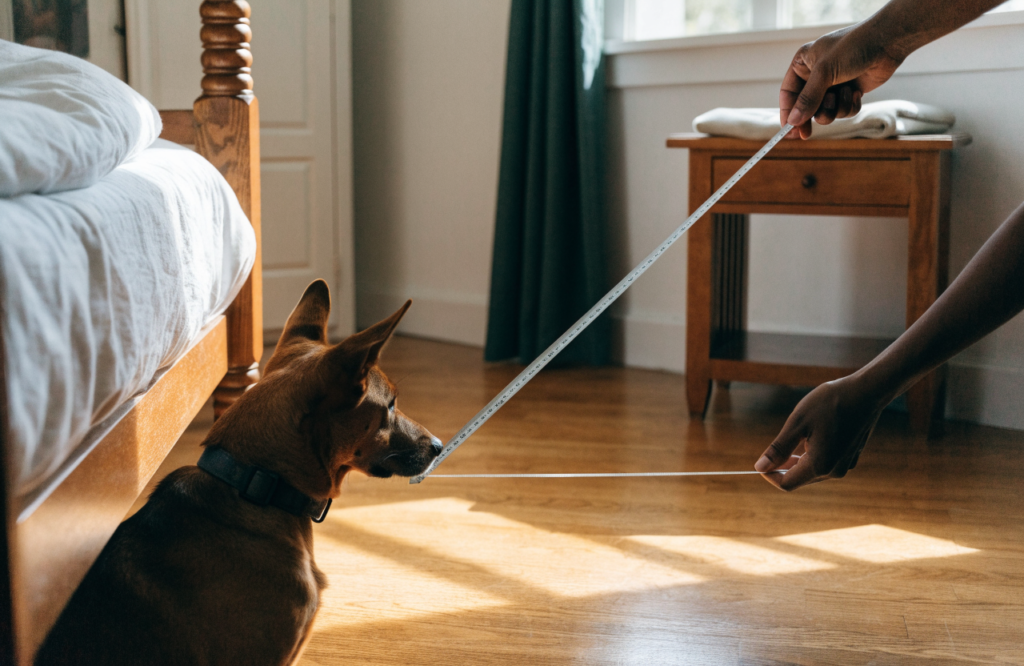
Most failed bedside setups are a geometry problem.
Measure from the floor to the top of your mattress, including the foundation. If you want a raised bed flush with yours, the platform has to reach that number, not “about nightstand height.” A gap of more than a few inches in height is what sends many dogs up onto the human bed anyway.
Measure the floor space on your side of the bed with the nightstand in its real position. A 40-by-28-inch platform will not fit between a queen and a wide nightstand. Decide what moves: the table, a lamp, or the plan. Leave a path so you can get out of bed without stepping on the dog, and so the dog is not boxed against a wall with no exit. Veterinarians who advise on placement stress easy access and a spot where the dog does not feel trapped.
Size the sleeping surface from the dog, not the breed label. Watch the dog asleep in a preferred position. Add roughly 6 to 12 inches beyond that length and width. A bed that forces a sprawler to curl will be ignored. A round donut under a Great Dane is a pillow, not a bed.
Check the gap between the dog bed and your frame. A wide crack is where paws, toys, and collars disappear, and where a small dog can get stuck. Push the bed flush, or bridge a small gap with a folded blanket that will not slide.
Also check cords, blind pulls, and space-heater placement. A tether or a dangling charger next to a chewing puppy is a separate hazard from the bed itself.
How to set it up so the dog uses it
Put the bed on your side of the mattress first, not at the foot and not across the room “to try it.” Dogs often treat the owner’s side as the real location. If the dog already naps on the rug beside the bed, put the new bed exactly there. Behavior advice on placement is consistent on this point: move the bed to where the dog has already voted, rather than expecting the dog to adopt a spot chosen for the furniture layout.
Make that spot smell like you. A worn T-shirt, not a freshly washed one, is enough. Feed an evening chew there. When the dog lies down, mark it calmly and drop a treat between the front paws so getting up is not required to collect the reward.
For the first stretch of nights, the bedside bed is the only comfortable option in the room. If the dog is allowed up after ten minutes of pawing, the mattress remains the prize. A simple sequence works better than a lecture:
- Evening walk and last potty, so restlessness is less likely to be a full bladder.
- Cue the dog onto the bedside bed with a known “place” or “bed” cue, reward, and sit on the edge of your bed so you are still close.
- If the dog gets up, return them without a fuss and reward the settle. Short, boring repetitions beat one long standoff.
- Keep a water bowl at the edge of their bed if they usually drink at night, so getting a drink is not an excuse to roam.
Puppies and newly adopted dogs who cannot be trusted loose overnight are the usual case for a co-sleeper tether. Applied animal behaviorist Kim Brophey’s version puts the bed beside yours, clips a leash to a bed leg under the pillow side, and uses a lightweight harness rather than a collar. The leash should reach the whole dog bed and a water bowl, and no farther. A hand down for brief reassurance is part of the method; a potty trip is the response if restlessness continues, then straight back, with no play.
Use that only while you are in the room and able to respond. The leash has to be short enough that it cannot wrap a nightstand, a heater, or the dog’s own legs. Do not leave a tethered dog alone in the bedroom.
Problems that show up after the first week
The dog still gets on the bed. Height match alone does not create a rule. If jumping up still works, it will continue. Block the edge with your body or a firm pillow for the first nights, return the dog to their bed, and reward the stay. A raised bed with no outer rail can make the jump easier, not harder. For a determined climber, a floor bed plus a consistent “off” is often simpler than a platform that acts as a step.
The dog ignores the bed and sleeps on the bare floor beside it. The location is right and the surface is wrong. Try a different fill or a lower bolster. Some dogs want to press against the frame or the wall more than they want cushion. Slide the bed so one side is backed by the nightstand or bed frame.
The bed slides across the floor. Hardwood and laminate need a non-slip pad underneath. A light cot will migrate every time the dog turns over.
You can still hear the snoring. A bedside bed does not fix noise. It only fixes contact and fur on the sheets. Earplugs, a white-noise machine, or moving the bed to the foot — still in the room — are the actual noise fixes. If the issue is a partner, the bed belongs on the dog-tolerant side, not in the middle.
The room is too small. A twin mattress topper on the floor can work for a large dog when a framed bedside bed will not fit. People with giant breeds sometimes use a twin foam mattress on a low frame a few inches below the human bed. The principle is the same: own surface, same room, no shared pillows.
Night waking gets worse, not better. Proximity can reassure an anxious dog, and it can also reward barking. If the dog learns that a whine produces you sitting up and petting for several minutes, the bedside bed becomes a cue to ask. Keep reassurance brief. Rule out pain, a need to go out, and hunger before you treat it as a training problem.
When this setup is the wrong fix
A dog bed next to the human bed is a poor plan if someone in the bed has severe asthma set off by the dog even when the dog is only in the room, if a toddler shares the room and the dog has no reliable off-switch around children, or if the dog guards the bedside spot and stiffens when anyone walks past. Resource guarding around sleep space needs a trainer, not a new cushion.
It is also the wrong tool if the real problem is daytime separation anxiety and the night arrangement is being asked to fix a dog who cannot settle when left alone at all. Night proximity can be part of a plan. It is not the plan.
Skip raised platforms for dogs who stumble, have recently had orthopedic surgery, or are small enough to fall through a rail gap. Floor level, a crate with the door open once the dog is reliable, or a pen beside the bed are the safer containers.
A simple decision check
| Situation | Better bedside choice |
|---|---|
| Partner wants the mattress back, dog wants to be near you | Floor or raised bed on your side only |
| Senior or arthritic dog | Thick orthopedic floor bed, no jump |
| Small dog or puppy at risk of falling off the bed | Floor bed, or a railed sleeper you can reach |
| Dog runs hot or the room is warm | Mesh cot or cooling cover, still beside the bed |
| Puppy who wanders and soils at night | Co-sleeper tether on a harness, supervised |
| Dog already sleeps on the rug by the bed | Put the new bed on that rug |
The test after a week is ordinary. You are sleeping. The dog is using the bed without a fight at 2 a.m. Nobody is stepping into a gap or hauling a stiff dog down from mattress height. If those three are true, the bedside bed is doing the job a shared mattress was doing, with fewer of the costs.
Frequently asked questions
Will a dog bed next to mine stop my dog from wanting the human bed? Not by itself. Dogs keep choosing the place that has paid off. The bedside bed works when it is close, comfortable, and the mattress is no longer available on demand. Scent from a worn shirt helps the new bed compete.
Does sleeping in the same room make a dog dominant? No. Wanting to sleep near people is normal social behavior, not a status play. The practical issues are sleep quality, allergies, space, and safety, not dominance.
How high should a bedside dog bed be? If you want it level with yours, measure floor to mattress top and buy a frame that reaches that height. If the dog is senior or unsteady, skip the height match and use a floor bed. A platform the dog can fall from is not an upgrade.
Can this replace a crate? For a house-trained adult who already settles, often yes. For a puppy still learning not to chew cords or soil the room, a bedside bed only replaces a crate if the dog is contained — a pen or a properly fitted tether — while you are there to respond.