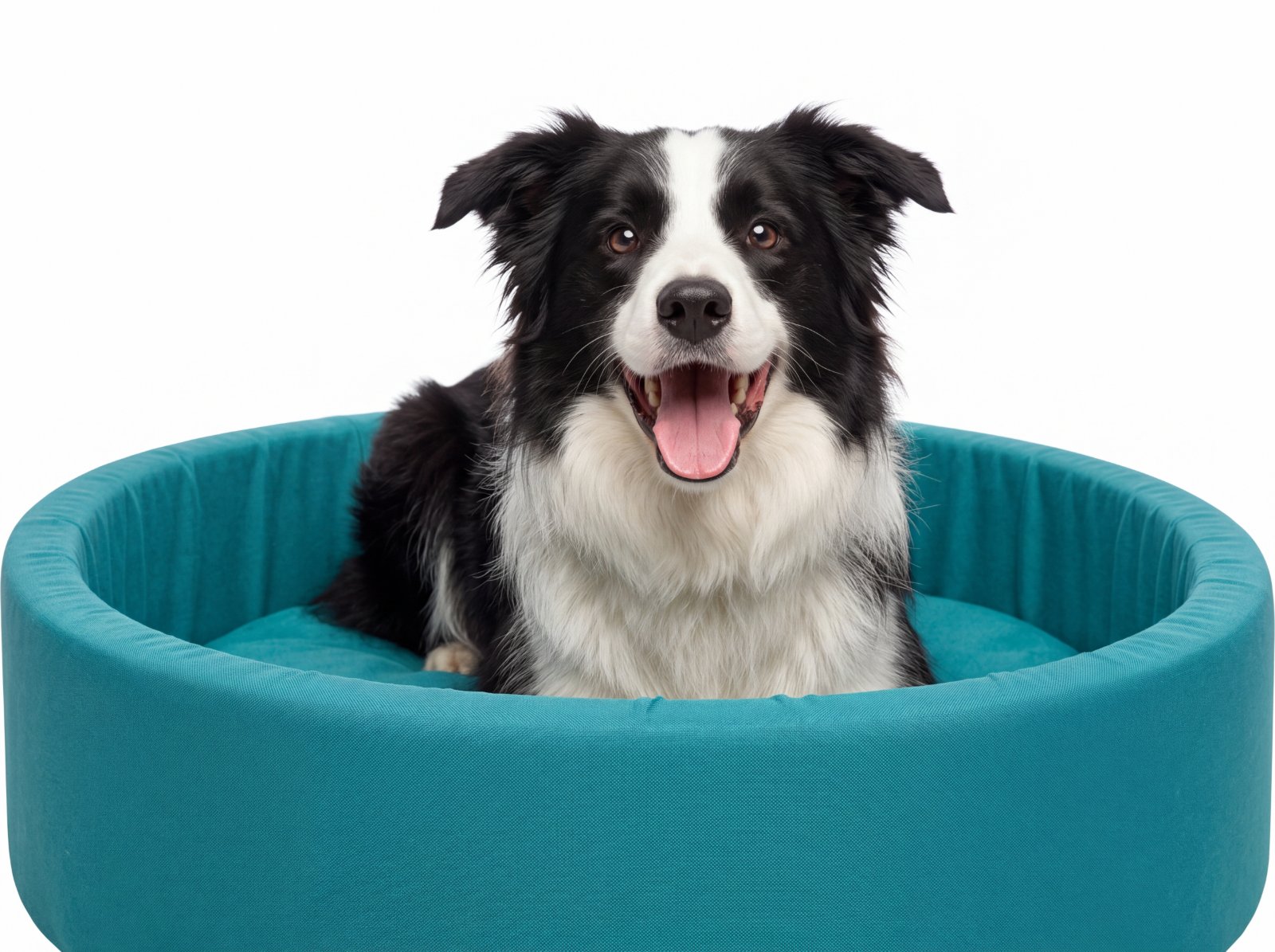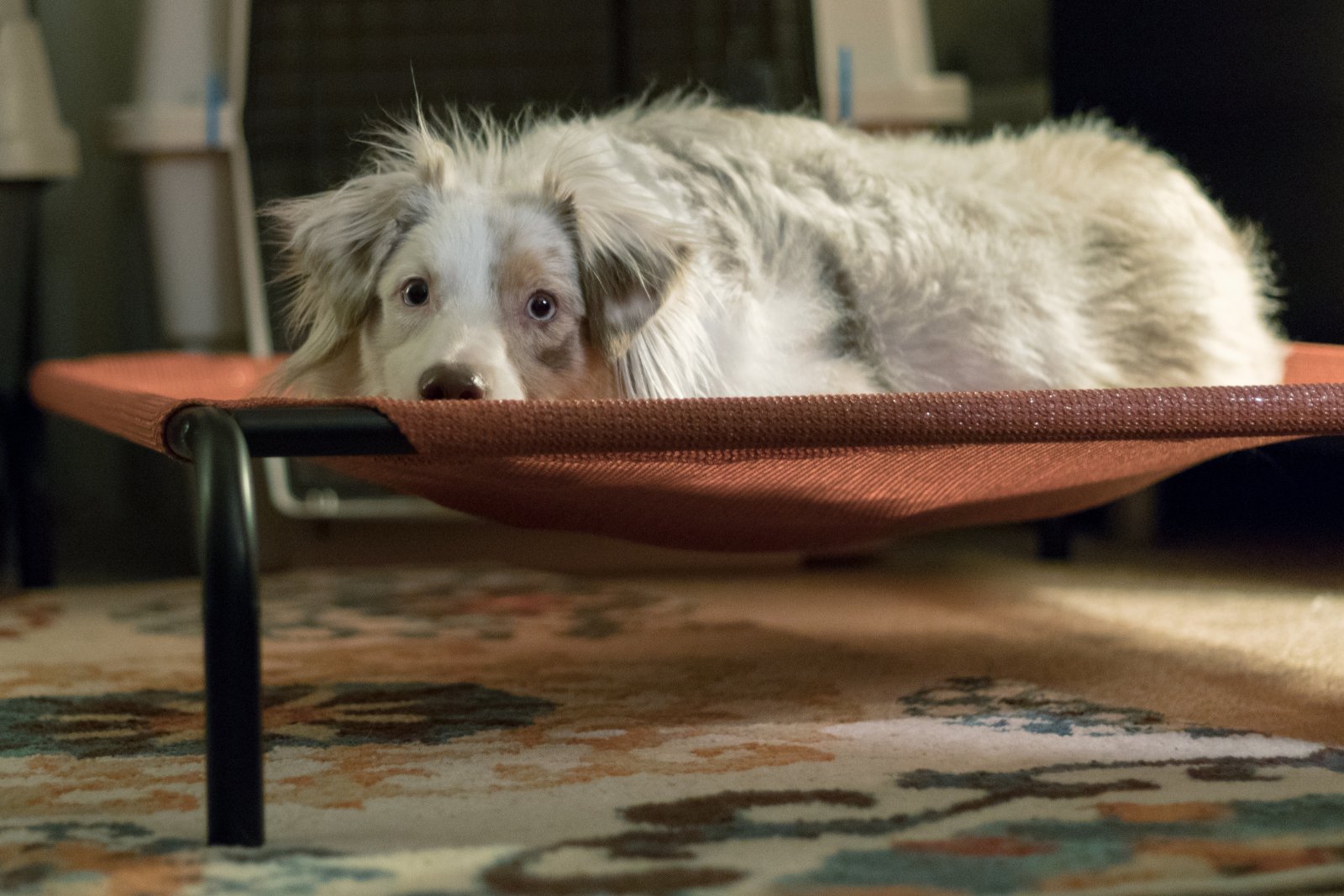

A PVC dog bed is an elevated cot: a rigid plastic-pipe frame, short legs, and a taut fabric sling instead of foam. It keeps a dog off hot, cold, or wet ground, sheds dirt and urine more easily than a stuffed cushion, and gives determined chewers fewer loose edges to grab. It is a poor match for dogs that want a nest, for dogs well over about 100 pounds on a standard PVC frame, and for pets that will chew the pipe itself.
Commercial versions, led for decades by furniture-grade frames such as Kuranda, hide the fabric edge inside the rail so teeth cannot get a starting grip. Homemade versions use Schedule 40 plumbing pipe and outdoor fabric. Both work. The difference is how long the fabric stays tight, how the joints hold under jumping, and whether a chewer can reach a corner.
What the bed is doing for the dog
The useful part is the gap under the fabric, not the plastic. Air moving beneath the sling pulls heat away in summer and lifts the dog off a cold floor in winter. A firm, even surface spreads weight across the body instead of letting shoulders and hips sink into a crater of foam. Shelters use the same idea for a practical reason: bedding stays drier when a water bowl tips, and the frame can be hosed.
That support is not the same as an orthopedic foam bed. A cot does not cradle a bony senior the way memory foam does, and some arthritic dogs prefer a lower, softer surface they can step onto rather than climb. The cot wins when the problem is heat, damp floors, smell, or destroyed stuffing. It loses when the dog needs cushioning for pressure points, or when the only available spot is a drafty corner the dog refuses to use.
Buy a finished bed or build the frame
A bought PVC cot makes sense when the dog already destroys beds, when the bed will live in a kennel or on a porch, or when replacement fabric and hardware matter more than saving money. Kuranda rates its standard PVC frames for dogs up to 100 pounds and its aluminum frames up to 250 pounds. Larger PVC sizes (the 44 by 27 inch and 50 by 36 inch frames) include a metal conduit inside the long rails because the plastic alone flexes under span and weight. Almond-colored frames are sold for indoor or outdoor use. Darker walnut frames are recommended for indoor use only, because the darker plastic heats in direct sun and can warp.
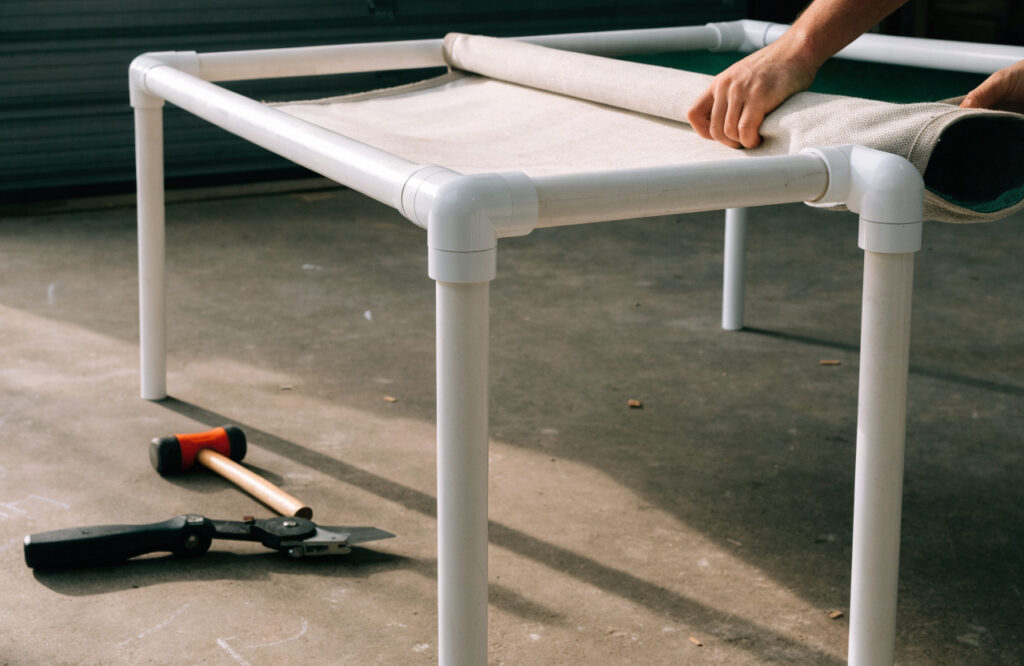
A DIY frame is the better spend when the dog is not a structural chewer, the size you need is awkward, or you are outfitting several kennel runs. Shelter-medicine plans put a basic vinyl-sling bed near $30 in materials and about an hour of work, using 1.5-inch Schedule 40 pipe. Hardware-store builds in 1-inch or 1.25-inch pipe commonly land in a similar range if the fabric is not a premium marine cloth. The money saved disappears if the fabric sags in a month or the joints walk apart.
| Decision | Finished PVC cot | DIY Schedule 40 frame | Aluminum cot |
|---|---|---|---|
| Best for | Chewers under about 100 lb, porch or kennel use | Custom size, several beds, mild chewers | Heavy dogs, dogs that attack the frame |
| Typical cost | Often around $80–$170 by size | Often $25–$60 in materials | Higher than PVC |
| Weak point | Fabric choice, flex on long spans | Exposed fabric edges, unglued joints | Price, not much else |
| Repair | Replacement slings and parts are sold | You recut pipe or fabric | Replacement parts from the maker |
Frame details that decide whether it lasts
Pipe diameter should follow the dog, not the cheapest stick in the aisle. One-inch Schedule 40 is enough for a small or medium dog on a short span. Dogs over roughly 50–60 pounds, or any bed longer than about 36 inches, are better on 1.25-inch or 1.5-inch Schedule 40. Thinner “furniture” pipe and foam-core pipe bow. Schedule 80 is stronger than necessary and harder to cut.
Corners should be side-outlet elbows (three-way fittings), not a pile of ordinary 90-degree elbows and tees. The side outlet points down and becomes the leg, so the sleeping surface stays a clean rectangle. Legs of 3 to 4 inches keep most dogs close to the floor. Seven inches or more looks roomier and then sags into a hammock that the dog has to climb out of. Senior, tiny, and post-surgery dogs need the lower end of that range so stepping off is not a jump.
Dry-fitting looks fine on day one. A dog that launches onto the bed pulls fittings apart over weeks. Solvent-cement the legs at minimum, and cement the rectangle if the floor is flat. On an uneven kennel floor, a fully glued frame rocks; leave the long rails unglued or add adjustable feet. Flat end caps keep the cut pipe from chewing the floor and from collecting grit. Stainless screws, not zinc-plated drywall screws, are the ones that survive outdoor hose-downs.
Fabric fails before the pipe does
Stretch is the enemy. Jersey, old sheets, and lightweight cotton feel soft and then belly into a hammock. The sling needs a woven outdoor cloth with almost no give: vinyl-coated polyester, Phifertex-style mesh, Sunbrella sling, ballistic nylon, or Cordura. Commercial lines rank heavy vinyl (about 40 oz vinyl-coated polyester) as the toughest and easiest to sanitize, canvas-like nylon as better traction for older dogs, and open mesh as the choice when urine or water must pass through.
How the cloth attaches matters as much as the cloth. Screwing the hem to the outside of the pipe leaves a lip a dog can pinch. Sewing pockets and sliding the pipe through is cleaner, but a pocket that is too tight is miserable to assemble and a pocket that is loose sags. A zip on one pocket, the method sailmakers use on pet cots, lets you tension the cloth and still remove it. The chew-resistant commercial design tucks the fabric edge inside a slotted rail so there is no hem to bite. A homemade bed cannot copy that extrusion easily. The practical substitute is a hem folded to the underside and screwed from below, with no loose corner, zipper pull, or binding tail.
Mesh breathes and drains. Solid vinyl is easier to wipe and harder to puncture, and it holds heat and puddles if the dog is wet. For an incontinent dog, mesh is the fabric that does not store odor. For a digger, heavy vinyl lasts longer.
Size and height, measured on the dog
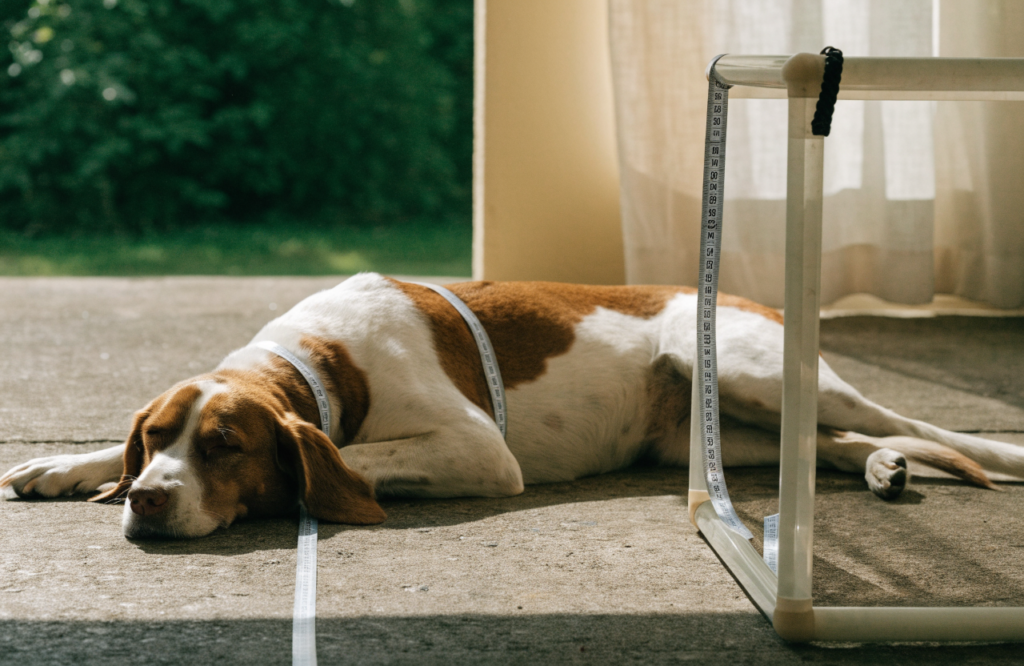
Length should cover the dog stretched on its side, nose to base of tail, plus a few inches. Width should let the dog curl without hanging a hip over the rail. A 30 by 42 inch cot fits many medium and large dogs. A 20 by 30 inch frame is a small-dog or crate insert, not a Labrador bed. Narrow beds are the common DIY mistake: the dog cannot turn around and ends up sleeping half off the sling.
Measure the crate before buying a crate insert. A PVC crate bed sits inside the wire tray and replaces the plastic pan as the sleeping surface, so the outside dimensions have to clear the door and the side latches. Too tall a cot in a crate turns the doorway into a step the dog scrapes on the way out.
Height is a joint decision, not a style choice. Three to four inches clears a wet porch and still lets a stiff dog step on. Taller legs help only if the dog is athletic and the floor underneath is something you want fully clear for sweeping. Add a thin mat only if the dog needs grip. A thick pad on top of the sling cancels the airflow and gives a chewer a new project.
Where homemade beds actually fail
Most DIY failures are predictable.
- Stretch fabric, or fabric cut too large, so the bed hammocks and the dog’s spine sits in a U.
- Unglued joints that creep apart after a few weeks of jumping.
- Screws driven through a single layer of cloth with no washer, which tear out in a crescent.
- Legs of unequal length because the pipe was not pushed to the stop inside the fitting before cement set.
- Paint on a bed the dog mouths. Rigid PVC does not need paint to be weatherproof. If the dog chews, coating chips become something to swallow.
- A bed parked against a heater or in full sun under a dark frame. Heat softens PVC. Dark outdoor frames are the ones makers warn against for that reason.
A center brace is worth adding on any DIY span over about 36 inches for a dog over 50 pounds. A single cross pipe under the sling, set just below the fabric, stops the long rails from bowing inward.
Chewing, ingestion, and what “chew proof” leaves out
No cot is safe to chew. The design only removes the easy grip. A dog that mouths the rail can still gouge PVC, crack a fitting, or work a screw loose. Commercial PVC is sold as moderately chew-resistant; makers point destructive dogs to aluminum because plastic can be scarred and flexed in a way metal is not. Aluminum also avoids the small burrs chewed plastic can develop, which give the next bite something to catch.
Rigid pipe is a different risk from soft vinyl toys. Flexible PVC toys are plasticized with phthalates that migrate into saliva when chewed. Schedule 40 pipe is rigid and not made as a chew toy, but shards are a foreign-body problem: sharp fragments can cut the mouth or obstruct the gut. If the dog is actively eating the frame, take the bed away. A tougher bed does not fix a dog that destroys things when left alone. That pattern needs the reason looked at, not a harder target.
Solvent cement should cure fully before the dog uses the bed, outdoors if the smell is strong. New PVC has a faint plastic odor that fades. An ongoing chemical smell is a reason to air the frame longer, not to ignore it.
Cleaning, weather, and where to put it
Hose the sling, wash with mild soap, and rinse. Disinfectants are fine if they are rinsed off. Mesh dries in place. Vinyl wipes clean and should not stay folded wet against the pipe, or the contact line stains. Feet on a hard floor can be capped or given small rubber tips so the bed does not walk when the dog jumps off.
Outdoors, shade matters more than a cover. UV fades fabric and heats dark pipe. A bed in standing water is fine for a day if the fabric drains. It is not fine as a permanent mud raft: the legs sink, the rectangle twists, and the sling loosens. Bring mesh beds in during a hard freeze if they are soaked. Ice in the weave makes the cloth brittle until it thaws.
Indoors, the same bed replaces a stuffed cushion in a crate, under a desk, or beside a sliding door. The tradeoff is noise. Pipe on tile clicks. Felt pads or caps fix that. A bunk version stacks two slings so two dogs share one footprint. Kuranda rates a PVC bunk at 100 pounds total, not per level, so it is a pair of smaller dogs, not two shepherds.
A short build sequence if you are making one
- Measure the dog on its side and add a few inches. Cut two length pipes, two width pipes, and four legs of equal length from Schedule 40. Deburr every cut.
- Dry-fit four side-outlet elbows with the outlets down. Square the frame on a flat floor. Mark insertion depth so every joint seats the same.
- Cement the legs, then the rectangle if the floor is even. Wipe excess cement. Let it cure for the time on the can before a dog steps on it.
- Hem a non-stretch outdoor cloth so the finished sling is slightly smaller than the frame opening, not larger. Attach from the underside with washer-head screws, or sew sleeves and add a zipper on one side.
- Load-test with your own weight at the center before the dog uses it. A frame that creaks or walks is not finished.
Frequently asked questions
Is a PVC dog bed better for joints than a foam bed? It is better when the foam has collapsed into a hole, or when the dog is sleeping on concrete. The sling is firm and level. It is not a substitute for a thick orthopedic pad if the dog has prominent bones and needs give under the hips.
Can it go in the washing machine? The fabric can, if it is removable and the care label allows it. The pipe frame should be hosed or wiped. A screwed-on sling is a hose-off job, not a laundry job.
Will it hold a Great Dane? Not a standard PVC frame. Those are rated around 100 pounds. A Dane needs a properly braced heavier frame or an aluminum cot rated for the dog’s weight, and a sling with no stretch.
Are the fumes a problem? Cured rigid PVC is stable in normal room and outdoor temperatures. The smell to respect is fresh solvent cement and any bed left against a heat source hot enough to soften plastic. Air a newly glued frame until the cement smell is gone, and do not park the bed on a heat register.