A dog bed sewing pattern is easier to draft than most printable downloads suggest. Measure the dog while it is lying down, pick a construction that matches how it sleeps, then cut a cover around a foam slab or a stuffed cushion. The difference between a bed that lasts and one that sags or refuses to fit after the first wash is mostly fabric, a real closure, and seam allowance that was planned before the scissors came out.
Match the pattern to how the dog sleeps
A single “dog bed” pattern does not fit every dog. Curl-up sleepers lean into a raised edge. Sprawlers need open floor space and will fight a bolster that steals inches from the middle.
Flat cushion or pillow cover. Two rectangles, an envelope overlap or a zipper, and either fiberfill or a ready-made pillow. Fastest to sew, easiest to wash, and the right choice when the dog already has a favorite pillow or you want a crate pad. It offers little joint support once the fill compresses.
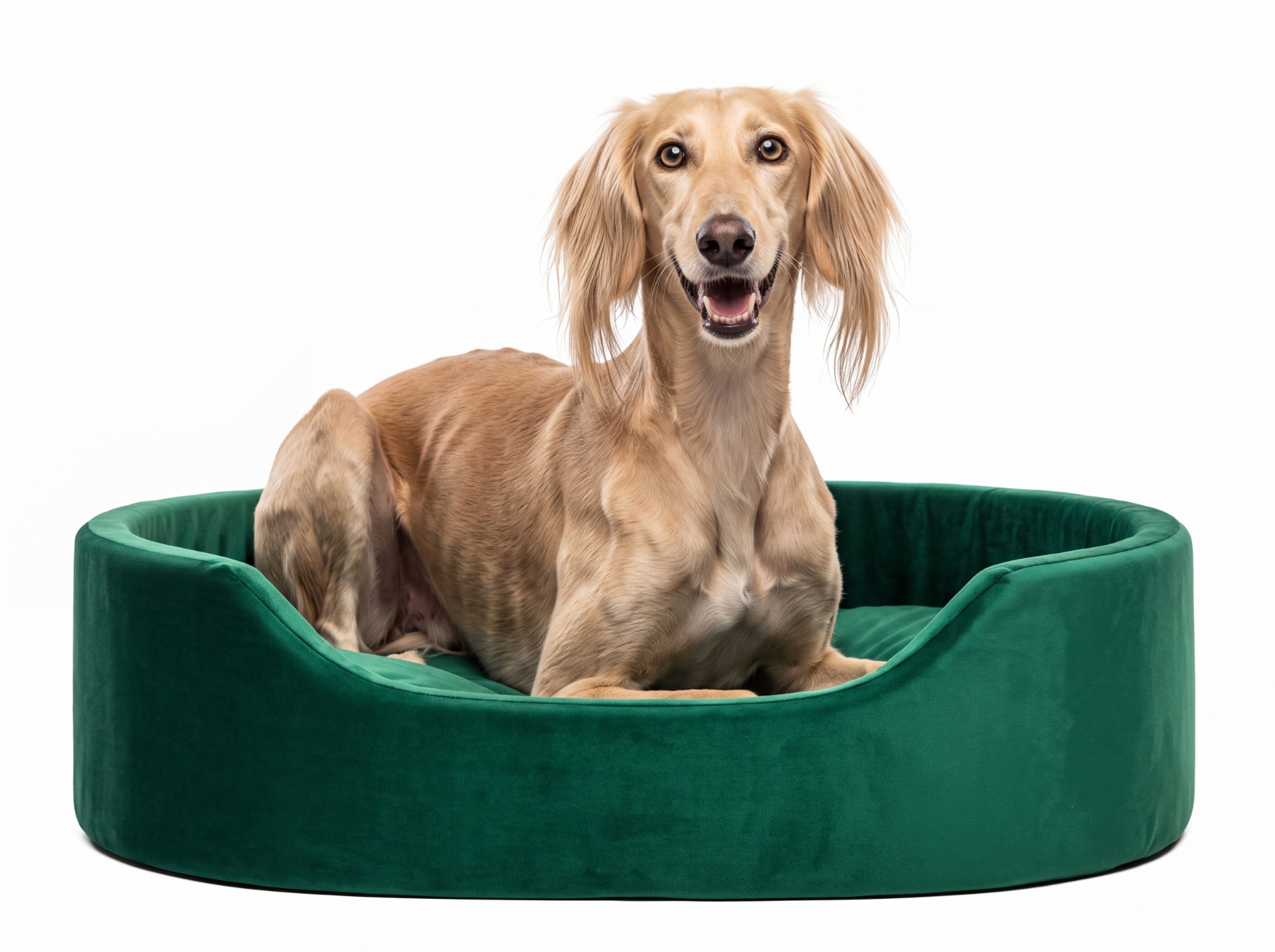
Boxed cover over foam. A top, a bottom, and a side band the height of the foam, closed with a zipper. This is the most useful everyday pattern. A 3- to 4-inch foam slab keeps its shape, and the cover comes off for the wash. Commercial beds and home sewing tutorials both land in that thickness range because thinner foam bottoms out under a medium or large dog.
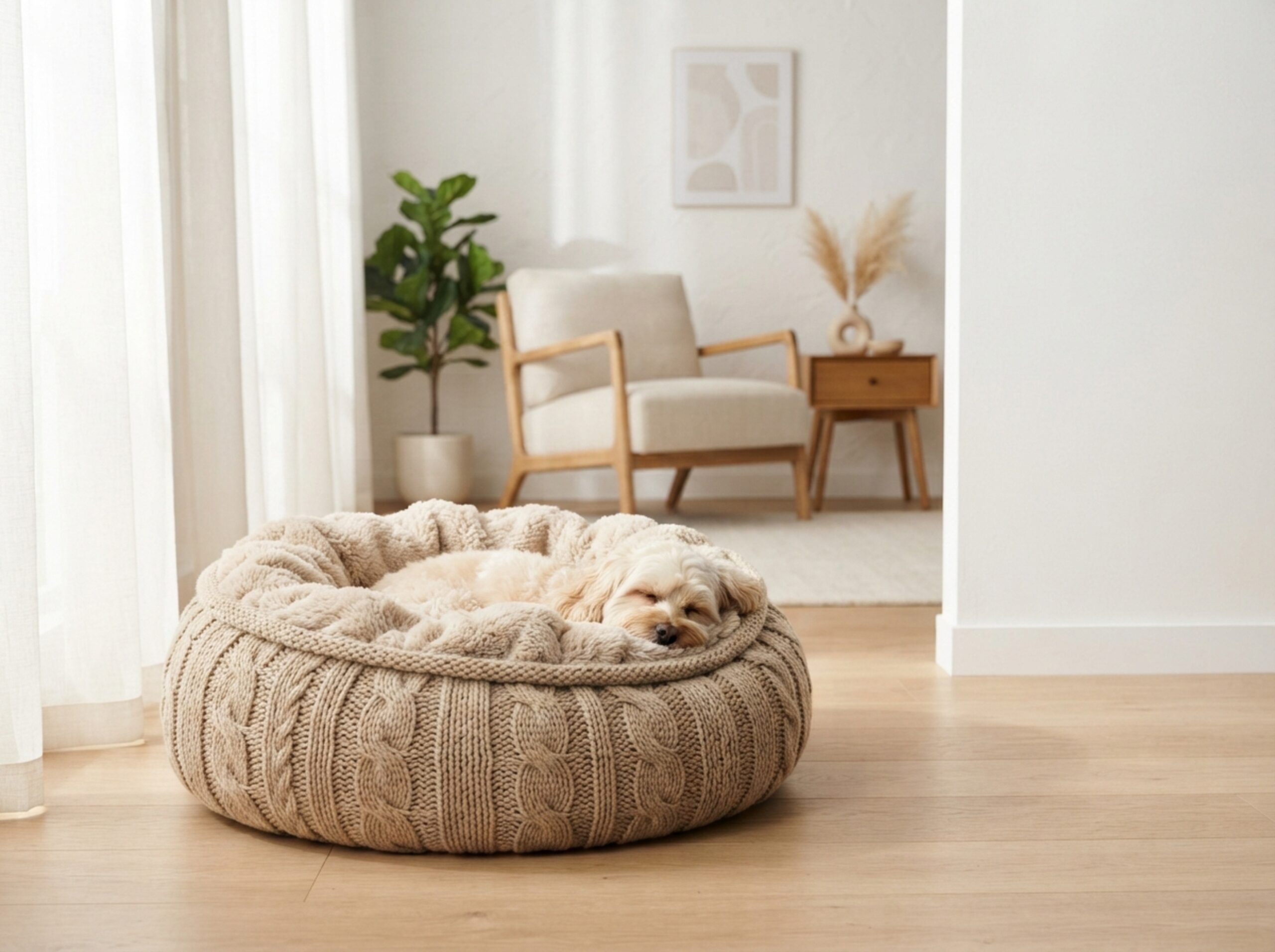
Bolster or donut bed. A flat center plus a stuffed tube or raised sides. Small dogs and anxious sleepers often prefer the wall to lean on. Large dogs that stretch out usually do better without a rim eating into the sleeping surface. A bolster also takes more stuffing and more seam length, so it is a second project, not the first.
If the dog digs, chews edges, or has accidents, sew the boxed foam cover first. You can add a bolster later. You cannot easily turn a stuffed donut into a washable orthopedic bed.
Size the bed from the sleeping dog, not the breed label

Breed charts are a starting point. The measurement that matters is the dog lying in its usual sleep posture.
Measure from the tip of the nose to the base of the tail, not the tip of the tail. Add about 6 inches for a dog that stays tucked, and 10 to 12 inches for a dog that flings its legs. Width should clear the shoulders with a few inches to spare on each side. A bed that is only as long as the standing dog is almost always too short once the dog lies down.
| Sleeping length (nose to tail base) | Typical finished bed | Foam thickness | Notes |
|---|---|---|---|
| Under 16 in | 20 × 16 in to 24 × 18 in | 2–3 in | Toy and small dogs; a bolster can eat the center, so keep the rim modest |
| 16–24 in | 28 × 22 in to 32 × 24 in | 3 in | Medium dogs; check crate interior before you commit |
| 24–32 in | 36 × 28 in to 40 × 30 in | 3–4 in | Labs, shepherds, and similar; foam weight matters when you insert it |
| Over 32 in | 44 × 34 in and up | 4 in | Giant breeds; plan fabric width and a long zipper before you buy |
Those ranges line up with finished sizes used in home sewing patterns: roughly 20 × 15 inches for a small boxed bed, the mid-20s by 18 for medium, and the mid-30s by high-20s for large. Round beds are sized by diameter instead. A 24-inch round suits a small curler; 36 inches is a common medium; 42 inches is a large round. Add the bolster outside that sleeping circle, or the dog will have less room than the diameter suggests.
If the bed must live in a crate, measure the crate floor and subtract an inch so the cover can still slide in. A perfect dog-sized bed that will not fit the crate is the wrong pattern.
Draft a rectangular boxed pattern
This draft uses a 1/2-inch seam allowance, the standard in most home dog-bed tutorials. Finished size means the foam size, not the cut size.
Example: a 30 × 24 × 3 inch foam slab.
Top: cut 31 × 25 inches (foam length + 1 inch, foam width + 1 inch).
Bottom: cut the same, 31 × 25 inches.
Side band: one long strip, or four panels joined into a loop. Height is foam thickness + 1 inch, so 4 inches. Length is the perimeter plus 1 inch for the joining seam: (30 + 24) × 2 + 1 = 109 inches. If your fabric is not long enough, piece the band and hide the joins at the corners.
Zipper panel: replace one long side of the band with two narrower strips that sandwich a zipper. For the 30-inch side, cut two strips 31 inches long by 2.5 inches wide (each takes a 1/2-inch seam to the top or bottom, a 1/2-inch seam to the zipper tape, and leaves enough band to cover 3 inches of foam). A separating or closed-end zipper at least as long as that side — 30 inches, or longer if you will trim it — lets the foam go in without a fight. Coil zippers are easier to shorten than metal ones.
Yardage, roughly, for 44–45 inch fabric: a small bed often fits in 1 to 1.5 yards if you are careful with layout. A 30 × 24 bed usually needs 2 yards of the main fabric. A 36 × 28 bed is closer to 2.5 yards. Fleece and canvas widths vary, so lay the pieces out on paper before you buy.
Wash and dry the cover fabric before you cut. Canvas and cotton shrink. A cover cut from unwashed fabric often will not go back over the foam after the first laundry cycle.
Fabric and fill that survive daily use
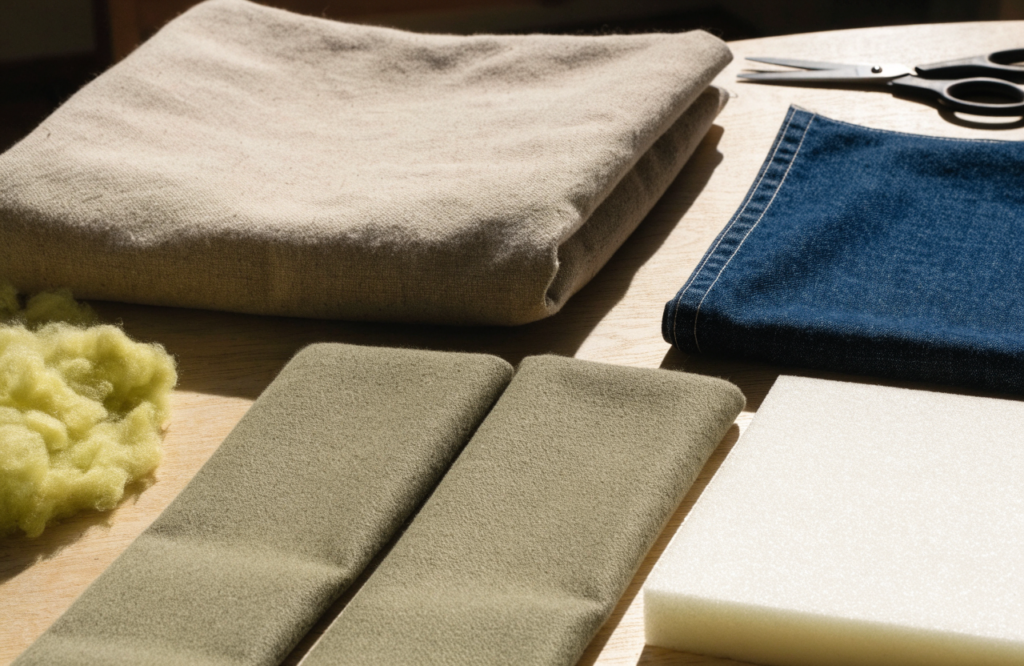
Pretty quilting cotton is a poor outer shell if the dog scratches or nests. Sew the outside from a tight weave: cotton canvas, denim, corduroy, or a heavy cotton twill. Those fabrics take machine washing and resist snags better than shirt-weight cotton. Use fleece, sherpa, or a cotton flannel only on the sleeping surface if you want softness, and keep a tougher fabric on the bottom and sides.
A water-resistant bottom — outdoor canvas, or a layer cut from a mattress protector — is worth it for dogs that dribble or have occasional accidents. It does not replace a washable cover. Do not rely on a thin laminated fabric alone if the dog’s nails are long; the coating scuffs.
Fill choices:
- Upholstery foam or a mattress-topper slab, 3 to 4 inches, is the best default. It does not clump, and senior or heavy dogs get more even support than loose fiberfill.
- Polyester fiberfill is fine for a light pillow bed and for bolsters. It packs down and migrates to the corners.
- Old towels and clothes work in a pinch and carry a familiar scent, but they shift, hold odor, and are harder to dry fully.
Keep foam out of the washing machine. Sew the cover with a zipper so only the shell is laundered. If accidents are common, make a second, simple muslin or protector cover that zips around the foam and stays in place when the outer cover is in the wash.
Use a universal or denim needle, size 90/14, on canvas, and polyester thread. A walking foot helps on fleece and on thick seam intersections. Clip or grade the corner seam allowances so the points turn cleanly.
Sew the boxed cover
- Stay-stitch or mark the 1/2-inch seam line at each corner of the top and bottom so you know where the side band must pivot.
- Install the zipper between the two narrow back strips. Stitch close to the coil, then topstitch the fold so the pull can move. Open the zipper halfway before the next seams — you will need that opening to turn the cover.
- Join the side panels into a loop, right sides together, matching the short ends. The zipper panel is one of the four sides.
- Pin the band to the top, right sides together, matching corners to the marked pivot points. Stitch with a 1/2-inch allowance, stopping with the needle down at each corner, lifting the presser foot, and turning. Do the same with the bottom.
- Turn the cover through the open zipper. Push the corners out. Do not clip so close to the stitching that the corner frays in the wash.
- Unzip fully and work the foam in. Folding the slab slightly, then letting it expand inside the cover, is easier than forcing a rigid rectangle through a short opening. If it will not go, the zipper is too short or the cover was cut without seam allowance accounted for correctly.
Piping is optional. Cut 1.5-inch bias strips, wrap 1/4-inch cord, and baste the piping to the top before you attach the band. It looks finished and reinforces the edge dogs lean on. Skip it on a first bed if you are still learning corners.
Adapt the same draft for a bolster
A three-sided bolster suits dogs that like a headrest and still need an open front to step in. Cut the center cushion as above. For the bolster tube, measure the three sides, add 4 inches for the end seams and ease, and cut a strip about 10 to 12 inches wide so it finishes around 4 to 5 inches thick once stuffed. Sew it into a tube, turn, stuff firmly with fiberfill (or wrap batting around a cut pool noodle if you want a firmer edge for an older dog), and hand-stitch or machine-stitch it to the cover along the back and sides.
Do not stuff the bolster rock-hard if you still need a flat seam allowance to attach it. Leave about an inch of unstuffed edge so the needle can catch fabric, not just fill. A round donut uses the same idea: a circular base plus one long tube joined into a ring. The tube’s length should match the circumference of the base plus a little ease, or the ring will pucker the center.
Mistakes that ruin an otherwise good pattern
Cutting to the finished size. A 30-inch foam needs a 31-inch top if you are using 1/2-inch seams. Covers cut “exact” will not close.
No prewash. The first hot wash shrinks cotton canvas enough that the zipper will not meet.
A short zipper on a long side. Inserting 4-inch foam through a 12-inch opening tears the tape and bends the slab. Put the zipper on a long edge, and make it nearly the full length of that edge.
Fiberfill as the only support for a large dog. It feels plush on day one and flat by month two. Use foam under big dogs; save loose fill for bolsters and toy-breed pillows.
Delicate top fabric. A dog that circles and scratches will pill fleece and shred quilting cotton at the same spot. Put the tough weave where the nails land, or quilt a soft top to a canvas underlayer.
Ignoring the crate or the doorway. Measure the spot, not just the dog. A 40-inch bed does not belong in a 36-inch crate.
One cover and no spare. Once the bed is in use, you will want to wash the shell. A second cover, even in plain canvas, keeps the foam in service.
Frequently asked questions
Can I use a bed pillow instead of foam? Yes for small and medium dogs. A standard pillow is about 20 × 26 inches; queen is about 20 × 30; king is about 20 × 36. Add 1 inch to width and several inches to length if you are making an envelope cover rather than a boxed one. Pillows compress more than foam and are a weak choice for a heavy senior dog.
What seam allowance should the pattern use? Half an inch is the reliable default for canvas and for joining a side band. Quarter-inch seams are fiddly on thick fabric and leave less room to turn corners.
How do I make the bed waterproof? Sew a separate inner cover from a mattress-protector fabric, or use water-resistant canvas on the bottom only. A fully waterproof outer shell traps heat and can feel clammy. The practical setup is a wipeable inner layer plus a washable outer cover.
Is a round pattern better than a rectangle? Only if the dog curls and the bed will not go in a crate. Rectangles waste less fabric, fit crates and corners, and are simpler to zipper. Round beds look softer and suit donut bolsters; they are harder to cut accurately without a paper pattern.
Can a beginner sew this on a domestic machine? A boxed rectangle in canvas is a confident-beginner project: straight seams, one zipper, four corners. A piped round bolster is intermediate because of curves, bulk, and stuffing. If the machine struggles, switch to a 90/14 needle, lengthen the stitch slightly, and avoid stacking too many layers at the zipper ends.