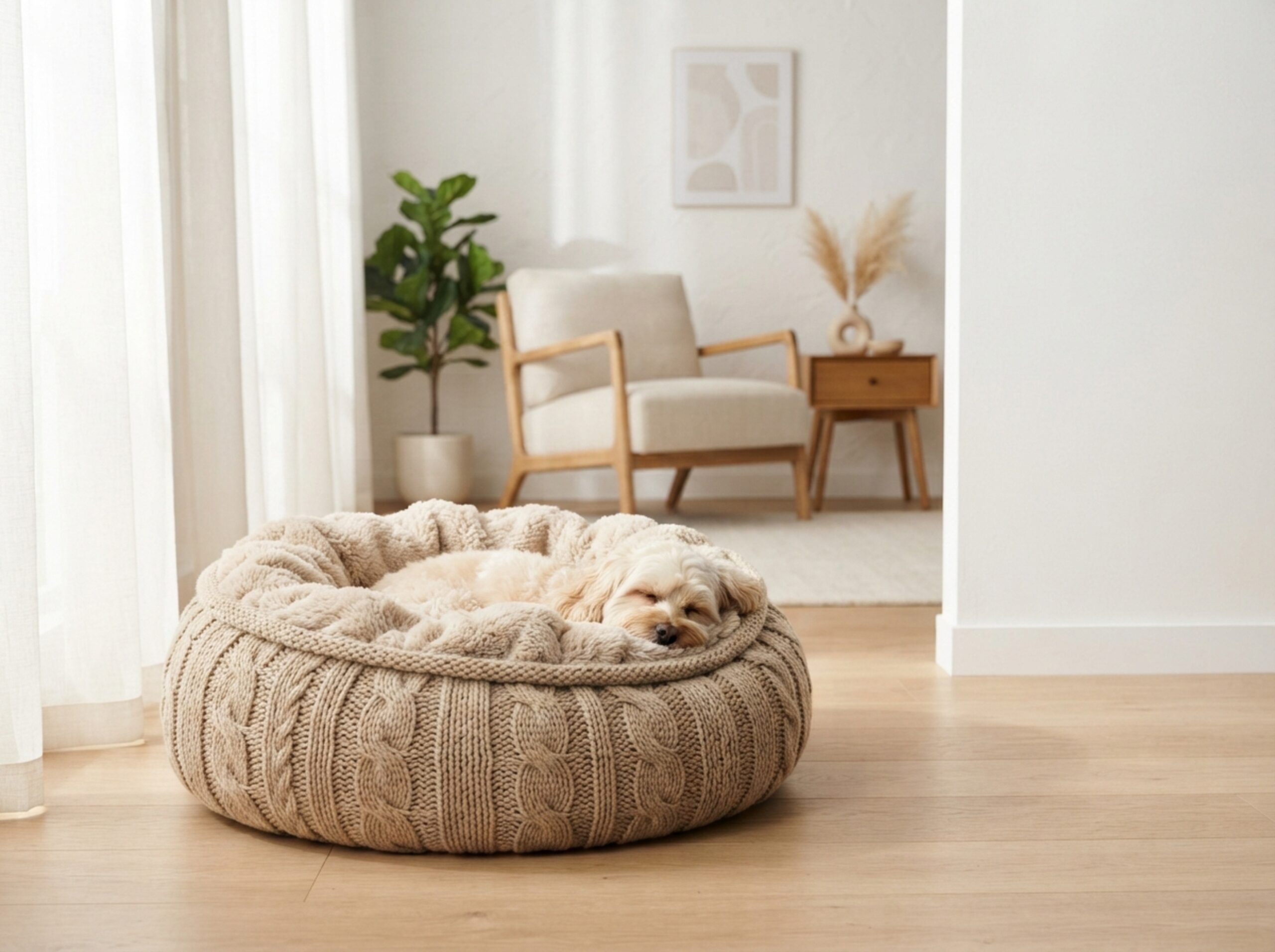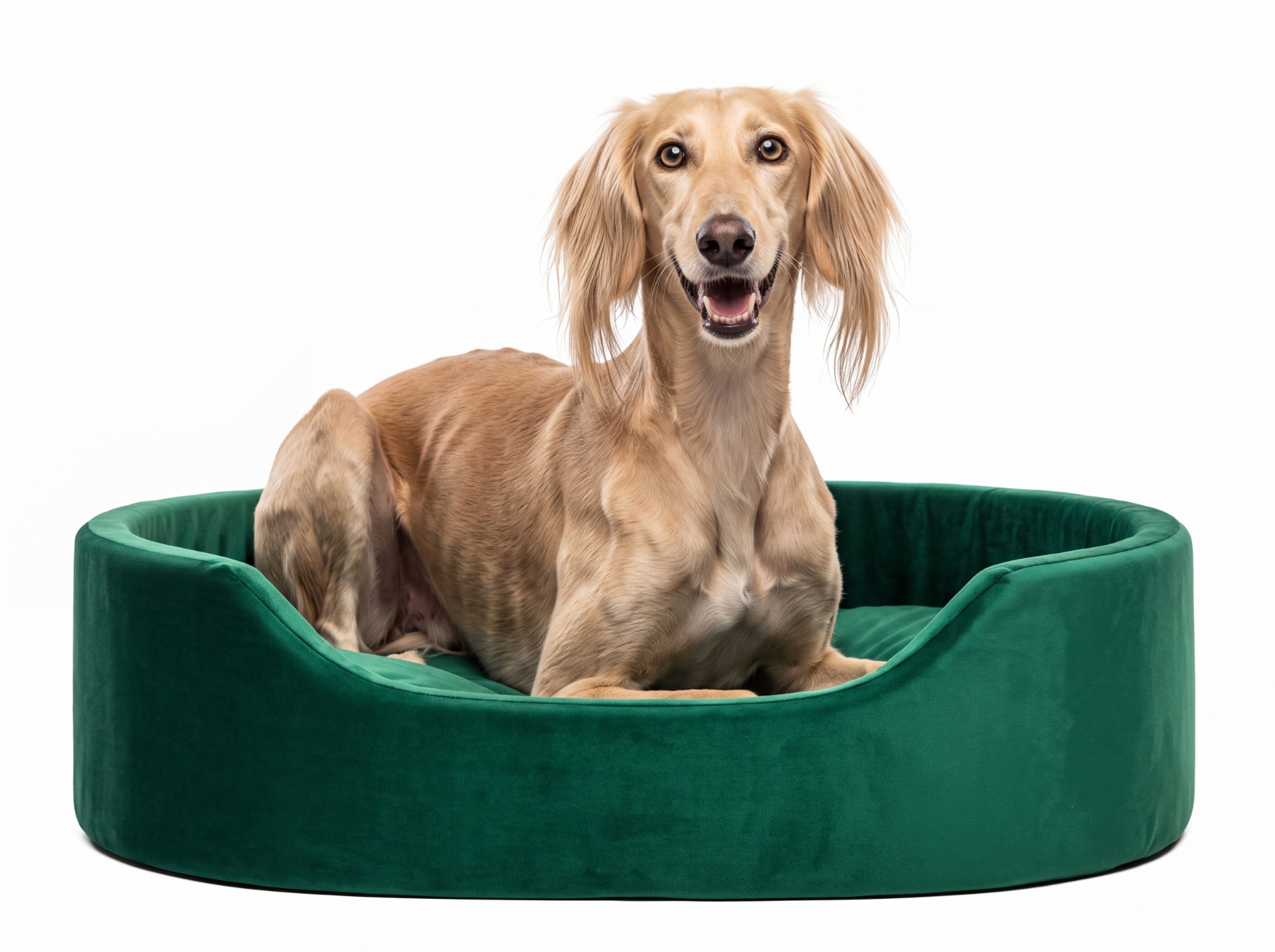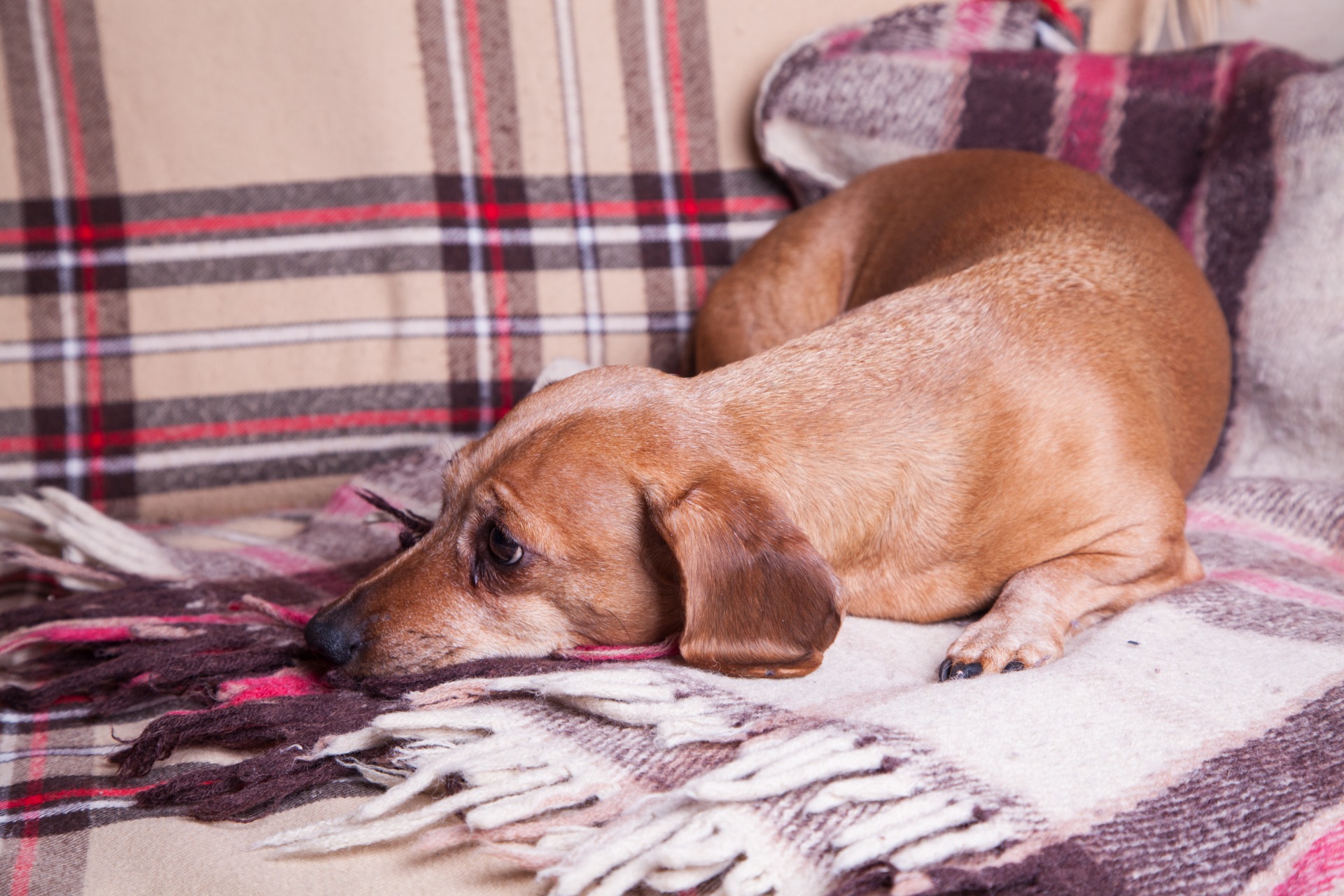

A no sew dog bed is two layers of fleece knotted around a pillow or cushion, and the finished sleeping surface is smaller than the fabric you cut. The fringe that becomes the knots eats about 3 to 4 inches on every side, and a half-tied strip will open the first time the bed is washed or pawed. Size the bed to how your dog actually lies down, then cut strips narrow enough to double-knot. Loose fiberfill is the wrong fill if your dog already destroys toys.
Measure the sleeping surface before you buy fabric

Weight charts are a rough filter, not a pattern. A useful published range puts dogs under 25 pounds on something around 18 by 24 inches up to 24 by 30 inches, 25 to 50 pounds on 24 by 30 up to 30 by 36, 50 to 75 pounds on 30 by 36 up to 36 by 42, and dogs over 100 pounds on 48 by 54 or larger. Labels are not standardized across brands, so inches matter more than the word “large.”
The measurement that actually fits is the dog on the floor. With the dog stretched out, measure from the tip of the nose to the base of the tail, then add 6 to 12 inches. That sum is the minimum length of the sleeping surface, according to a commonly used dog bed size rule. For width, measure from the back to the front paws while the dog is lying on its side, and add the same 6 to 12 inches. A dog that curls into a ball can sit at the low end of that range. A dog that sprawls on its side needs the high end, or the hips and a hind leg will hang off.
That finished size is not the cut size. If you want a 30 by 40 inch sleeping surface and your fringe is 4 inches, each fabric piece needs to be about 38 by 48 inches before you cut the corners. Add a little more if the insert is thick: a 4-inch cushion has to be covered on the sides as well as the top, so the two panels have to meet around that depth. One maker’s shortcut is to add about 6 inches to the length and width of the pillow itself, which leaves roughly 3 inches of fringe after the pillow is enclosed. Skip that shortcut on a thick foam slab or the knots will sit on the top face instead of at the edge.
Shape is the easy part. Square, rectangle, oval, and round all work with the same knot method. Rectangle is the least wasteful if you are cutting from a blanket. Round looks neat and wastes more fabric in the corners you cut away.
Use fleece for the shell and a whole insert for the fill
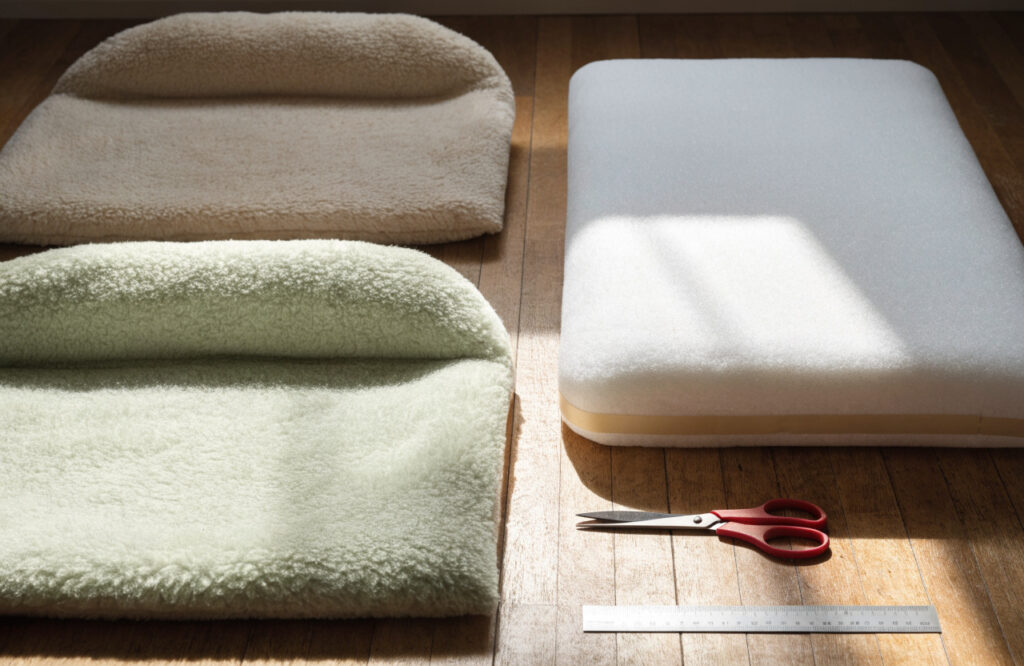
Fleece is the fabric that makes the no-sew method work. It does not fray when cut, so the strips stay intact after knotting, and it is soft enough that most dogs will lie on it. Anti-pill fleece holds its surface longer than bargain craft fleece, which mats and pills in a busy house. Dark or heathered colors hide hair and mud better than white. A 50 by 60 inch throw is often cheaper than fleece by the yard and yields two panels for a medium bed once the stitched binding is pulled off. Yardage is the better buy when you want a contrasting top and bottom, or a bed wider than a throw.
The bottom layer does not have to match the top. A tighter woven cotton canvas or an old flannel sheet on the underside grips the floor and hides less of the wear. Fleece on both sides is warmer and simpler to cut, because both layers behave the same under the scissors.
Fill is the decision that decides whether the bed can be washed. A whole pillow, a folded quilt, or a crib mattress pad already has its own cover. You untie one side, pull the insert out, and wash only the fleece. Loose polyester fiberfill, cotton balls, and cut-up foam do not do that. They shift into lumps, leak through any knot that loosens, and have to be bagged or thrown out at the first accident. One published build used two 16-ounce packs of fiberfill; a 20-inch square bed in another tutorial took a single 20-ounce bag. Those amounts are examples, not targets. Firmness is a feel test: the dog should sink a little and still have support under the hips.
Chewers change the fill choice. Polyester stuffing is not a poison, but a swallowed wad can block the intestine, and foam pieces are worse because they do not pass easily. Knots themselves can be chewed off and swallowed. If your dog already guts toys, do not stuff this bed with loose fill or leave it unsupervised. A tied cover around a pillow you can remove is still a risk. A flat folded blanket the dog cannot open is safer until the chewing settles.
Old pillows are fine if the ticking is intact and the smell is gone. Wrap a foam topper in a plastic mattress bag only if you also accept the downside: a destructive dog that opens the knots will shred the plastic. People who have built large tied beds this way report the bag saves the foam from accidents, and other owners report pups that treat the knots as a project. Match the insert to the dog in front of you, not to the neatest photo.
Cut the corners and the strips so a double knot can close
Work on the floor. Stack the two panels, fuzzy sides out, edges matched. The inside faces touch. If the blanket has a serged edge, snip one stitch and pull the thread out before you measure, or that hem will sit thicker than the rest of the fringe and the knots will not lie flat.
Mark a square at each corner the same length as your fringe, then cut those four squares out through both layers. A 4-inch fringe means a 4-inch square. Leaving the corners intact makes the knots bunch into a lump the dog will avoid.
Strips that hold are about 1 to 1.5 inches wide and 3.5 to 4 inches long. The Honest Kitchen’s published no-sew bed used 1.5-inch by 3.5-inch strips and warned that wider strips are hard to pull into a snug double knot. Shorter than about 3 inches and you cannot tie twice. Longer than about 5 or 6 inches and the sleeping surface shrinks while the fringe becomes something to chew. Cut both layers at once so the pairs already match. A ruler or a book laid across the fabric stops the scissors from running past the stop line. A cut that runs into the body of the bed is a hole, not a strip.
Count the strips on one side before you move on. An odd number is fine. What fails is a strip on the top with no partner on the bottom, which happens when the panels slip mid-cut.
Knot three sides, load the insert, then close the fourth
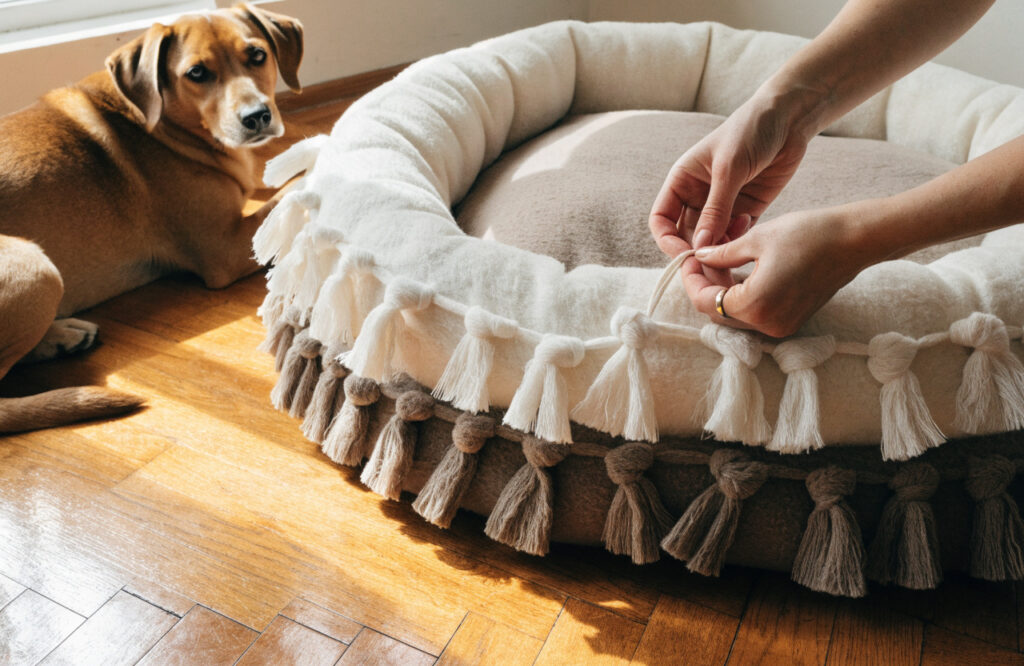
Start at a corner. Take one top strip and the matching bottom strip, tie them once, then tie again in the opposite direction so you have a square knot, not a single half hitch. A half hitch looks closed and opens under agitation. Pull each knot snug against the edge without stretching the fleece so hard that the strip thins and tears. Work around three sides. Leave the fourth side open, ideally a long side, wide enough for the pillow.
Slide the insert in before you tie the last side. Push fill into the corners first, then the middle. A mound in the center is the usual mistake, and dogs avoid the lump. If you are using loose fill rather than a pillow, add it in handfuls and stop while the bed still flexes. Overstuffing makes the knots strain and makes the bed harder to wash later.
Tie the last side the same way. Fluff from the center outward. The bed should look like a pillow with a tied border, not a sack. If a corner gaps, that square was too small or the first knot on that side was too loose. Untie those few strips and redo them. Untying is normal on this project. It is also how you will wash it.
A medium bed takes about 45 to 90 minutes the first time, most of it in the tying. A bed large enough for three dogs can take an afternoon.
The failures are knots, lumps, and chewing
Tied fleece opens for three reasons, and each one is visible before the dog rejects the bed.
The knots were never finished. Fleece is slippery. One loop pulls out in the washer or under a digging paw. Two loops in opposite directions, pulled tight, are what last. Some people add a tiny dot of fabric glue on the knot after the bed is shaped. Glue makes later untying harder, so use it only on a bed you plan to spot-clean rather than strip.
The strips were the wrong size. Wide strips will not cinch. Short strips give you one weak knot. Inconsistent lengths make the edge ripple, and the gap between two loose knots is where fill escapes.
The fill was loose and uneven. Fiberfill migrates toward the side the dog does not lie on. A whole pillow cannot do that. If you already stuffed with loose fill and the bed is lumpy, untie one side, pull the fill out, and restuff, or replace it with a pillow.
Chewing is the limit of the method, not a knotting problem. A Reddit owner who built a large tied bed for three dogs was told, accurately, that a pup who unknots things will open the edge, shred any plastic liner, and turn foam into confetti. The same risk is why published instructions tell you to watch a destructive dog: the knots can be chewed off. If you see frayed strips or missing knots, take the bed away. Do not “reinforce” a bed a dog is already eating.
Cost is the other disappointment. A throw, a spare pillow, and an hour can land well under the price of a small shop bed. A huge custom bed in new fleece and a new topper can hit the same $50 that discount stores charge for a finished bed, before you count the afternoon. The tie method earns its place when you need an odd size, already own the pillow, or want a cover you can remake when the fleece pills.
Wash the fleece, not the insert
This bed has no zipper. Washing it means untying one side, removing the pillow or cushion, and washing the shell. That is a feature. Fiber beds that go in whole clog machines with hair and come out still damp in the middle.
Vacuum hair off the fleece before it hits water. The American Kennel Club notes that wet hair clumps and clogs the machine, and that wash frequency depends on how often the dog uses the bed, the coat type, outdoor habits, and whether anyone in the house has allergies. The AKC also points to weekly washing as a way to cut the spread of parasites and zoonoses, with a deep clean every two to three weeks as a flea-control cadence from EPA guidance. A muddy dog or a puppy still having accidents needs the cover washed as soon as it is dirty, not on a calendar.
Polyester fleece wants cold water and a gentle cycle. Hot water and a normal cycle pill the pile and can flatten it. High dryer heat melts polyester, so use low or no heat, or dry flat. Fleece holds little water, so it dries faster than cotton. Skip fabric softener. It coats the fibers and speeds pilling. Wash the shell alone, not with towels that shed lint into the nap.
Spot-clean the insert. A damp cloth and a little diluted white vinegar handle a small mark. Foam that gets soaked needs to air-dry completely before it goes back under the cover, or it smells. If the pillow ticking is stained through, replace the pillow. The fleece shell can be retied around the new one in a few minutes.
Questions people ask after the first bed
Can I make this from old T-shirts instead of fleece? You can cut a large shirt into two panels and fringe the edges, but knit jersey rolls, frays, and stretches under a knot. It works as a short-term cover for a small dog. It will not hold like fleece, and the knots loosen sooner.
How much fabric does a large dog need? Two panels, each the finished sleeping size plus twice the fringe length. A 36 by 48 inch surface with 4-inch fringe needs two pieces about 44 by 56 inches. A single yard of 58-inch fleece is enough for many medium beds and not enough for a sprawling large dog. One yard for the top and one yard for the bottom was enough, in one published example, for a 100-pound dog that curls.
Do I have to cut the corners out? Yes, if you want a flat edge. The corner squares are the scraps that would otherwise stack into a thick knot. Cut them the same depth as the fringe.
Will the bed survive the washer if I do not untie it? Sometimes, for one cycle, if every knot is a real double knot. Agitation is what opens half hitches. Untying one side and washing the empty shell is the version that still closes afterward.
Which version to build
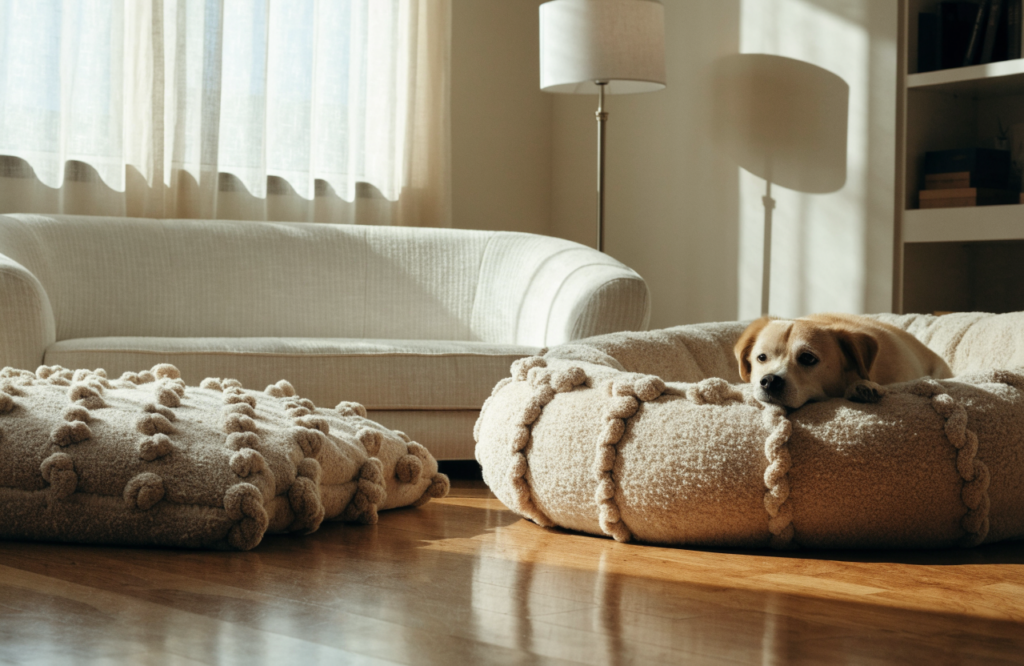
Build the pillow version if the dog rests without chewing: fleece top, optional canvas bottom, fringe about 1 to 1.5 inches wide and 3.5 to 4 inches long, double knots, one side left easy to untie. Size the sleeping surface to the stretched-out body plus 6 to 12 inches, and size up if the dog sprawls.
Skip loose fill, foam scraps, and plastic liners if the dog already opens toys. Use a tied cover only while you are in the room, or use a flat blanket until the chewing stops. A bed that cannot be opened is the right bed for that dog, and this method is the wrong one.