
A free dog cave bed pattern only works if the dog can walk out of it and you can wash the cover. Most free builds miss one of those. The well-known cone tutorial on Instructables hides a cardboard half-circle inside the shell, and the common free crochet cave is written for a cat or a toy dog with no finished measurement and no way to remove the yarn for a wash. Commercial cave beds start around 65 cm across for dogs under 7 kg and run past 1 metre for sighthounds, so a single unscaled sketch will not fit the dog in front of you.
Size the opening before you cut anything
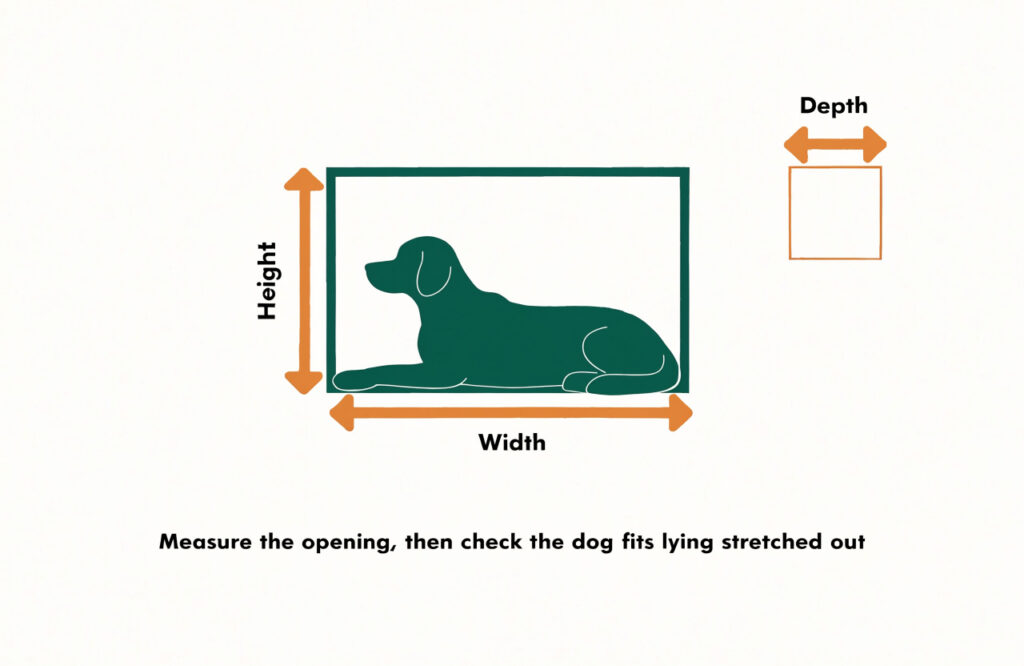
Cave beds suit dogs that curl, burrow, or want a wall at their back. They are a poor match for sprawlers. Dogster’s sizing note for cave beds is to measure from the nose to the base of the tail and add 8 to 12 inches for the diameter. A dog that measures 12 inches nose to tail base needs about a 20 to 24 inch sleeping circle.
Retail size charts land in the same place. Snoozer’s Cozy Cave guide lists a 65 cm diameter for dogs under 7 kg, 90 cm for 7 to 23 kg, and 115 cm for dogs over 23 kg. Collared Creatures maps 65 cm to toy breeds and mini dachshunds, 80 cm to cocker spaniels, French bulldogs, and whippets, 98 cm to boxers and vizslas, and 114 cm to greyhounds. KONA’s large cave is 110 by 85 cm with a 65 cm opening, rated to about 40 kg. If your dog is between sizes, or likes to stretch once inside, use the larger cut.
The opening is the measurement people skip. A hood that looks cozy in a photo can trap a tall dog if the lip sits below the shoulders. Keep the front edge at least as tall as the dog’s shoulder height while standing, and wide enough that the dog turns around without backing out. The pattern below uses three openings: 10 inches, 13 inches, and 16 inches.
| Size | Dog weight guide | Finished base | Opening height | Who it fits |
|---|---|---|---|---|
| Small | Under 7 kg (15 lb) | 24 in (61 cm) | 10 in | Curlers: Chihuahua, Pomeranian, pug |
| Medium | 7–23 kg (15–50 lb) | 32 in (81 cm) | 13 in | French bulldog, corgi, beagle, whippet |
| Large | Over 23 kg | 40 in (102 cm) | 16 in | Boxer, vizsla, greyhound that curls |
These diameters sit just under the retail charts on purpose. A bolster or hood steals interior space, the same way a bolster bed’s usable area is smaller than the outer label. A sighthound that sleeps in a long line, not a ball, still needs the 40 inch base or larger. One Horse and Hound maker used a 42 inch round bed under a duvet hood and found it large enough for two whippets.
Fabric and fill that can leave the bed
Use two fabrics. The outside should be a tight weave: cotton canvas, denim, or outdoor upholstery. Fleece and faux fur feel better on the inside, but they pill, hold hair, and give a chewer a loose edge. Dogster’s roundup flags the same practical limit on bought caves: most are not made for heavy chewers, and a puppy that is still learning with its mouth will open seams before the bed has earned a wash.
Cut the fill as its own part. A round pillow or a foam disc inside a zipped case can be pulled out. Loose polyester stuffed into the hood will clump after one wash, which is the failure Dogster notes on beds whose filling cannot survive the machine. Do not put cardboard in the shell. The Instructables cone uses a 41 by 20 inch cardboard half-circle and a 10 inch entrance hole, which holds a nice shape until the first accident. Cardboard warps when wet and cannot go through a washer.
If the hood needs to stay open, sew a casing along the lip and slide in a plastic-coated wire, a short section of foam pipe insulation, or a lightweight plastic rod. The rod should pull out before washing. A soft hood with no support is fine for a dog that likes to nose under a blanket. It is not fine if you want a standing cave.
Skip cooling gel packs and hydrogel mats inside the cave. The ASPCA Poison Control warning on hydrogel cooling pads is specific to those products, but the general rule still applies: if a dog eats bedding fill, call a veterinarian or poison control rather than waiting to see what comes out the other end.
Free pattern: cut list and seam plan
This is a round mattress with a separate hood that snaps or Velcros to the back half of the top. The hood comes off for washing. Seam allowance is 1/2 inch throughout. A zipper on the mattress cover is worth the extra ten minutes.
Small (24 inch finished base)
- Mattress: two circles, 25 inches across
- Optional side band: 4 inches high by 76 inches long (pi times 24, plus 1 inch for the join)
- Hood outer and hood lining: two rectangles, 28 inches wide by 16 inches tall
- Lip casing strip: 2 inches by 26 inches, if you want a removable rod
- Four sets of snaps or 12 inches of sew-on Velcro, split into four short pieces
Medium (32 inch finished base)
- Two circles, 33 inches across
- Side band: 4 by 101 inches
- Hood rectangles: 36 by 20 inches, cut two
- Casing strip: 2 by 34 inches
Large (40 inch finished base)
- Two circles, 41 inches across
- Side band: 5 by 127 inches
- Hood rectangles: 44 by 24 inches, cut two
- Casing strip: 2 by 42 inches
The hood width is a bit more than one third of the base circumference, so it covers the back and sides without sealing the front. Draw the circles with a thumbtack, string, and marker. The string length is half the cut diameter. Mark the back half of the top circle with pins before you sew anything else, so the hood lands on the rear arc and the opening faces the room.
Yardage, with matching nap and a little waste: about 1.5 yards of outer fabric and 1 yard of lining for small, 2 yards and 1.5 yards for medium, 2.5 yards and 2 yards for large. A queen flat sheet is enough outer fabric for the small and often the medium if you piece the side band.
Sew the bed in this order
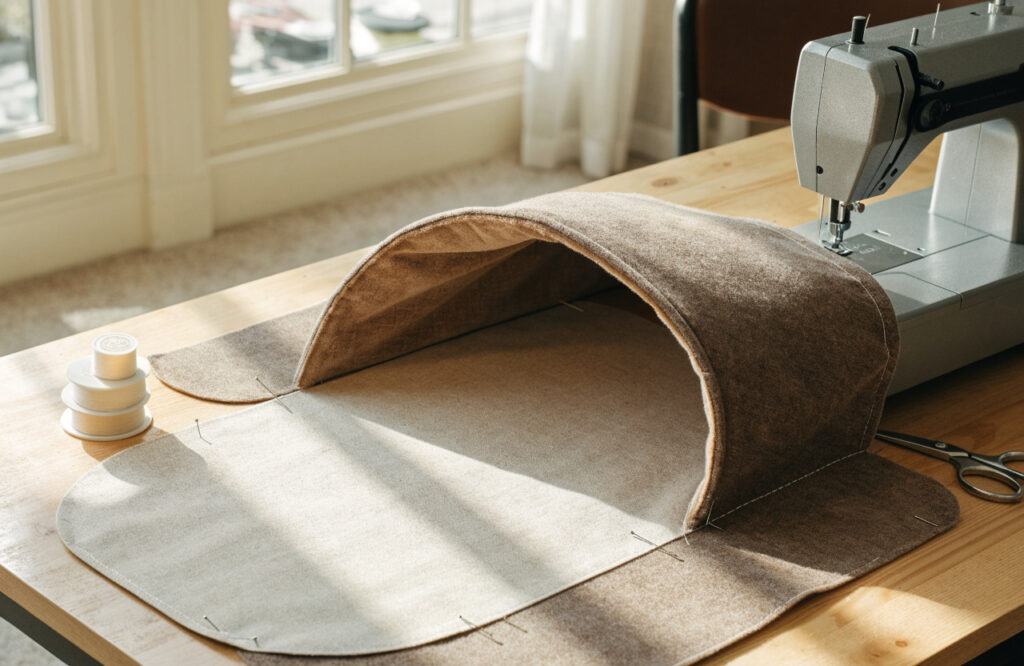
- Sew the side band into a loop. Pin it to one circle, right sides together, and stitch. Repeat with the second circle, leaving a 12 inch gap if you are not using a zipper. Clip the curves so the circle lies flat.
- Insert a zipper in the gap, or turn the cover through the gap, stuff a round pillow or foam disc, and close it. The fill should be firm enough that the dog does not sink to the floor, and separate from the hood.
- Place hood outer and lining right sides together. Stitch the two short sides and the bottom edge. Turn and press. The open top edge is the lip.
- If you want a standing opening, fold the lip down 1 inch, stitch a casing, and leave a 2 inch gap. Slide the rod in after the bed is finished, not before the next wash.
- Pin the bottom edge of the hood to the marked rear arc of the mattress top. Attach with snaps or short Velcro tabs every 6 to 8 inches. Sewing the hood on permanently is faster and worse. You will want it off the first time the dog tracks mud inside.
- Topstitch the hood side edges so the lining does not roll out. Check that the front gap is at least the opening height in the table. If the lip sags onto the mattress, the opening is too soft or the hood is too wide. Shorten the hood width before you add more stuffing.
A sewing machine makes the circles easier, but the same order works by hand with a backstitch and a thimble. Budget an afternoon for a first medium bed, less once the circles are cut.
No-sew version from a round bed and a duvet
If you already own a round bed, copy the method a sighthound owner posted on the Horse and Hound forum, with one change. They bought a 42 inch round bed for £16 to £17, sewed a cheap duvet into an old duvet cover, folded that duvet in half, stitched the sides, and stuck it to the base with Velcro. Total spend was about £25. The whippet cross slept in it the first night, snout out, then turned around so only two paws showed.
Skip the glue some no-sew videos use on braided covers. Glue blocks washing, and a commenter on one of those builds pointed out the obvious next problem: the bed falls apart in the machine. Velcro or large snaps on the base, and a duvet that already has a cover, give you the same cave. Fold the duvet so the open edge faces forward, and leave that edge unstitched. Show the dog the opening with a treat inside. The forum report said the dog needed a little coaching before it used the hood on its own.
This shortcut is the right one for a nervous adult that already likes blankets. It is the wrong one for a puppy, because a duvet is mostly loose fill behind a thin cover.
Mistakes that make the cave unusable
The entrance is a porthole. A 10 inch hole is what the cardboard cone uses, and it suits a small dog only. Scale the hole with the shoulder, not with the photo. If the dog hesitates, backs out, or will not turn around inside, cut the hood shorter and raise the lip.
The shell is the structure. Cardboard, cereal-box inserts, and glued braids all fail at the first wash. A removable rod in a casing does the same job and comes out in seconds.
Fill is one bag of loose fiber. Polyfill in a closed hood shifts to the edges and leaves a cold bare spot in the middle. A channeled pillow, or a foam disc in its own case, stays put. If your dog already opens seams and eats the inside, do not leave this bed out unsupervised. Covered beds have more seams than a flat mat, and seams are where chewing starts.
One size for every sleeper. A cave that is only a little bigger than the curled dog feels secure. The same cave on a dog that sleeps on its side with legs out becomes a tight shirt. Dogster notes that sprawlers do not have enough room in a typical cave. Give that dog a flat bed, or make only the hood and leave the front two thirds open.
The cover cannot come off. Odor sets in when owners delay washing a heavy one-piece bed. A hood that unsnaps and a pillow that unzips can be washed on cold and dried on low, or air-dried if the outer fabric is canvas. Wash the cover when it smells or looks soiled, not on a fixed heroic schedule. Two hoods beat one hood washed every week until the fleece pills through.
What to do after the first night
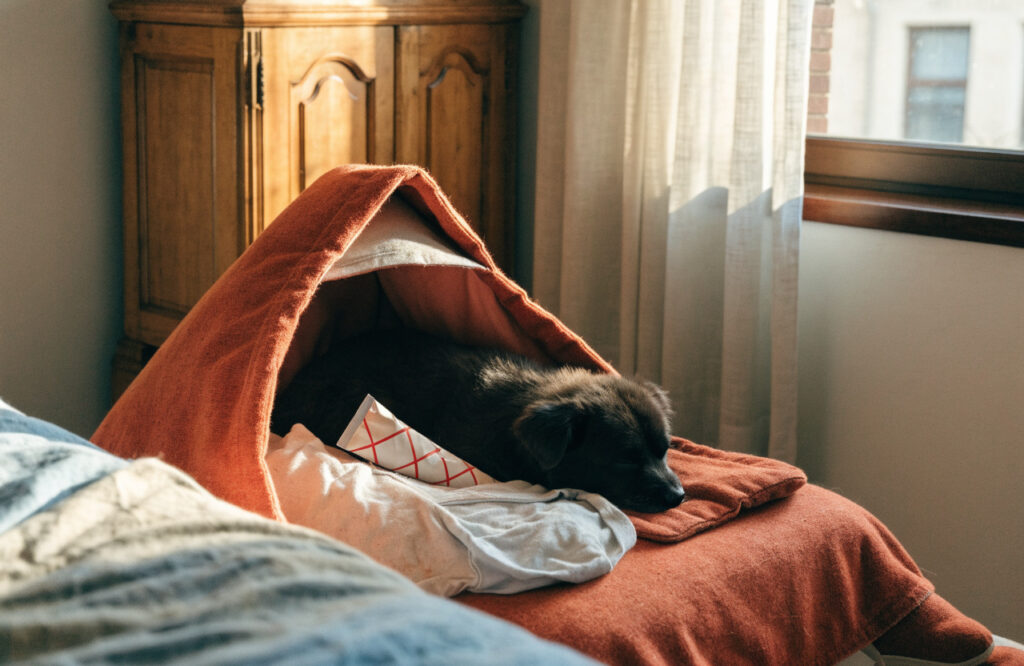
Put the bed where the dog already rests, not in a new corner, and leave the hood off for the first session if the dog is unsure. Lift the lip, toss a treat to the back, and let the dog leave on its own. A fit is right when the dog can turn around, lie with the spine against the hood, and exit without scraping the shoulders. If the dog only sleeps with the head and shoulders outside, the opening is low or the base is short. Raise the lip or recut the next size up. If the dog ignores it for a flat mat, the dog is a sprawler and the cave was the wrong bed, not a failed sew.
Questions makers ask after the first cut
Can I make this from an old sweater? A sweater works as the hood lining on the small size, not as the whole bed. Knit stretches, seams pop, and there is no casing for a rod. Use it inside a canvas hood if you want the smell of home on the fabric.
Does a heavy chewer need a different pattern? Yes. Wait, or build a flat canvas mat with no hood. Dogster’s product notes repeatedly mark cave beds as not made for heavy chewers or puppies. More fabric means more edges. A denim outer delays damage. It does not stop a dog that swallows pieces.
Do I need the side band? No. Two circles sewn together make a flatter cushion and a wider sleeping area. Add the band only if you want a bolster height of about 3 inches. The band also makes the zipper easier to install on a straight edge.
How do I scale past 40 inches? Add 8 inches to the finished diameter and about 3 inches to the opening height, then recompute the side band as pi times the new diameter plus 1 inch. A 48 inch base is in the range of the largest retail caves and needs a wider hood rectangle, about 52 by 28 inches, or the hood will not reach the sides.