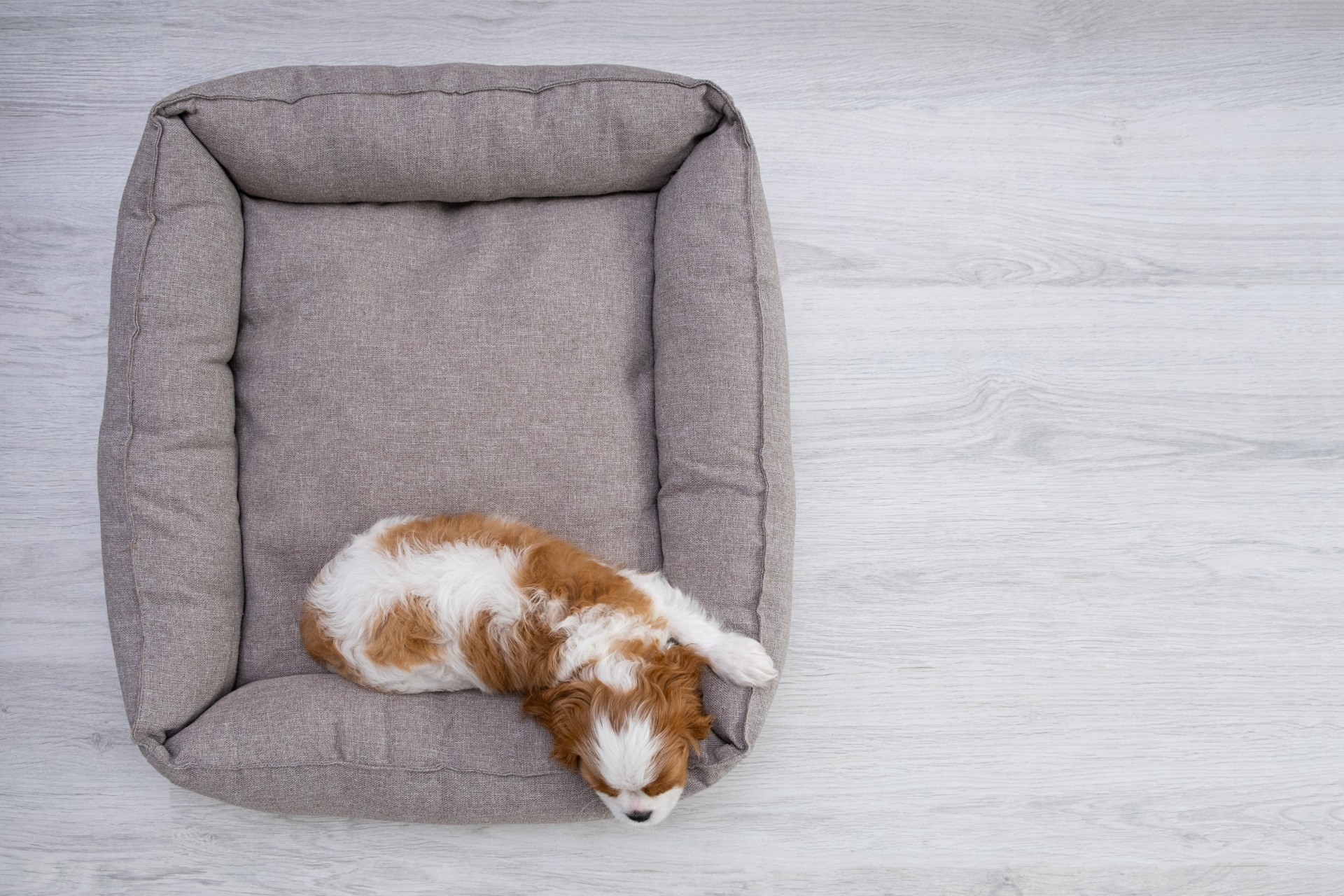

A published dog bed plan is a cut list for someone else’s cushion, not a size for your dog. The Woodshop Diaries plan hosted by Kreg is built around a commercial pad of about 25 by 35 inches when puffed up (28 by 38 inches flat). That rectangle suits many medium dogs and fails a sprawling Labrador. Bolster-style frames make the miss worse: the outer length on the plan is not the length the dog can actually lie on.
Size the sleeping surface before you open a plan
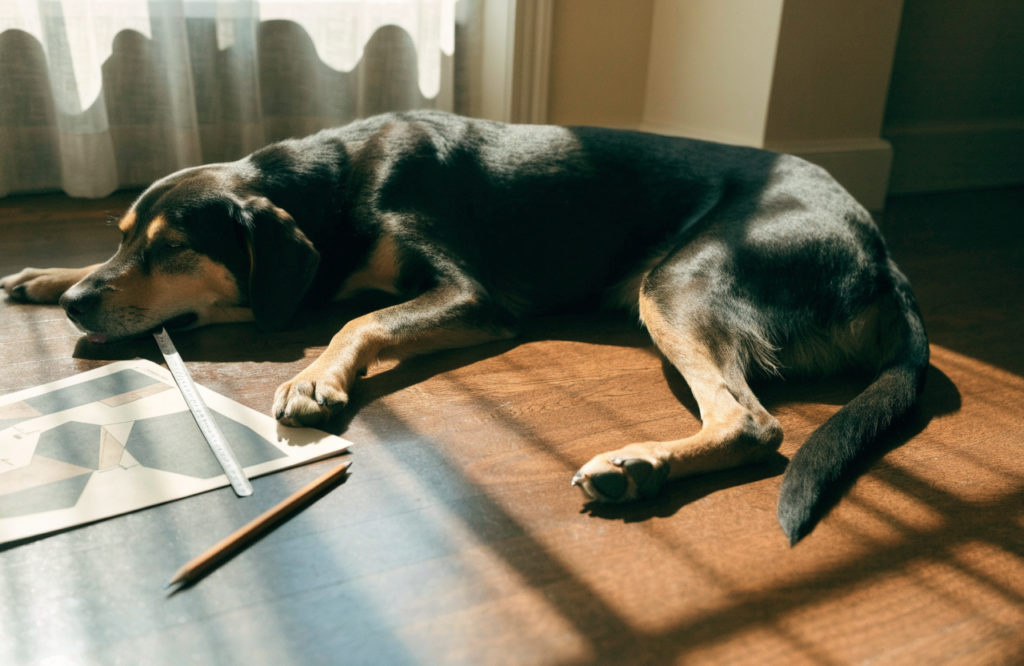
Measure the dog lying in the position they actually sleep in, from the tip of the nose to the base of the tail, not the tail tip. Retail sizing charts then add about 6 inches for a dog that curls and 10 to 12 inches for a dog that stretches flat. Weight charts are only a starting point, and they do not agree with each other. One common retail band puts dogs under 25 pounds on beds around 18 to 30 inches long, 25 to 50 pounds on about 24 to 36 inches, and 50 to 75 pounds on about 30 to 42 inches. A long, light dog breaks that chart. A 23-pound dog can outspan an “extra large” bed if the body is dachshund-long.
Width matters as much as length for sprawlers. Measure across the body at the widest point while the dog is on its side, then add the same extra inches. Curlers can live with a tighter circle, and a bed that is much larger than the curl can feel exposed. When you are between two sizes, go up one step, not two.
Bolster and box frames steal the measurement people forget. Raised sides eat the flat interior. A frame listed as 36 inches long may leave only 28 to 30 inches of sleeping surface once the rails are in place. Size the cushion to the interior, then build the rails around that cushion. If the plan you like is a three-sided box, buy or sew the pad first and cut the bottom about an inch smaller than the pad in both directions, which is how the Kreg modern bed is meant to be resized.
Match the plan to how the dog sleeps and where the bed lives
Four plan families cover almost every free dog bed plan online. Pick by the dog’s problem, not by the photo.
PVC cot. A fabric sling on schedule 40 pipe is the fastest outdoor or garage bed. HGTV’s raised cot finishes at 27.5 by 31.5 inches from one 10-foot stick of 1-inch pipe cut into two 28-inch rails, two 24-inch rails, and four 4-inch legs, plus furniture-grade three-way corners that big-box stores often do not stock. This Old House’s outdoor bed uses 1¼-inch pipe, 5-inch feet, and a canopy, rated easy, about four hours, and $100 to $200. Air under the sling keeps hot sleepers cooler and lets hair fall through. The sling is a poor choice for a senior who needs a firm push-off point to stand, and chewing dogs will puncture the fabric.
Plywood box. A three-sided box on short legs holds a bought orthopedic pad and looks like furniture. The Kreg version uses a half sheet of ¾-inch plywood, pocket holes, and 1¼-inch pocket screws, and is marked easy. Low entry on one side matters more than a tall back. A dog with stiff hips should not have to hop a 10-inch rail.
Slatted wood frame. An Instructables elevated frame uses 2-by-2 stock: four 8-inch legs, two 28-inch rails, two 32-inch rails, and five 1-by-6 slats, for an 85-by-85-centimeter (about 34-by-34-inch) platform. This is the right family for a heavy indoor dog if you add a center support. It is the wrong family if you skip that support.
Sewn cushion only. A cover with a zipper and a foam insert needs no frame. It is the right plan when the dog already has a corner, a crate, or a piece of furniture to sleep against. Finished sewing sizes in one quilting pattern run 20 by 15 by 3 inches (small), 24 by 18 by 4 inches (medium), and 36 by 27 by 5 inches (large). Foam depth is the whole product. Welfare groups do not publish a minimum thickness. What fails in practice is thin foam that compresses until the dog is lying on the floor.
Pallet builds sit in the slatted family and add a materials check. Under the ISPM 15 wood-packaging standard, a pallet stamped HT was heat-treated to at least 56°C (133°F) through the core for 30 minutes. A pallet stamped MB was fumigated with methyl bromide. Use only a clearly stamped HT pallet, and skip anything with no mark, an odd smell, or dark chemical staining.
Scale the cut list without breaking the joints
Change length and width. Do not freely change height, rail thickness, or fastener size.
Start from the interior. If the pad is 30 by 40 inches, the platform or box floor should be about an inch smaller so the pad sits inside the rails instead of sliding off. Side rails then become pad width plus the thickness of the two end boards. Write the new numbers on the cut list before you buy lumber. A half sheet of ¾-inch plywood (48 by 48 inches) covers a large box floor and the rails for a medium-large dog. A giant breed often needs a full sheet, and the floor should be two pieces with a center rail under the seam.
Leg height is a mobility choice, not a style choice. The HGTV cot uses 4-inch legs. This Old House uses 5-inch feet. The Instructables wood frame uses 8-inch legs. Short legs keep a stiff dog from having to climb. Taller legs help a hot sleeper and make cleaning under the bed easier. Do not copy a 12-inch “sofa” height for an arthritic dog unless you also build a ramp. A raised bed only helps joints if getting off it is easier than getting up off the floor.
PVC does not scale the way wood does. A 1-inch cot that is fine at 28 by 24 inches will sag under a 90-pound dog if you stretch it to 48 inches without going up to 1¼-inch or 1½-inch schedule 40 pipe and adding a mid-rail. Buy extra pipe. Both the HGTV and This Old House builds assume a mis-cut.
Stop the frame from racking under a heavy dog
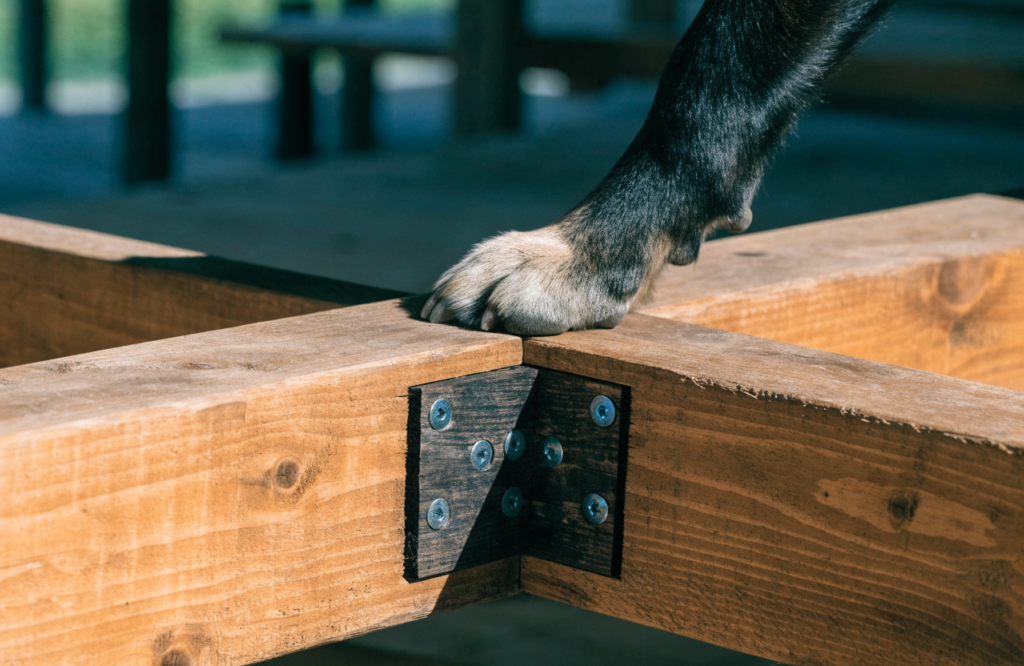
A light dog hides bad joinery. A young large dog does not. Woodworkers building frames around 52 by 30 inches for Great Danes in the 140- to 160-pound range worry about racking, which is the frame twisting into a parallelogram when the dog plops down on a corner. Butt joints and glue alone are a weak answer, especially where end grain meets face grain.
What holds:
- A full ¾-inch plywood floor, set into a rabbet or resting on a ledge cut into the rails, turns the box into a torsion box. A glued-on ledge is weaker than a dado or rabbet, and a narrow ledge lets the floor pop out when the dog stands on one edge.
- If you want hair to fall through, use slats with a center beam under them, not three decorative boards that miss the load path. Move supports close to the side rails and glue them to the rails.
- Pocket screws plus glue are enough for a small pine box. On a large frame, add dowels or a rabbet so the joint is not only fasteners in end grain.
- Four legs need a lower stretcher or the plywood floor tying them. Metal sofa legs with no stretcher are a common racking point.
Test the empty frame by pushing a corner diagonally. If it shifts, fix it before the cushion goes in. A cushion will not stiffen a loose frame.
Finish and fabric the dog will actually contact
Clear film finishes are widely treated as safe for incidental contact once they have fully cured, which is not the same as dry to the touch. Oil-based polyurethane often needs about a month before the smell is gone. If it still smells, it is not cured. Danish oil and boiled linseed oil contain metallic driers that remain in the film, so they are a poor choice on a rail a puppy chews. Shellac and pure tung oil, fully cured, are the more conservative indoor options. Paint is fine if it is fully cured and not flaking. Skip pressure-treated lumber indoors.
Outdoor cots need outdoor or upholstery fabric, not bedsheets. Stretch it and screw it through a double fold, as the HGTV cot does with #8 by ½-inch lath screws, or the sling walks off the pipe. A bought orthopedic pad needs a waterproof liner and a washable cover. A human mattress topper is the same foam family and none of that protection. One accident ruins it.
What the build costs against buying the bed
The frame is the cheap part. The pad is the product.
HGTV’s comparison put store cot beds at $60 to $100 and the PVC copy under $30, before a cushion. Creator-reported wood costs in popular small-bed plans land around $12 for furring strips and around $36 for a frame aimed at a 60- to 70-pound dog. This Old House’s canopied outdoor bed is the outlier at $100 to $200, mostly fittings and fabric. Those figures assume you already own a saw and a drill.
Retail orthopedic beds run from under $50 to well over $350. Big Barker’s original beds list from $249.95 to $359.95 by size, with a 10-year no-flatten warranty on the foam. A DIY frame plus a mid-range pad often beats a furniture-style bed. It does not beat a warranty on seven inches of foam if the dog is heavy and the pad is the thing that fails. Build the frame. Buy the foam unless you already know how to encase it so it can be washed.
Mistakes that make the dog ignore the bed
The usual failures are sizing and entry, not stain color.
- Building to the outer dimension of a bolster plan, then wondering why the dog hangs off the end.
- Using a cute high rail on a senior. Easy in and out matters more than the look of a sofa.
- A soft, deep nest for an arthritic dog. Sinking makes standing up harder. Firm support that does not bottom out is the point of an orthopedic pad.
- No center support on a wide slatted bed. The middle sags, the dog stops using it, and the joints loosen.
- An MB pallet, or an unmarked one, brought indoors.
- Putting the bed in a draft or a traffic lane and blaming the plan. Dogs abandon beds for location as often as for size.
Questions builders ask after the first cut
How big should the bed be if I only know the weight? Use weight only to pick a starting band, then measure nose to tail base and add 6 to 12 inches. A long 25-pound dog can need a large bed. A compact 50-pound curler may not.
Are raised beds better for sore joints? They keep the dog off cold, damp floors and can make standing easier if the exit is low. A high cot with a soft sling is a worse stand-up than a firm pad on a 4-inch frame. Offer the lower option if the dog is stiff.
Can I enlarge a free plan by a percentage? Scale the floor to the pad. Do not scale leg stock, pipe diameter, or screw length by the same percentage. A 20 percent longer cot needs thicker pipe or a center rail, not just longer sticks.
Is a pallet bed safe? Only with a visible HT mark under the ISPM 15 stamp, after sanding and a cured finish. MB-marked and unmarked pallets are the ones to leave outside the project.
Which plan to build this weekend
Build a PVC cot if the bed lives outside, the dog runs hot, or you want the project done in an afternoon and already have a pad. Build a low plywood box if the bed lives in the house and you are dropping in a bought orthopedic cushion. Build a slatted frame with a center rail only if the dog is heavy and you want hair to fall through. In every case, buy or measure the pad first, cut the interior an inch inside that pad, and keep the entry low enough that the dog does not have to hop. If the empty frame twists when you push a corner, it is not finished.