
The search results are mostly free patterns. The gaps are fit, washable yarn, joint support, and the chewing risk, so the article is built around those.
A knit dog bed is a soft nest or mat, not a joint-support mattress. The versions that hold up are sized to how the dog actually sleeps, made from yarn you can wash, and kept away from chewers. Yarn and string are classic linear foreign bodies, and the Merck Veterinary Manual notes that this type of obstruction carries a higher risk of the object sawing through the intestinal wall. A pretty pattern does not cancel that.
Two constructions, and what each one can do
Most free knit dog bed patterns fall into one of two builds.
A chunky mat or nest is a rectangle or oval in jumbo or super-bulky yarn, often arm-knit or worked on very large needles, sometimes with a raised edge. The yarn itself is the cushion. One 2025 hand-knit pet bed used four skeins of a jumbo chenille (listed at about 550 g and 26 yards each) and finished around 24 by 30 inches. The maker’s 70-pound standard poodle would settle on it but could not fully stretch out. That is the useful limit of this style: a soft landing for a curl or a nap, not a full sprawl bed for a large dog.
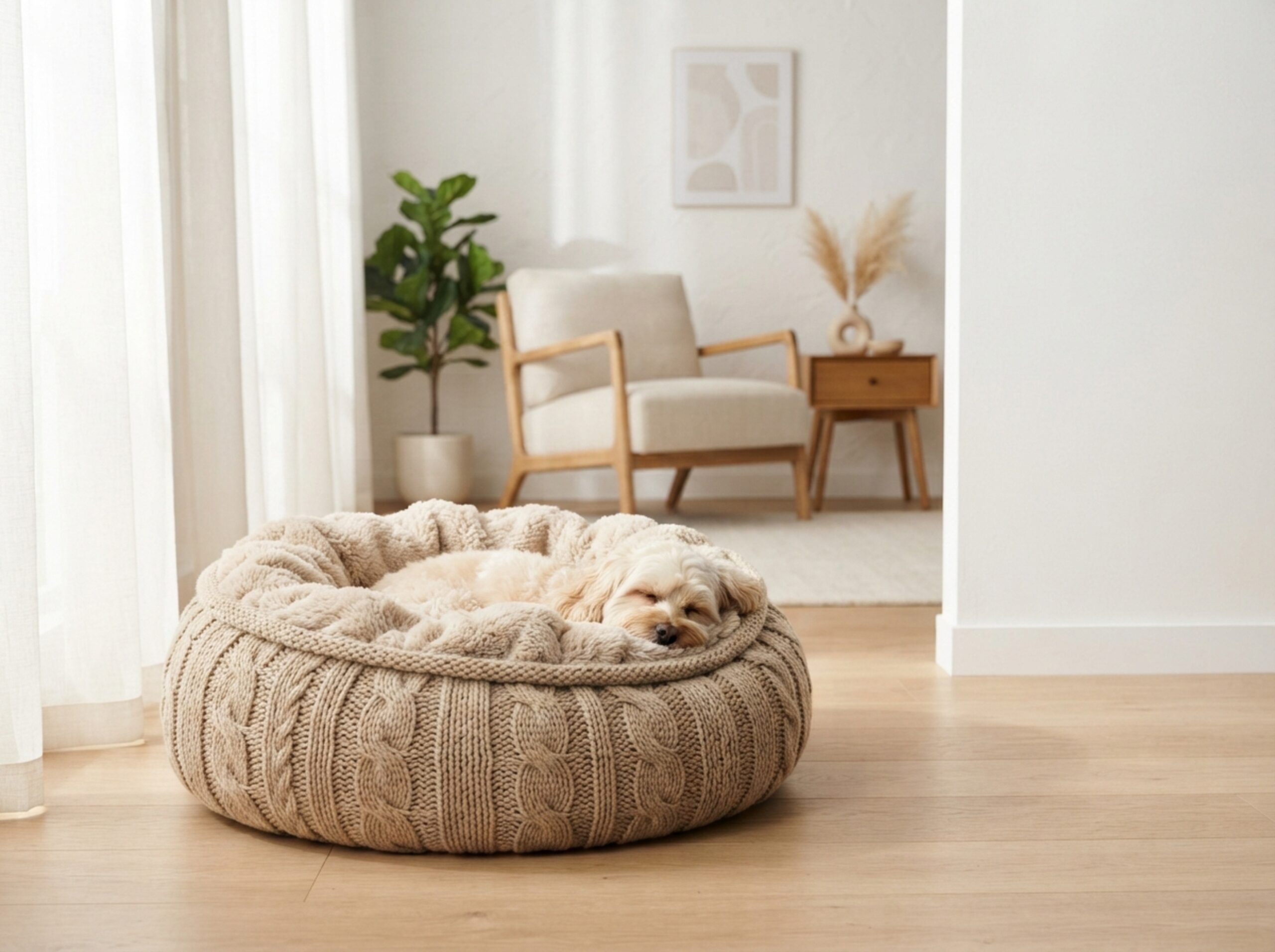
A donut or bolster bed is a knitted base plus a stuffed ring, or a cover slipped over a cushion. A published mega-chunky version finished about 25 inches (63.5 cm) across and used a 16-inch (40 cm) scatter-cushion inner, roughly 400 g of main-color yarn plus a contrast skein. Yarnspirations’ Bernat knit pet bed is offered at about 16, 24, and 35 inches in diameter, with a side border about 6 to 8 inches tall, and calls for quilt batting as well as super-bulky yarn. A smaller stuffed “bone” or character bed in DK or chunky yarn, with toy stuffing, is a third variant and is really a toy-scale bed for a cat or a very small dog.
Neither build replaces a foam mattress. The knit layer supplies texture, warmth, and a rim to lean on. Support comes from what you put under it, or from whether you skip the knit bed entirely.
Size it from the sleeping pose

Weight charts are a rough start and a common miss. Measure the dog lying down, from the tip of the nose to the base of the tail. That length is the minimum usable floor, not the outside diameter. A CertiPUR-US sizing summary of American Kennel Club guidance adds 8 to 10 inches for comfort and sorts dogs into curlers, burrowers, sprawlers, and leaners. Other retailer guides add 6 to 12 inches, or about 15 to 30 cm. The exact add-on matters less than measuring the interior after walls and thick yarn eat space.
A 32-inch outer basket with 4-inch walls may leave only about 24 inches of floor. The same problem shows up in the published knit sizes: a 24-inch medium donut is a curl bed, and the 24-by-30-inch jumbo mat was already tight for a leggy 70-pound dog.
| How the dog sleeps | Usable floor to aim for | Knit style that matches |
|---|---|---|
| Curls into a circle | Diameter of the curl, plus a few inches | Donut or nest with a low rim |
| Leans into a wall | Curl length, rim high enough for a chin | Bolster only if the step-in stays low |
| Sprawls on the side | Nose-to-tail plus 8–12 inches, and shoulder width plus room for elbows | Flat mat, or knit cover over a mattress |
| Large or giant, full stretch | Often 40 inches or more of interior | Knit alone rarely reaches this without a huge yarn bill |
Watch two or three nights before you cast on. A curler in a huge flat mat may never settle. A sprawler in a 16-inch small donut will hang off it and ignore it. Between sizes, size up, except for a nervous small curler who wants walls close in. The PDSA’s arthritis advice is to offer a choice: an enclosed bed or a flat mattress, because some dogs need to stretch and some need to snuggle.
Yarn that can be washed, and fillings that stay inside
Dog beds meet mud, saliva, and the occasional accident. Washability beats fiber romance.
Machine-washable polyester chenille and acrylic or acrylic-blend chunky yarns are the practical default. Lion Brand’s Cover Story, a 100% polyester super-bulky chenille, is labeled machine wash and machine dry, which is the care profile you want even if you use a different brand of jumbo tube yarn. Makers who use tube yarns such as Loops & Threads Wild & Free or similar arm-knitting tubes choose them for the same reason: the bed will need a wash, and wool felt or a non-superwash merino will not forgive a hot cycle. Wool can regulate temperature and resist odor when it stays dry, but a pet bed rarely stays dry.
Skip these fills unless the cover is a real barrier:
- Polystyrene beads in a loosely seamed cover. A pulled stitch turns the bed into a scatter of beads.
- Loose toy stuffing in a bed a chewer can open.
- Anything with buttons, safety eyes, or sewn-on bows on a bed the dog will mouth. Those belong on a display piece, not a sleep surface.
Sew every seam twice. Weave in ends and knot joins so a claw cannot start a run. On the first week, check the bed after each nap. A loop that pulls out is a string, and a string is the hazard in the next section.
Yardage climbs fast. A small hand-knit nest can be one or two jumbo skeins. A medium donut in mega-chunky yarn is often several hundred grams. A large 35-inch bolster pattern can take multiple skeins of super-bulky yarn plus batting. Chunky kits are sometimes priced like a finished store bed. If the yarn bill approaches the cost of a washable foam bed with a spare cover, buy the foam bed and knit a blanket instead.
Why a chewer should not get a knit bed
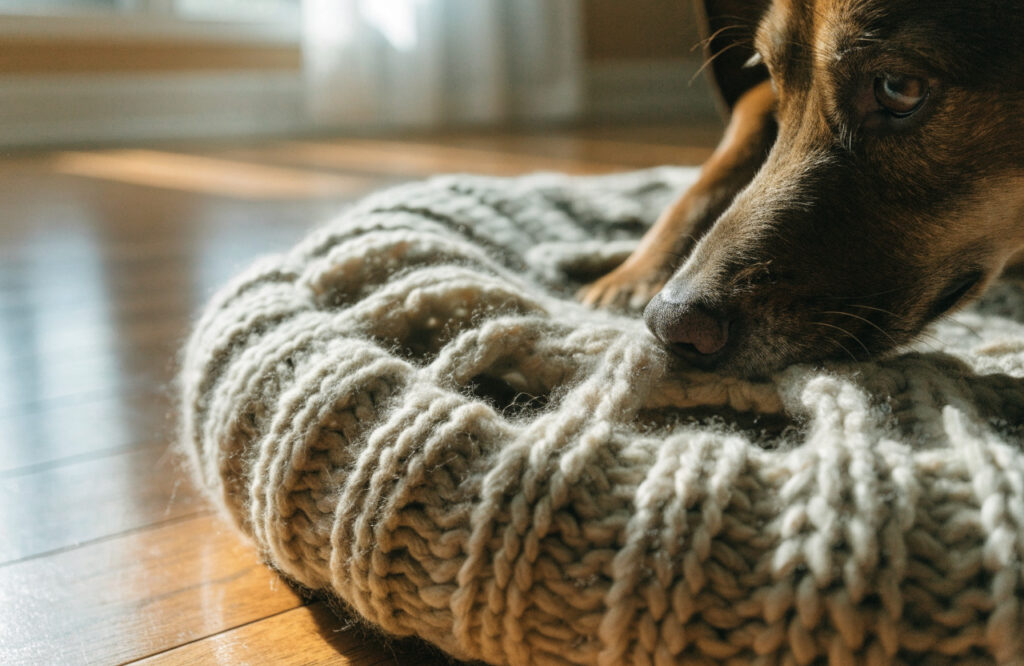
Pattern pages treat this as a gift project. Veterinary sources treat loose yarn as an emergency risk.
The Merck manual describes linear foreign bodies — string, yarn, dental floss — as more typical in cats, but the mechanism is the same in any animal that swallows them. One end catches, often under the tongue or in the stomach, while the rest is pulled forward. The intestine bunches on the strand and the strand can cut through the wall. Cornell’s Riney Canine Health Center lists string and ribbon among foreign bodies that cause more severe damage than a simple blockage, and says most gastrointestinal foreign-body obstructions in dogs need surgery. Outcomes are better when the object is removed early.
That is why Reddit knitters and crocheters who actually live with chewers often talk each other out of the project. A bed that looks durable in a photo can still shed a loop. Puppies and known shredders are the wrong audience. A calm adult who sleeps on the bed and does not mouth fabric is the right one.
If a dog does swallow yarn, do not pull a strand that is hanging from the mouth or the other end. Pulling can tighten the plication. Call a veterinarian. Do not induce vomiting unless a vet tells you to.
The PDSA makes a similar practical point about handmade pet items: stitching has to be secure, use should be supervised at first, and the piece needs regular checks for wear. A knit bed fails that test the moment loops are loose or the dog is unsupervised with a half-eaten edge.
When the knit layer should sit on foam
Senior dogs, dogs with arthritis, and heavy dogs need pressure relief a tube of chenille does not give. The PDSA says memory foam beds are kind to joints. In an NBC Select review of dog beds, Dr. Joe Wakshlag, a professor of clinical nutrition and sports medicine at Cornell’s College of Veterinary Medicine, suggests foam around 4 to 5 inches thick for older dogs who need more cushioning.
A knit nest on a hard floor compresses to the thickness of the yarn. Under a 70-pound dog that can be an inch or two of give, then floor. Elbows and hips take the rest. For those dogs, use the knitting as a washable topper or a bolster cover over a dense foam slab, and keep the entry low enough to step over. A tall stuffed ring that looks cozy in a photo is a hurdle for a stiff dog.
Puppies are the other mismatch. They chew, they have accidents, and their joints do not need a heirloom. A waterproof, removable cover on a plain pad is the better first bed. Knit the nest after the chewing phase, if it ends.
Hot sleepers are a smaller mismatch. Thick polyester holds heat. A flat, loosely knit mat in a breathable washable yarn is kinder than a fully stuffed donut in a warm room. Offer the floor as well. Dogs move when they overheat.
A build order that does not depend on one pattern
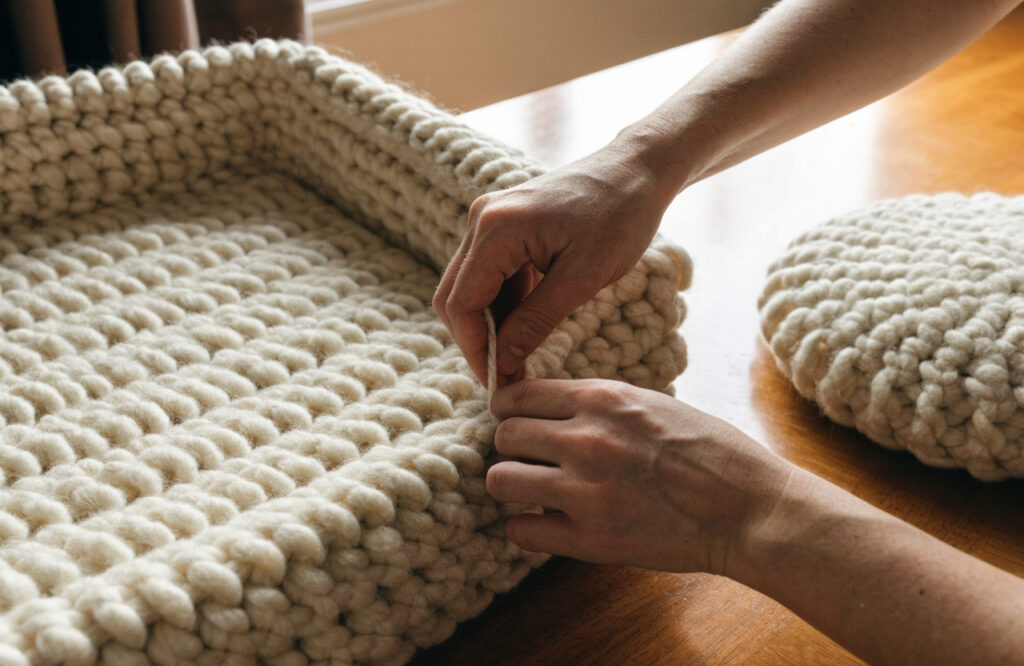
You do not need a new stitch dictionary. The beds that get used are simple fabric, sized first.
- Measure nose to tail base and the curl diameter. Write down the interior size you are making, not the outer size.
- Swatch. Jumbo yarn lies about gauge. A too-tight fabric is stiff and a too-loose fabric snags.
- For a mat, cast on the width, work garter or a simple knit-purl until the length matches the interior, then cast off. An optional raised edge is a second strip sewn on, or a few rows picked up and worked in a thicker rib. Stop while you still have yarn to sew with.
- For a donut, knit the base to the interior diameter, then knit a long strip for the wall, seam it into a tube, stuff it firmly enough that it holds a circle, and sew it to the base. A cushion insert in a sewn liner is safer than loose fill against the knit.
- Seam with a strong thread or a doubled strand, not a single thin tail. Weave ends into the fabric, not into a surface loop.
Free patterns from Yarnspirations, magazine sites, and independent designers already cover beginner rectangles and shaped beds. Use one for stitch counts. Change the cast-on until the interior matches your dog, and change the fiber if the pattern specifies a yarn you cannot wash.
Washing, smell, and when to throw it out
Wash before the dog smells the bed as “done,” then wash on the yarn’s cycle. For most polyester chenille and acrylic chunky yarns that means cold or gentle, low spin, and dry flat so the donut does not grow. High heat can melt some synthetics and felt wool. A removable knit cover over a foam core is easier to wash than a stuffed ring that will not fit in the machine.
Retire the bed when you see pulled loops, thin spots, or stuffing at a seam. Repair is reasonable on a clean snag. It is not reasonable once the dog has started unpicking it. At that point the object is a toy they are allowed to destroy, which is the wrong category for a bed.
Which knit bed fits your dog
Choose a small donut or nest in washable chunky yarn if the dog curls, does not chew fabric, and you want a rim to lean on. Choose a flat mat, or a knit cover over 4 to 5 inches of foam, if the dog sprawls, is older, or is heavy enough to flatten a yarn-only cushion. Skip the knit bed if the dog is a puppy or a known shredder, and buy a chew-resistant washable bed instead. In that case the knitting belongs on a human blanket, not in the crate.
Questions patterns leave open
Can you knit a dog bed without needles? Yes, if you use jumbo tube yarn and arm knitting or finger knitting. The fabric is a loose garter-style mat. It is fast and thick, and it is also the easiest fabric for a claw to snag. It suits a supervised nest for a non-chewer, not a crate bed for a teether.
How much yarn does a medium bed take? Published examples cluster around a few hundred grams of mega-chunky yarn for a roughly 25-inch donut, and about four jumbo skeins for a 24-by-30-inch mat. A 35-inch bolster takes more. Buy an extra skein of the same dye lot. Running out mid-wall is how beds end up lopsided.
Is wool safer or healthier than acrylic? Wool can buffer moisture and temperature, which is why some bedding makers prefer it. It is not safer in the mouth. Swallowed wool yarn is still a linear foreign body. For a bed that will be washed often, a labeled machine-washable polyester or acrylic is the lower-maintenance choice. Use wool only if you can wash it on the care label and the dog will not chew it.
Will a dog actually sleep on it? Often, if it is the right size and in a spot they already use. The usual rejection is a bed that is too small, too tall to step into, or so precious that it stays on a chair. Put it where the dog already naps, leave an old blanket they recognize on top for a few nights, and do not force the issue.