
An RV dog bed has to clear the aisle when the slides are in, stay put on vinyl, and come out of the way before you drive. A thick orthopedic bed from the house often fails all three. The American Kennel Club’s RV guidance treats a bed as a parked rest spot under a dinette or in a spare corner, and treats a secured kennel as the travel setup. Those are different jobs, and buying one product for both is the usual mistake.
A bed is for parked time, not a sudden stop
A dog bed does not restrain a dog. On travel days the dog should ride secured in the same vehicle as the driver. If you are towing, the dog does not ride in the trailer: the AKC’s RV travel guidance warns that a towed unit can overheat and fill with exhaust. Veterinarian Sara Ochoa, quoted in that guidance, calls a kennel the safest way for a dog to travel because the dog stays contained if you brake hard or crash.
The Center for Pet Safety adds a separate warning about cargo areas. Anchors there are not always rated for crash forces, and the platform itself may not be as solid as it looks. Their 2015 crate study found that strength-rated anchor straps reduced how far a crate moved toward the seatback. A folded pad, a cot, or a blanket tied to a cabinet handle is not that system. Do not improvise a restraint from the bed.
Use the bed once you are parked and the dog is out of the crate or harness. If the crate stays set up in the RV, a thin crate mat is often the only “bed” you need on driving days. The plush option comes out at the campsite, where sliding into a cabinet is an annoyance rather than a projectile.
Pick the bed type by the spot it has to occupy
Most catalog roundups sort beds by brand. In an RV the first sort is the hole the bed has to fit: a dinette bay, a slide-out wall, a crate, or a patch of floor you reclaim every morning.
Roll-up pads are the default for small floor plans and weekend trips. A thin pad with a stuff sack or buckle straps disappears into a closet or the tow vehicle. Dogster’s 2026 travel-bed roundup lists the Chuckit! Travel Pillow at about 1 pound, water-resistant and machine-washable, and notes it is a weak choice for giant breeds, heavy chewers, and dogs that need real joint support. Pads in this class are a familiar surface, not a mattress. They work when the dog already sleeps curled, and they fail when an older dog needs several inches of foam on a hard linoleum floor.
Folding foam mattresses are the compromise for dogs that will not settle on a pad. Egg-crate or memory-foam travel beds fold to a few inches and can slide under a dinette or behind a seat. They take more basement space than a roll-up, and compressed foam can need many hours to recover after it comes out of the box. Open a new foam bed at home, not the night before a departure. Waterproof oxford or similar covers matter more than the foam brand: muddy paws, a spilled bowl, and a wet dog after a lake stop all land on the same small floor.
Elevated cots solve heat and damp better than they solve storage. Mesh over a frame lets air move under the dog, which helps in desert and humid camps, and it keeps the dog off a cold or wet floor. The frame has to live somewhere when the slides come in. Collapsible cots with short legs can stay in a corner of a larger fifth wheel; in a camper van they usually go outside or into a bin. Check the stated weight limit before you put a heavy dog on a budget cot. Kuranda, a long-running elevated-bed maker, says its standard PVC beds have been tested to 100 pounds and its aluminum frames to 250 pounds. A sagging mesh cot is not a joint-support bed.
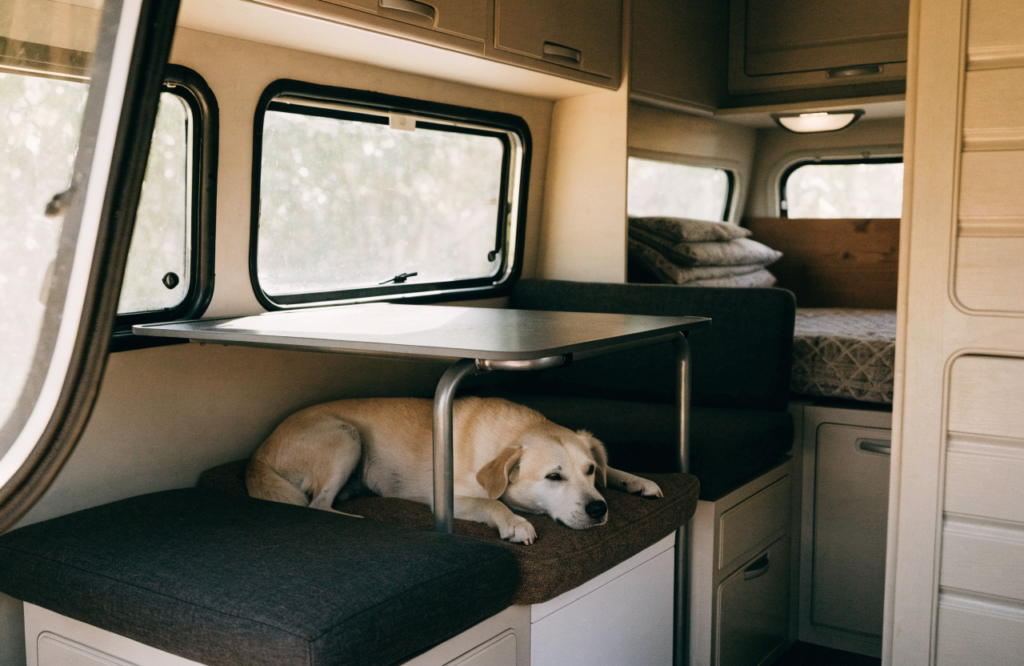
Crate mats and corner nooks are the setups full-timers actually keep deployed. A low mat with a rubber back stays inside the travel crate and doubles as the night bed. The empty bay under a dinette can hold a thin cushion if legroom still works for people at the table. A wedge or bolster can sit in a dead corner beside a slide, but only if that corner still exists when the slide is in. Measure that footprint with the slide retracted. A bed that only fits when the room is expanded is a campsite bed, not an everyday bed.
| Spot in the rig | Bed that usually works | What fails |
|---|---|---|
| Crate on travel days | Low non-slip crate mat | Thick bolster that bunches in a corner |
| Under dinette, slides in | Thin pad or fold-flat foam | Tall cot or round donut that blocks knees |
| Hot or damp camps | Elevated mesh cot | Memory foam that traps heat |
| Senior dog, larger fifth wheel | Folding orthopedic foam, stored when driving | One-inch travel pad on bare vinyl |
Measure the dog, then measure the aisle
Product photos hide the frame. Kuranda’s size chart tells buyers to measure from the tip of the nose to the base of the tail and add 4 inches, then pick a bed at least that long. A 23-inch dog needs a bed of 27 inches or more, which on their chart is a 30-by-20-inch small, not a “medium” guessed from weight. Their large is 40 by 25 inches, aimed at dogs in the Boxer and Labrador range; the 50-by-36-inch size is the one they point at Dobermans and larger. Weight ranges are a rough check. Length is the fit.
Do the same measurement on the floor. A 40-inch bed in a 28-inch aisle becomes a trip hazard the first time someone walks to the bathroom at night. If the only clear floor is 24 inches wide with the slides in, the bed has to be a pad you stow, a crate mat, or a cushion that lives under the dinette. For a crate, Kuranda’s own note is to add about 2 inches to the bed’s length and width so the bed can actually go through the door.
Two dogs do not need two full beds if they already share a spot. They do need a second surface if one of them guards the bed or if you separate them on travel days. A shared cot that only works outside is fine for camp; it is not a plan for a rainy layover when both dogs are inside.
Keep it from sliding, soaking, and smelling
RV flooring is slick vinyl, laminate, or tile. A bed with a “non-slip” label can still creep when a wet dog spins on it. Test it parked, with the dog getting on and off, before you trust it on a travel day. A gripper underlay or a piece of rubber shelf liner under a bed you already own often fixes the slide without a new purchase. Trim the underlay to the bed so it does not become its own loose mat. Do not use permanent double-sided tape on vinyl wear layers; it can leave residue or lift the finish.
Damp is the quieter failure. In cold weather, vehicle floors collect condensation under mattresses and dog beds. Van and boat dwellers see the same pattern: the top feels dry, the underside is wet and smells musty. An air gap fixes more of this than a thicker cover. A cot, a slatted platform, or simply standing the bed on its side in the morning so the floor can dry will beat another waterproof layer that still sits flat on a cold surface. Waterproof bottoms still matter for spills and muddy paws. They do not replace airflow.
Odor concentrates because the room is small and the same fabrics get hiked on, swam in, and slept on. Washable, removable covers are the feature that matters after the first week, not the color. Rotate a second cover if you are out for more than a few days, and keep the spare in a dry bin rather than under the bed. Chewers change the short list: plush and sherpa look homey and shred into the air handler. A tougher crate pad with a rubber back is the better indoor surface for a dog that digs at bedding.
What to do when the dog only wants your bed
Forum threads from full-time RVers repeat the same outcome. The dog bed goes in; the dog jumps onto the human bed because it is one step away. That is not a product defect. A defined spot only works if it is easier or more familiar than the alternative.
Put an unwashed blanket or the cover from the dog’s home bed on the RV bed for the first nights so the smell is already known. Place that bed where you want the dog before you make up your own bed, and return the dog to it when they hop up, the same way you would at home. A crate with the door open, mat inside, and a chew already in it often wins because it is a room, not a rectangle on the floor. If the rig is small enough that the only real sleeping surface is your mattress, accept that and protect the mattress with a fitted cover you can wash. Forcing a ignored donut bed into the aisle does not create a habit. It creates clutter.
Anxious dogs are a separate case. A bolster or a covered crate can help a dog that paces during storms, but only after the travel restraint is already sorted. A calming bed does not replace the kennel Ochoa recommends for the drive.
Which bed fits the trip you actually take
Choose by the constraint that fails first, not by the highest star rating.
- Weekend travelers in a small trailer should buy a roll-up pad with a waterproof bottom and a sack. Store it in the tow vehicle so it is not another item to move when the slide comes in.
- Hot-climate and humid trips favor an elevated cot at camp and a crate mat on the road. Foam that sleeps warm at home sleeps warmer in a closed rig.
- Senior dogs and dogs with sore hips need the folding foam bed if you have a place to store it. A one-inch pad will not replace that support on a hard floor. Open the foam early so it has recovered before the first night.
- Full-timers should own two surfaces: a tough crate mat that stays put, and a washable camp bed that can leave the rig. One bed asked to do both jobs is the one that ends up in a basement compartment unused.
- Heavy chewers should skip sherpa and stuffed bolsters inside the coach. A rubber-backed mat costs less to replace and puts less fluff into the vents.
Skip any bed that only fits with the slides out, any cot whose weight limit sits under your dog, and any setup that asks the bed to hold the dog during a stop. The bed’s job starts when the parking brake is on.
FAQ
Can my dog lie on the bed while the RV is moving?
Only if a separate restraint is already doing the safety job. The AKC guidance says the dog should be in a kennel, or in a harness-and-seat system you have already practiced with, in the vehicle you are driving. A bed on the floor or on a seat is not a substitute.
What size RV dog bed fits a Labrador?
Measure nose to the base of the tail and add several inches rather than buying from weight alone. On Kuranda’s chart, dogs in the Labrador range are pointed at a 40-by-25-inch bed. Then check that length against the aisle with the slides in. If it does not fit, use a crate mat indoors and the longer bed outside.
How do I stop the bed sliding on RV flooring?
Start with a rubberized bottom and test it while parked. If it still creeps, add a gripper mat or shelf liner cut to the bed. Elevated cots need grip under the feet, not just under the fabric. Loose beds should be stowed before you move the rig.
Do I need a heated bed for winter RV trips?
Usually not as the first purchase. A self-warming pad or a cot that gets the dog off a cold floor covers most nights, and an electric heated bed adds a cord, a power draw, and a chew risk. Use heat only if the dog is thin, old, or ill and your veterinarian has already told you the dog should not be in a cold rig. The AKC still says not to leave a dog in a vehicle on a warm day without air conditioning running.
Travel day versus camp night
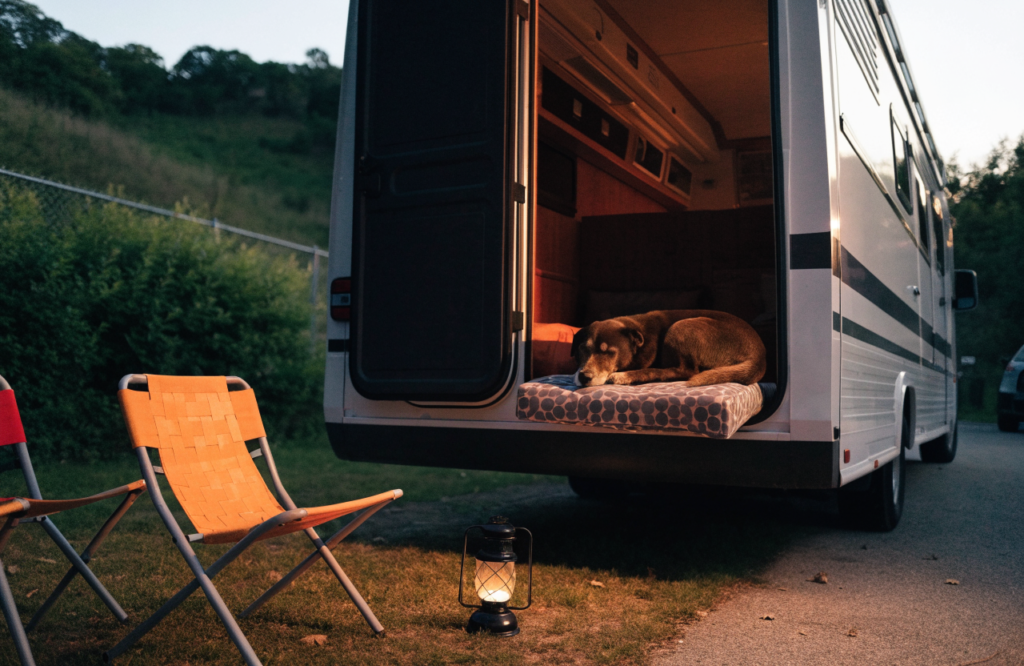
On departure morning the dog goes into the secured crate or harness in the driven vehicle, and the loose bed is stowed where a hard stop cannot turn it into cargo. At the campsite the bed comes out only after you have a spot that still exists with the slides in, a surface that does not skate on the vinyl, and a cover you can wash when the dog comes back wet. If the dog skips that spot for your mattress, change the placement or the cover before you change the product. The right RV dog bed is the one that is in use on night two, not the one that looked largest in the listing.