
A cozy cave dog bed is a covered sleeping spot with a hood, dome, or blanket that lets a dog curl under something and still get out on its own. It suits dogs that already burrow under blankets, wedge behind furniture, or settle more readily in a dim corner. It is a poor match for dogs that sprawl, pant easily, or need a low, open surface they can step onto without ducking. The useful decision is not which listing looks softest. It is whether the opening stays clear, the interior is large enough to turn in, and the cover can actually be washed after the first muddy week.
“Cozy Cave” is also a product name. Snoozer’s Cozy Cave line popularized the round, sherpa-lined bed with a flexible hood held open by a removable plastic tube. Many other beds now use the same idea. Treat the name as a style, then check construction, because two beds with the same label can behave very differently once a dog leans on the hood.
What the enclosed shape is actually doing
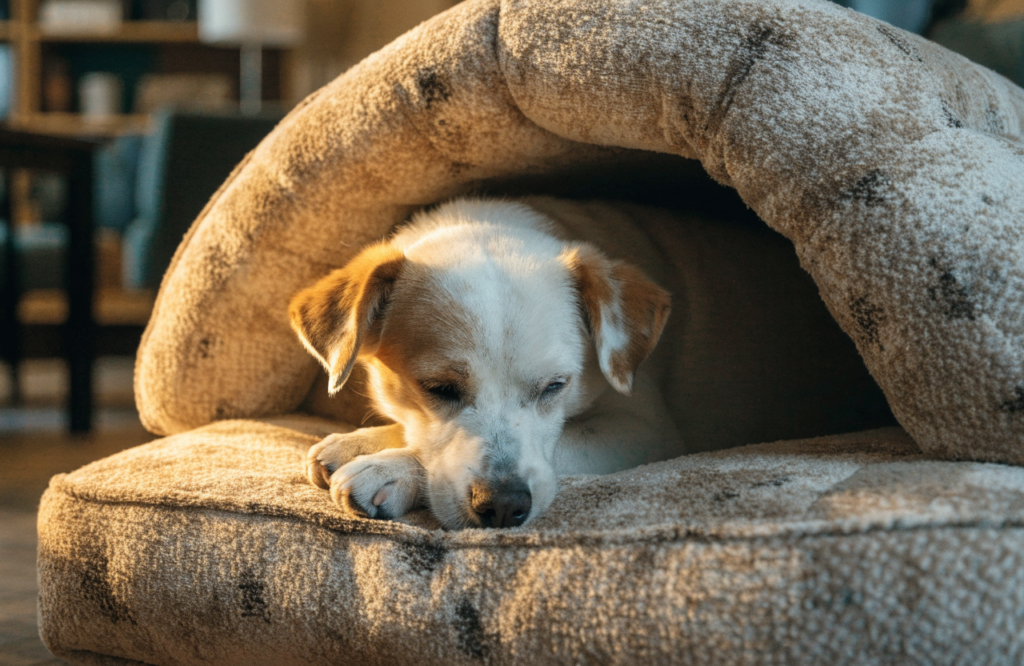
Dogs often rest in tighter spaces than an open cushion offers: under a desk, behind a sofa, or with their head shoved under a throw. A cave bed copies that geometry. Raised sides and a cover reduce drafts, block some room movement, and hold body heat. For a thin-coated dog in a cool room, that trapped warmth is the point. For a thick-coated dog in summer, it can be the reason they sleep on the floor beside the bed instead.
The enclosure is a comfort preference, not a treatment. A covered bed can be a useful resting option for a dog that already seeks cover during storms, guests, or ordinary household noise. It does not replace training, a predictable routine, or veterinary care if the dog is panicking, injuring itself, or unable to settle when left alone. A bed the dog can leave at any time is a different tool from a closed crate.
Which dogs tend to use one, and which skip it
Watch the dog you already have before you buy for the dog you hope to create.
Signs the style may fit
- The dog pushes under blankets, cushions, or laundry and stays there.
- They sleep curled, not stretched on their side.
- They choose the space under furniture over an open bed in the middle of the room.
- They get cold easily: short coat, small body, senior dog that seeks warm laps.
- They startle at movement and settle faster once their back is against something.
Small and medium burrowers are the core audience, partly because most cave beds are built around them. Round Cozy Cave-style beds commonly come in about 25, 35, and 45 inch diameters, with a sidewall only a few inches high and a hood around 8 inches tall. That hood height is easy to miss. A dog that sits upright inside the bed, or a broad-chested dog that needs headroom to turn, can find a “large” cave cramped even when the floor diameter looks generous.
When an open bed is the better choice
Skip a full cave, or choose a hood you can flatten, if the dog:
- Sprawls, sleeps on their back, or hangs legs off every cushion.
- Pants in ordinary room temperatures, has a dense double coat, or is overweight.
- Is brachycephalic (short-muzzled breeds such as pugs, French bulldogs, and many bulldogs). These dogs already lose heat less efficiently through panting, so a warm enclosed microclimate deserves extra caution.
- Has trouble stepping over a bolster or ducking through a low opening. Seniors and dogs with back, hip, or neck pain often do better on a low orthopedic mattress with a clear entrance.
- Chews fabric, foam, or plastic. A hood support tube is a chew target, and swallowed filling is an emergency, not a durability issue.
A dog can be anxious and still hate a cave. Some nervous dogs relax only when they can see the room and the people in it. If yours patrols from the sofa arm or sleeps in a doorway, a donut or bolster bed keeps the “edge to lean on” without covering the head.
Three cave styles that do not work the same way

Listings blur these together. The structure decides whether the dog can get in, whether the ceiling survives a wash, and whether you can cool the bed down in July.
Hood held open by a removable tube
This is the classic Cozy Cave pattern: a soft arch with a plastic pipe hidden in the hood. The opening stays defined, and many dogs push through the sherpa and let it fall behind them. Removing the pipe turns the hood into a loose blanket, which is useful when the room warms up. The failure mode is a cracked, loose, or chewed tube. If an end works free, stop using the bed until the support is replaced or removed.
Floppy blanket or snuggle sack
No rigid arch. The dog makes the opening by burrowing, the way they do under a duvet. This suits dogs that insist on total cover and will rearrange a structured hood anyway. It is a weaker choice if the dog is small, elderly, or easily tangled, because nothing holds an exit path open. A light blanket the dog can push off is safer than a heavy cover that has to be lifted for them.
Structured igloo or tent
Foam walls or a supported dome create a fixed entrance. These hold their shape better than a thin polyfill hood, which often sags into a pancake after a week of leaning. Check that the entrance is wide enough for the shoulders, that the bed does not tip when the dog puts weight on one side, and that you can see or reach the dog without dismantling it. A tent with an open front gives overhead cover while leaving sightlines; a closed igloo does not.
Rectangle caves sit against a wall or inside a crate more neatly than rounds. Rounds encourage circling and curling. Neither shape is universally calmer. Match the footprint to where the bed will live.
How to size it without trusting the weight chart

Weight ranges on product pages ignore leg length, chest depth, and whether the dog sleeps in a ball or a comma. Measure the dog in the position they actually rest in.
- With the dog curled, measure from nose to the base of the tail. Add roughly 6 to 12 inches. That number is a starting point for interior floor length or diameter, not the outside of the bolsters.
- Measure shoulder height while standing, and note how low they are willing to duck. A hood listed at about 8 inches will brush the back of many medium dogs. That contact is pleasant for some burrowers and irritating for others.
- Ask for interior floor size and opening size. Thick walls, a deep bolster, and a sloping roof shrink the usable space. A 35-inch external diameter can leave a much smaller sleeping circle.
- Confirm the dog can turn around and leave without crouching or reversing blindly. If they can only enter and not spin, the bed is too small even if they look cozy in the photo.
- When torn between two sizes, size up for a growing adolescent or a dog that sometimes stretches. Size to the curl, not the stretch, only if you already know they refuse open space.
A cave that is far too large often gets ignored. The walls never touch the dog, so it feels like a normal bed with a useless flap. Too small is worse: the dog cannot exit cleanly, overheats faster, or sleeps half-out with the hood on their neck.
Materials, warmth, and what “machine washable” leaves out
Sherpa and fleece feel like the blanket the dog already steals. They also hold heat and hair. Microfiber and microsuede are easier to wipe and a bit less insulating. Canvas or cotton stays cooler and is a better warm-climate shell if the dog still wants a roof. Long-pile faux fur looks plush and catches claws; short, tight pile is kinder to seniors and tiny dogs whose nails snag.
Fill is the part that flattens. A solid sheet of polyfill compresses under a dog that circles every night. Shredded foam mixed with fiber rebounds better. A thin foam slab is not orthopedic support. If the dog is older, heavy for their frame, or sore getting up, look for a real foam mattress, often around 3 inches in cave models sold as orthopedic, plus a waterproof liner between foam and cover. Memory foam holds heat. That is fine in a cold room and a problem in a warm one.
Read the wash instructions for the exact bed. On a typical tube-hood cave, the cover unzips and the pipe comes out through a small hidden opening in the arch before the cover goes in the machine. The inner pillow or liner is often spot-clean only. Enclosed beds trap odor faster than open mats, so a cover you can wash on a normal cycle matters more than cedar-scented fill claims. Dry the cover fully before reassembling. A damp liner against foam is how cave beds start to smell permanently.
Non-slip dots or a rubberized base matter on wood and tile. A light round bed walks across the floor when a dog launches into it.
How to introduce it without stuffing the dog inside
Put the bed where the dog already rests, entrance facing the room, nothing blocking the mouth. Leave an open mat or their old bed nearby for the first week. Lift the hood once so they can see the interior, drop a familiar blanket or an unwashed T-shirt inside, and let them investigate. Treats or a toy tossed just inside the lip are enough for many dogs. Do not push, lift, or close them in.
Use is voluntary or it is not working. A good sign is the dog entering, circling, and staying, then later sleeping with a nose or tail at the opening as they warm up. A bad sign is panting, scratching to get out, refusing the entrance, or only settling after you flatten the hood. In that case the cave format is wrong for that dog, even if the product is well made.
Problems that show up after the first week
The dog will not go in
The opening may be too low, the bed too new-smelling, or the hood too dark for a dog that wants to watch the door. Try the bed with the support tube removed so it behaves like a blanket, or place it inside a crate the dog already accepts. Some dogs need the hood held up for the first entries and then use it on their own.
The ceiling collapses
Thin hoods sag once the fill shifts. A bed with a real stiffener or removable arch tube holds an exit path; a decorative flap does not. If the hood lies on the dog’s neck every time they lie down, they will abandon it. Replace the tube if it has bent, or switch to a structured dome.
The dog gets too warm
This is the most common reason a loved cave becomes a spare bed in summer. Remove the tube and fold the hood back, switch to a cooler cover, move the bed off sunlit floors and away from vents blowing hot air, or offer an elevated cot as the warm-weather alternative. Do not add a heavy blanket on top of an already covered dog. Short-muzzled, very young, elderly, obese, and thick-coated dogs need the more open setup by default in warm weather.
Chewing starts
Plush caves are not chew-proof. Puppies and determined chewers open seams, pull sherpa, and find the plastic arch. Supervise early sessions. If fabric, filling, or the tube is damaged, take the bed away. A raised cot with a tight mesh, or a crate pad with no loose parts, survives destructive dogs better than any cozy hood.
Smell builds up
Hair and drool collect under the hood where air does not move. Wash the cover on the schedule the fabric allows, spot-clean the pillow, and air the bed with the hood open between washes. If the fill itself is soaked from an accident, replacement is more realistic than another vinegar spray.
Cave bed, donut bed, or a covered crate

| Choice | What the dog gets | Better when | Watch-out |
|---|---|---|---|
| Hooded cave | Cover overhead, one main opening, strong warmth | Buries face, hides under furniture, runs cold | Heat, low hood, chewing the support |
| Donut or bolster | Raised rim to lean on, open top, easy view of the room | Wants an edge but still monitors the household | Rim flattens; not a full den |
| Blanket over a crate | Familiar den, cover you already own, pad underneath | Already crate-trained and you want adjustable cover | Cover must not block all airflow; dog must be crate-comfortable |
| Open orthopedic mattress | Support and an easy step-off | Senior, sprawler, or heat-sensitive dog | No enclosure if that is what they were seeking |
You can own two. Many burrowers use the cave at night and a cooler mat in the afternoon. The mistake is buying a cave as the only bed and then wondering why a panting dog will not stay in it.
Frequently asked questions
Is a cozy cave dog bed only for small dogs? Most are. Standard round sizes top out around a 45-inch diameter with a low hood, which can work for a large dog that curls tightly and does not sit up inside. Giant breeds and tall dogs usually need a rectangle cave with published interior dimensions, or a crate with a breathable cover, rather than a standard round.
Will it help separation anxiety? It can give a familiar, covered place to rest, which some dogs use when the house is quiet. It will not teach a dog to tolerate being alone. If the dog is destroying doors, soiling only when left, or injuring itself, the bed is optional equipment around a behavior plan, not the plan.
Can I leave the hood support in during washing? No. On tube-hood beds the pipe has to come out first, usually through a small opening in the arch lining, and the inner pillow stays out of the machine. Wash and dry the cover, then reinsert the tube and pillow.
How long should a dog take to start using it? Some walk in the first hour. Others sniff for days and then claim it. Forcing speeds nothing up. If there is no voluntary use after a week of open access, a visible treat trail, and a trial with the hood folded back, that dog is telling you the format is wrong.