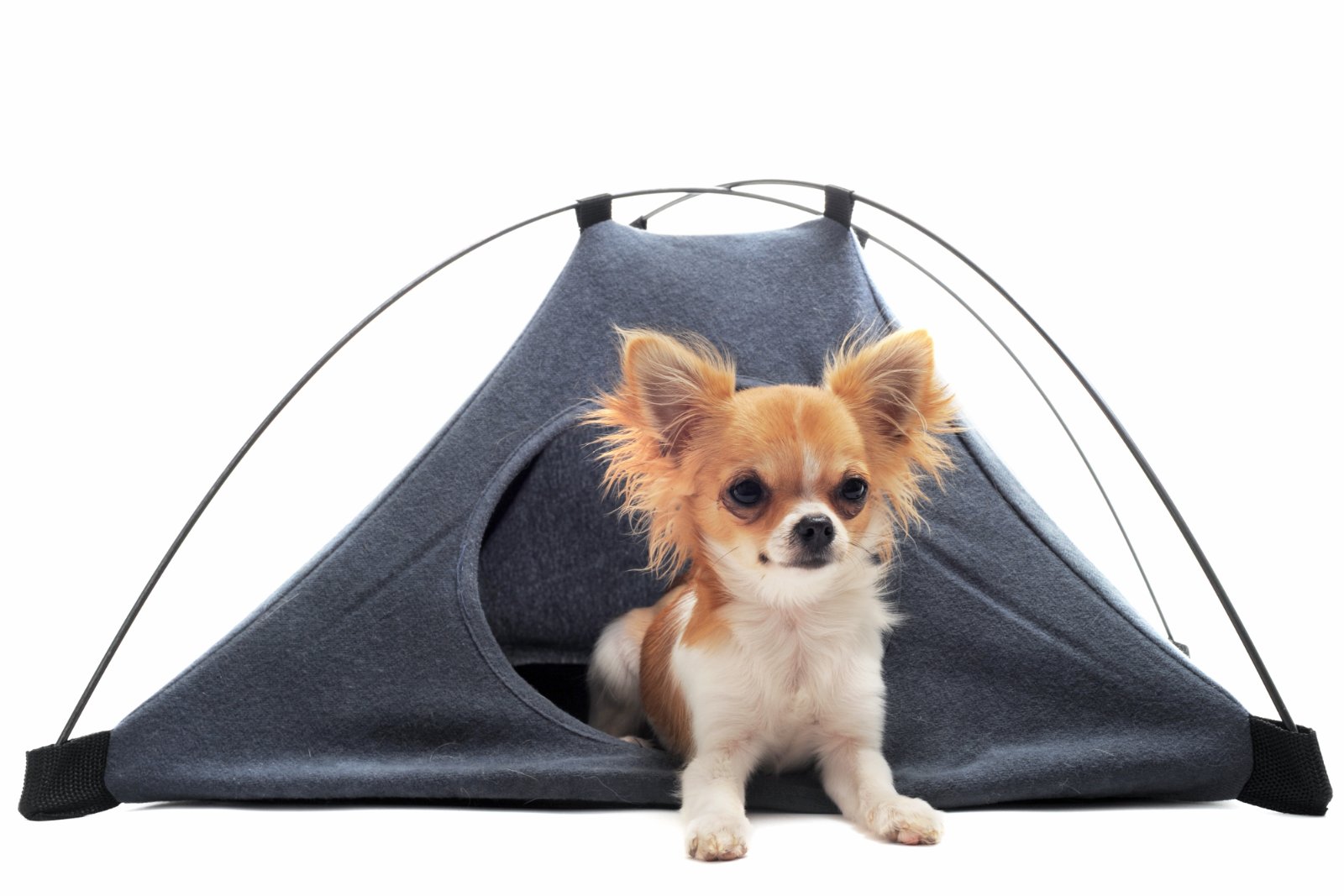

A dog tent bed is a covered sleeping spot shaped like a small tent, teepee, or soft canopy, usually with a cushion on the floor and an open front. It is meant for dogs that already like a roof over their heads — under a table, behind a sofa, or under a blanket — not for every dog, and not as a fix for serious anxiety.
Most models are indoor furniture for small and medium dogs. A few are weather-ready outdoor shelters or raised cots with a shade cover. Those are different products, and buying the wrong one is the most common mistake.
What a dog tent bed is, and what people confuse it with
Search results mix three products that look related and behave differently.
Indoor tent or teepee beds use poles, a fabric cone or house shape, and a removable mat. The dog can walk in, turn around, and look out. Coverage is partial: walls and a roof, with a wide opening. Many include tie-backs so the flaps stay open.
Cave or hooded beds are lower and more enclosed. A padded hood or tunnel lets the dog disappear, often with sherpa or fleece against the body. These trap more heat and feel tighter. A tent-style bed is the middle option for a dog that wants cover but not a tight burrow.
Outdoor dog tents and canopy cots are camping or patio gear. Pop-up shelters, mesh houses, and elevated beds with a shade fly are built for sun, wind, wet ground, or bugs. A cotton teepee from a home-goods listing will not do that job.
If the dog sleeps in the living room, shop the indoor category. If the dog is coming camping or spending afternoons on a hot patio, shop outdoor shelters and raised beds, then add a separate pad so the dog is not lying on cold or damp ground.
Which dogs tend to use one
Dogs that already seek enclosed spots are the realistic audience. That pattern shows up often in small breeds, terriers, dachshunds, and some anxious or noise-sensitive dogs that retreat during storms or when guests arrive. The appeal is practical: a defined space, less visual clutter, and trapped warmth.
A tent bed does not treat separation anxiety, noise phobia, or panic. It can be one resting option for a dog that already burrows or hides, alongside a behavior plan if the fear is severe. A dog that sprawls on its side, runs hot, or avoids tight spaces will usually ignore the canopy and sleep on the mat, or avoid the bed entirely.
Skip a covered bed, or at least do not push it, if the dog:
- Has trouble stepping over a bolster or backing out of a low opening
- Chews and swallows fabric, cords, or plastic hardware
- Pants heavily in warm rooms or has a thick double coat
- Panics when exits are blocked
For those dogs, a flat orthopedic mat or a raised cot with no cover is the safer default.
Tent, cave, or outdoor shelter
| Need | Better fit | Why |
|---|---|---|
| Cover, but room to sit up and watch the room | Indoor tent or teepee | High ceiling, wide door, less trapped heat |
| Full hide, burrowing, extra warmth | Cave or hooded bed | Body contact and a darker interior |
| Hot patio or yard | Elevated cot, with or without a shade fly | Airflow underneath; shade without a sealed tent |
| Camping in weather or bugs | Purpose-built dog tent plus a pad | Floor, mesh, and stakes that a house teepee does not have |
| Senior joints | Whatever shape has a firm, low-entry cushion | Shape matters less than foam and step-in height |
A cave bed that is too roomy loses the den effect, because the dog never feels the walls. A teepee that is too small fails the opposite way: the dog cannot turn without hitting poles. Match the enclosure to how the dog already sleeps, not to the photo.
Size it from the dog, not the label

Labels such as “small” and “medium” are inconsistent. Measure the dog, then check the interior, not the outside of the fabric.
- Length from nose to the base of the tail while the dog is standing.
- Height at the shoulder, plus a few inches of headroom if the dog sits up inside.
- Add about 6 inches to the length so the dog can turn and shift. Curl-sleepers can live with less; sprawlers need more.
A listed external size on a teepee overstates the floor. Poles splay, and fabric hangs off them, so the usable interior is smaller than the product photo suggests. If the listing only gives outside dimensions, assume the mat is the real sleeping area.
Weight limits matter on elevated outdoor models. A 40-pound limit on a cute tent is a real limit, not a suggestion. Large-dog tent beds exist, but the selection is thinner, and many “large” cave beds still top out around 40 to 50 pounds.
Frame, fabric, and cleaning
The parts that fail first are the frame and the wash path.
Frame. Wood or plastic poles should seat fully and stay tied or clipped at the peak. A loose cord lets the cone collapse when a dog leans on it or when someone walks past. Look for a design that stays open at the door. A hood that flops shut is a poor choice for a dog that startles easily, because the exit has to stay obvious.
Fabric. Cotton canvas and heavier weaves breathe better and look more like furniture. Plush and sherpa linings feel warmer and hold more hair and odor. Neither survives a determined chewer. No soft bed is chew-proof. If the dog guts toys, do not leave a tent bed unsupervised.
Cushion. A thin pad is fine for a young, healthy dog. Older dogs and dogs with stiff joints need a thicker foam slab that does not bottom out. Removable, zip-off covers are worth prioritizing. Whole-bed washing sounds convenient until the tent does not fit in the machine or the fill stays damp.
Wash covers on a gentle cycle with unscented detergent, and dry them fully before reassembly. Damp fill grows odor fast. Enzyme cleaner on urine spots before the wash cycle works better than fragrance. Check poles, ties, and pom-poms or decorative trim — those are the pieces dogs pull off.
Where to put it, and how to introduce it
Place the bed where the dog already rests, not in a draft or a hallway people kick. A corner gives the tent a stable back wall. On slick floors, a non-slip mat under the cushion stops the whole structure from skating when the dog jumps in.
Introduction is usually uneventful if the door stays tied open:
- Set it up with a familiar blanket on the mat.
- Drop a few treats inside and leave the room.
- Do not push the dog in or close the flaps on the first uses.
- Leave the ordinary bed available so the tent is a choice.
Some dogs use only the cushion. That is a normal outcome, not a failed purchase, as long as the mat works on its own. Others claim it immediately and ignore every other bed. If the dog pants, tries to back out and cannot, or will not enter after several calm offers, take the canopy off or return it.
Indoor use versus outdoor use
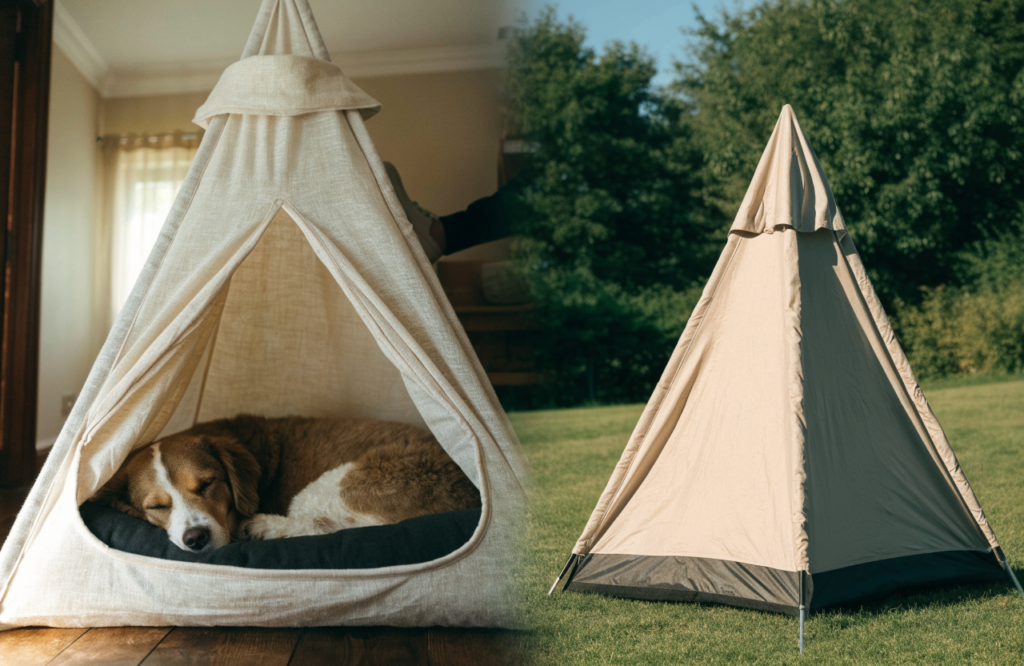
An indoor tent bed is a comfort item. It is not waterproof, not staked, and not insect-proof. Sun will fade thin cotton, and rain will soak the cushion.
Outdoor use needs a different spec list: a floor that blocks ground moisture, mesh that can be covered, stakes or a heavy base, and a pad so the dog is insulated from cold dirt. A fabric roof does not warm the floor. In hot weather, a sealed tent without airflow is worse than no shelter. Elevated mesh with a removable shade is often the better patio choice.
Never use a heated tent bed, such as a low-watt canopy model, unless the cord is protected and the dog cannot chew it. Heated options are for cold indoor rooms, not for unsupervised yards.
Problems that show up after the first week
The tent collapses. Retie the peak, check that every pole is seated, and move it out of the traffic path. If it still falls when the dog leans, the frame is too light for that dog.
The dog will not go in. Tie the flaps fully open, move the bed to a known resting spot, and stop luring with pressure. A dog that only sleeps on the mat may simply prefer an open bed.
It smells within days. Hair packs into the seam where the hood meets the base. Vacuum that crease, wash the cover, and dry it completely. Persistent urine odor needs an enzyme cleaner, not another scented wash.
The dog overheats. Remove the canopy in summer, switch to the cooler side of a reversible mat, or retire the covered bed until the weather cools. Thick-coated dogs often abandon covered beds once the house is warm.
Chewing starts. Stop unsupervised access. Decorative balls, loose cords, and thin mesh are the usual targets. A chewed fragment is an ingestion risk, not just a cosmetic problem.
What to check before buying
- Interior length and height, not just the outside measurement
- A door the dog can enter and exit without ducking hard or fighting a flap
- A cushion thick enough for how the dog sleeps, with a washable cover
- A frame that stays upright when leaned on
- Indoor-only versus genuinely weather-resistant construction
- No small parts if the dog mouths bedding
A dog tent bed is a good buy when the dog already wants a roof and the opening stays easy to leave. It is a poor buy when the goal is to contain a chewer, cool a hot dog, or replace training for fear. Match the shape to the sleeping habit, size it from the dog’s body, and keep the ordinary bed available until the tent earns its place.