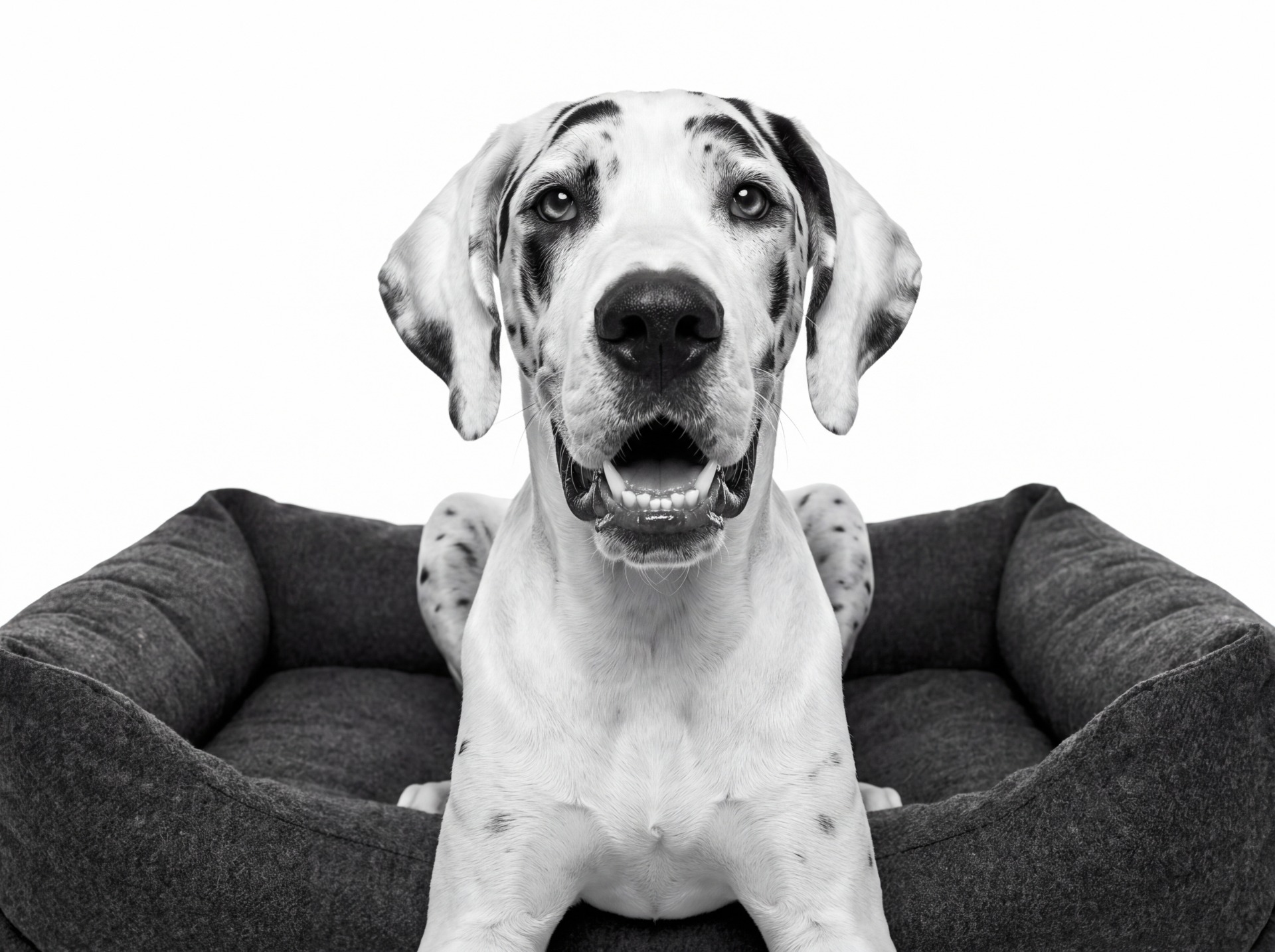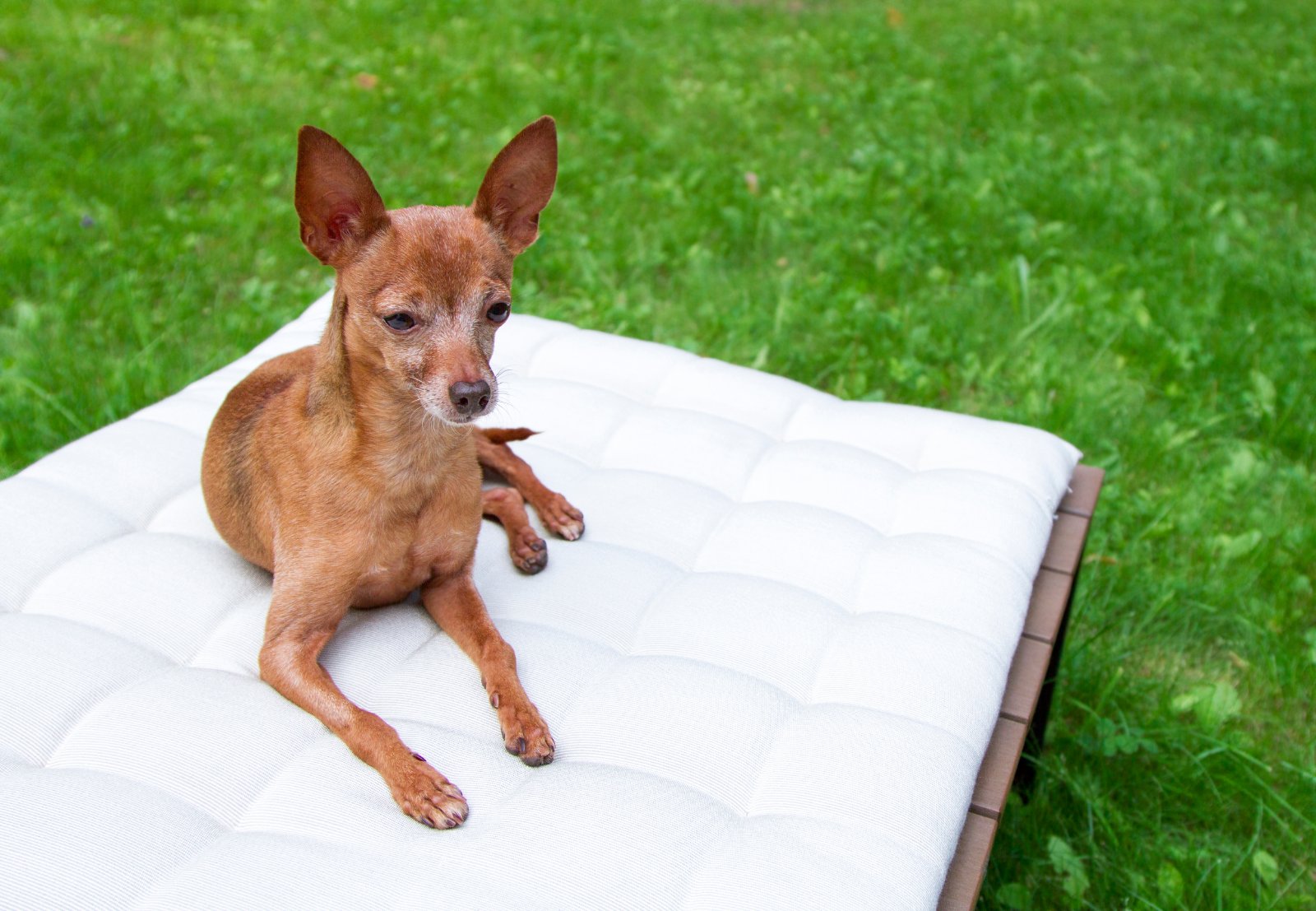

A memory foam dog bed is worth buying when the dog needs a surface that spreads weight off hips, elbows, and shoulders, and when the foam is dense enough not to collapse under that dog. It is a poor default for a dog that already sleeps on tile because of heat, or for a chewer who will open the cover. The label “orthopedic” does not settle either question. Construction does.
Memory foam is viscoelastic polyurethane. It softens under pressure and warmth, then slowly returns toward its shape. On a dog bed, that contouring can keep bony points from taking the whole load the way they do on a hard floor or a flattened stuffed cushion. It does not treat arthritis, hip dysplasia, or post-surgical pain. A useful bed is supportive bedding with a washable cover and a core you can actually compare.
What the foam is doing under the dog
A new solid slab molds around the body instead of pushing back at a few contact points. For a senior dog, a large breed, or any dog that spends long stretches lying down, that is the practical benefit: less concentrated pressure while resting, and a surface that still has some give.
The same property creates the main tradeoff. Memory foam is designed to respond to heat. A dog’s normal rectal temperature runs about 99.5–102.5°F (37.5–39.2°C), higher than a typical human resting temperature, so the foam under a dog can soften more than the same foam would under a person. Dogs also dump heat mainly by panting, not by sweating through the skin. A solid slab that feels pleasant in a cool room can feel stuffy in a warm one, which is why many dogs start on the bed and finish on the floor.
Firmness matters as much as softness. Foam that is too yielding creates a quicksand effect: the dog sinks, then has little to push against when standing. That is a real problem for stiff seniors. A thin comfort layer over a firmer base usually works better than one very soft slab.
Solid slab, shredded fill, and layered foam are different products
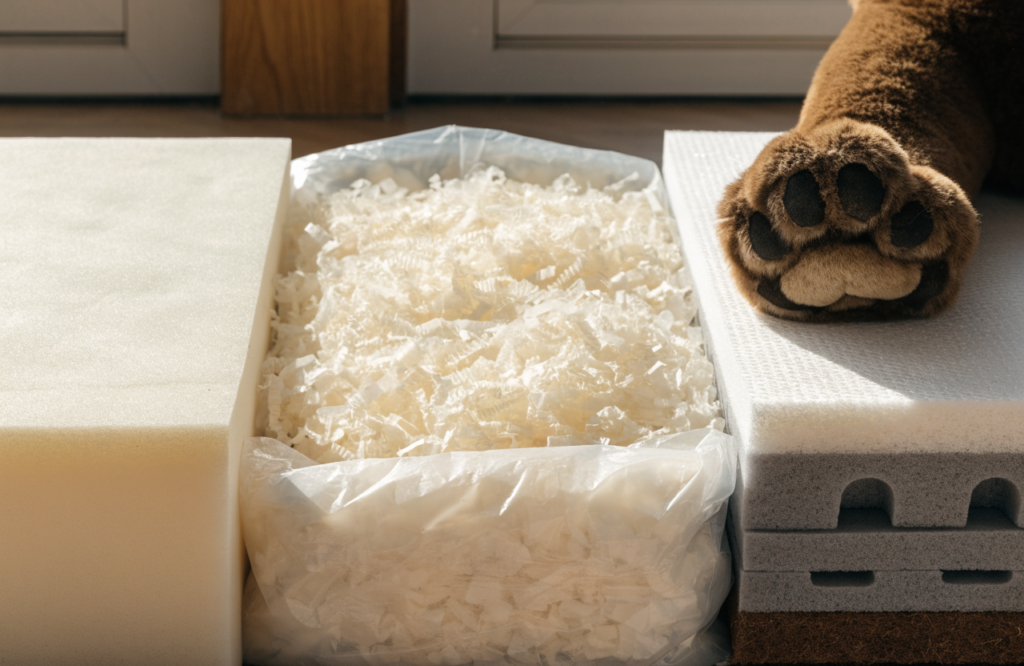
“Memory foam” on a product page can mean three constructions.
A solid slab gives the most even contour and the most consistent support, if the density and thickness match the dog. It is heavier, warmer, and useless once it has a permanent dent in the hip spot.
Shredded memory foam is chopped foam in a baffled liner. Air moves through it more easily, so it often sleeps cooler, and it can be fluffed when it clumps. Support is uneven. Pieces migrate, and a heavy dog can still bottom out. It suits nest-makers and dogs that circle before lying down more than it suits a dog with sore hips.
Layered foam is the construction that usually holds up for larger dogs: a memory-foam top over a high-density polyurethane base. The top spreads pressure. The base stops the dog reaching the floor and gives older legs something to push off. Egg-crate foam looks supportive in photos, but the valleys are thin, so support is inconsistent under a bony elbow or hip.
If the listing does not say whether the fill is a solid sheet, shredded pieces, or a layered core, and does not give layer depths, you are comparing marketing, not beds.
Density and thickness matter more than the word “orthopedic”
Orthopedic is not a regulated grade for pet beds. Two beds with the same claim can be a 2-inch soft topper and a 7-inch layered core.
Density, measured in pounds per cubic foot (lb/ft³), is the closer proxy for how fast the foam will take a permanent set. More material per volume generally resists compression longer. It also weighs more and often holds more heat. Specialty makers commonly sort dog-bed foam roughly like this, as buying guidance rather than a veterinary standard:
| Density | What to expect | Reasonable use |
|---|---|---|
| Under about 2.5 lb/ft³ | Compresses early, often within months under daily use | Temporary bed, very light dog |
| About 3.0–4.0 lb/ft³ | Usable everyday support if thickness is adequate | Small to medium dogs |
| About 4.0–5.0 lb/ft³ | Slower sagging, better for repeated hip and elbow load | Most medium and large dogs |
| About 5.0 lb/ft³ and up | Heaviest, slowest to collapse, usually a base or premium core | Giant breeds, dogs that live on the bed |
Thickness only helps if the foam is dense enough to keep it. A thick low-density slab can compress until the dog is effectively on the floor. As a shopping range, not a formula: about 3–4 inches total for a small dog, 4–5 inches for a medium dog, and 5–7 inches or more for a large or giant dog, with a firm base once the dog is much over 50 lb. The check that matters after delivery is simple. In a normal lying position the dog should not feel the hard floor through the bed, and should be able to stand without the surface collapsing under the paws.
Weight is a crude but useful clue. Quality foam is heavy. A large “memory foam” bed that is easy to lift with one hand is usually a thin foam sheet over fiberfill, or shredded fill with a lot of air.
Who should get one, and who should look elsewhere
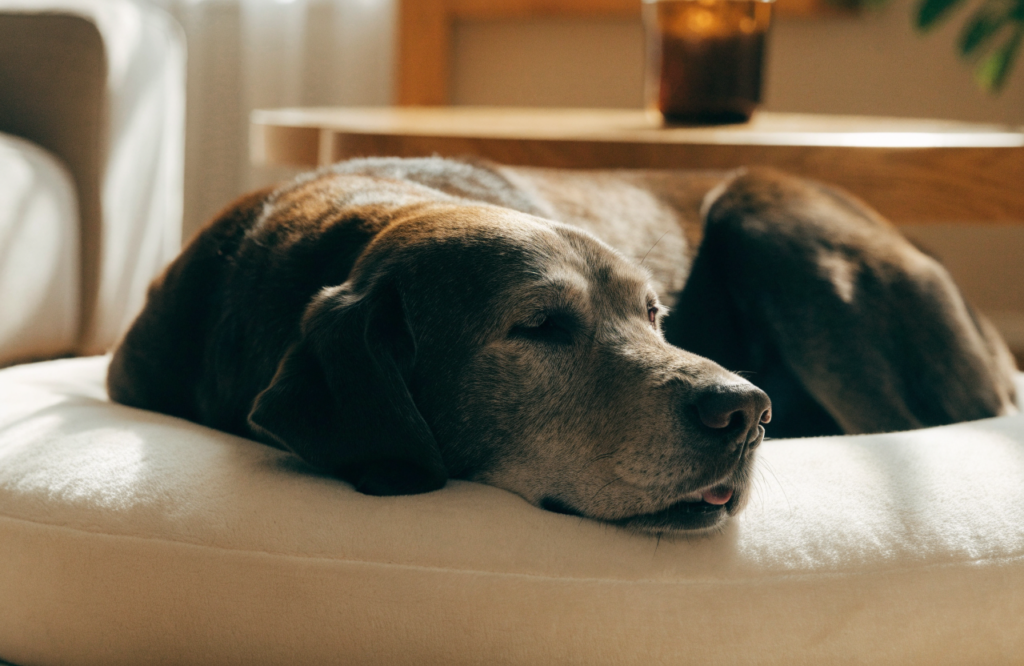
A memory foam bed is the stronger choice when the dog is older, large, overweight, or recovering from orthopedic surgery and the veterinarian has already recommended a supportive sleeping surface. It is also reasonable for a young large-breed dog that sprawls for hours, if you buy for the adult weight rather than the puppy weight.
It is the weaker choice in a few common cases.
Hot sleepers and double-coated breeds often reject solid foam. Huskies, malamutes, samoyeds, and chows are the obvious examples, but any dog that already migrates to tile is telling you the problem. Gel-infused foam can feel cooler at the surface than plain memory foam. It is not the same thing as an elevated mesh cot or a dedicated cooling mat. In a warm room, those alternatives usually win.
Chewers should not have an ordinary foam bed unsupervised. Once the cover is open, polyurethane pieces are an ingestion hazard and can cause an obstruction. A ripstop cover and a hidden zipper slow the damage. They do not make the bed safe for a determined chewer. Remove it if chewing starts, and call a veterinarian if foam may have been swallowed.
Dogs that only nap in short bursts on a couch may not use a thick bed enough to justify the cost. A washable mat is enough until sleeping habits change.
Fit, entry, and the cover decide whether the bed gets used
Measure the dog from nose to the base of the tail while stretched on the side, then add room for the head and hind legs. Bolsters shrink the flat interior. A dog that sleeps stretched needs the internal length, not the outside dimensions on the box.
Seniors and dogs with mobility trouble need a low front edge or a side without a bolster. A non-slip bottom matters as much as the foam: a bed that slides when the dog stands is a joint problem of its own.
The core should not be soaked or machine washed. Water breaks down the cell structure and leaves odor trapped inside. What you can maintain is the cover and the liner. Look for a removable, machine-washable cover and, if the dog drools, is incontinent, or is still being housetrained, a waterproof liner with sealed seams. A pretty sherpa top that cannot be washed will not stay in use.
CertiPUR-US applies to the foam, not the finished bed. Certified foam is tested for certain flame retardants, heavy metals, regulated phthalates, and low volatile organic compound emissions, with a total VOC limit under 0.5 mg/m³ in a chamber test. It does not grade firmness, pet durability, or the fabric. OEKO-TEX Standard 100 is the separate textile check. “Non-toxic” without a named certification is a claim, not a test. New foam can still smell. Air the bed in a ventilated space until the odor fades before the dog sleeps on it.
Care, odor, and when the foam is finished
Wash the cover on the schedule the fabric can survive, more often if there are accidents. Use an enzymatic cleaner on urine rather than soaking the foam. Spot-clean the core and let it dry fully before the cover goes back on. A damp core grows odor that no wash cycle on the cover will fix.
Replace the bed when the foam no longer rebounds. Press the usual hip spot for several seconds. If the dent stays, or the dog is reluctant to settle and slower to rise than when the bed was new, the support is gone even if the cover still looks fine. Low-density foam can reach that point in under a year with a heavy dog. Denser layered cores often last several years, which is why a longer warranty on compression is more informative than a long warranty that excludes flattening, stains, and pet damage.
A warranty of one year on a large-dog bed is a weak signal. Multi-year coverage of the foam itself is better, provided you read the exclusions.
Mistakes that waste the purchase
Buying on thickness alone. Seven inches of soft fill can be worse than four inches of dense layered foam.
Trusting “memory foam feel” or “orthopedic grade” with no density and no layer depths. Those phrases often mean a thin topper or polyester fill.
Choosing a deep bolster bed for a dog that can no longer step over the edge.
Ignoring heat. If the dog has a history of leaving cushions for hard floors, start with gel-infused foam, shredded fill, or an elevated bed rather than a solid slab in a thick fleece cover.
Putting the bed on a slick floor with no grip underneath.
Letting a puppy or anxious chewer have the bed as the only unsupervised option.
A simple way to decide
Match the bed to the constraint that actually limits this dog.
If joints and long lying time are the issue, buy a solid or layered core, ask for density, and size it so the dog can stretch. Prefer a firm base under the memory foam once the dog is large.
If heat is the issue, do not expect a standard slab to win against tile. Use gel-infused or shredded foam, a breathable cover, and a cooler backup surface in the same room.
If accidents are the issue, the liner and the washable cover matter more than an extra inch of foam.
If chewing is the issue, skip foam until the behavior is under control.
Price follows weight and density. A large supportive bed costs more than a stuffed rectangle because the foam itself is the product. A very cheap large “memory foam” bed is usually the thin topper case, and it will tell you so within a few months.
Frequently asked questions
Does a memory foam bed help arthritis? It can make lying down more tolerable by spreading load across hips, elbows, and shoulders. It does not treat the joint disease. Pain management still belongs with a veterinarian.
Why does my dog sleep on the floor instead? The usual reason is heat. Solid memory foam holds warmth against the body. Try a cooler room, a lighter cover, gel-infused or shredded foam, or an elevated cot. A bed the dog will not stay on is not supporting anything.
Is the new-bed smell harmful? New polyurethane can off-gas. CertiPUR-US-certified foam has been tested for low emissions of specific compounds, which is a better screen than an uncertified bed. Air it out until the odor is gone. If the smell stays strong, do not put the dog on it.
Can the foam go in the washing machine? No. Wash the cover and liner. Spot-clean the core and dry it completely. Soaking it is a common way to ruin an otherwise sound bed.
How long should it last? There is no single lifespan. Density, the dog’s weight, hours of use, heat, and moisture all change it. Judge the bed by rebound and by whether the dog still uses it, not by the age of the cover.