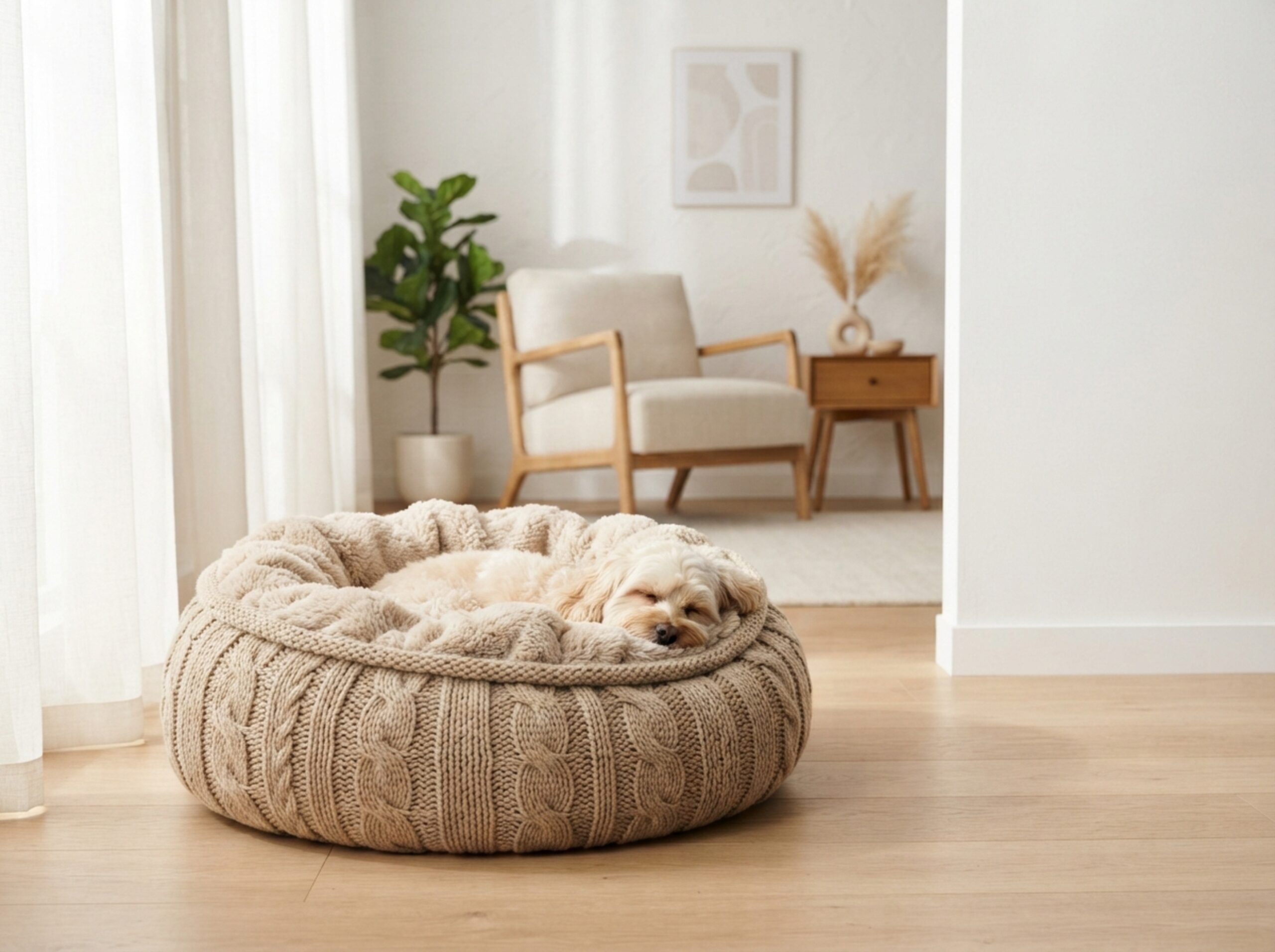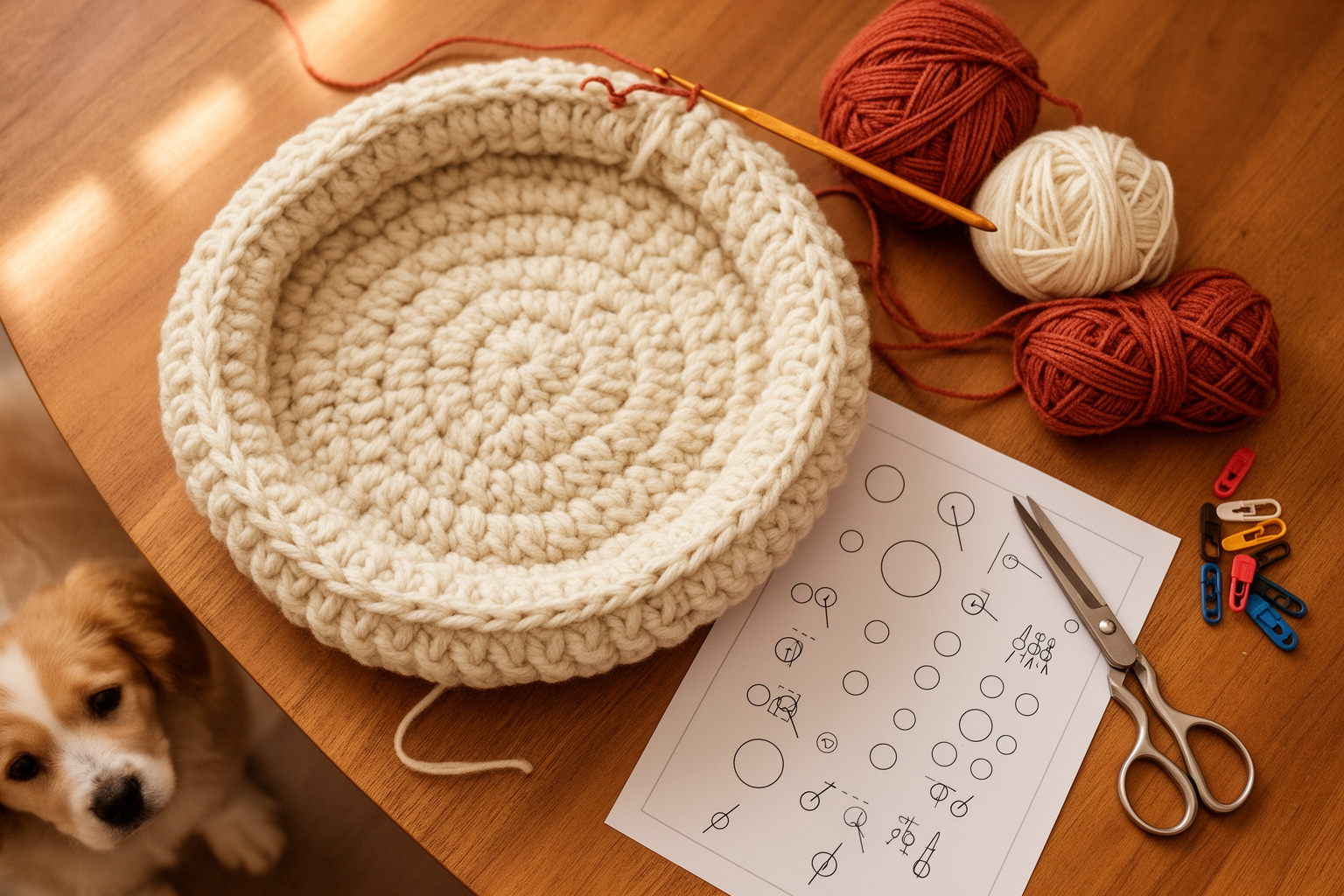

A crochet dog bed that actually gets used is a tight fabric cover over a firm pad, sized to the dog in front of you, not a fluffy nest stuffed only with fiberfill. The free pattern below is a beginner rectangle in single crochet: two panels, three seams, a 3-inch foam insert, and a closed fourth side. Curlers can add a low rim. Sprawlers should skip the rim and add length.
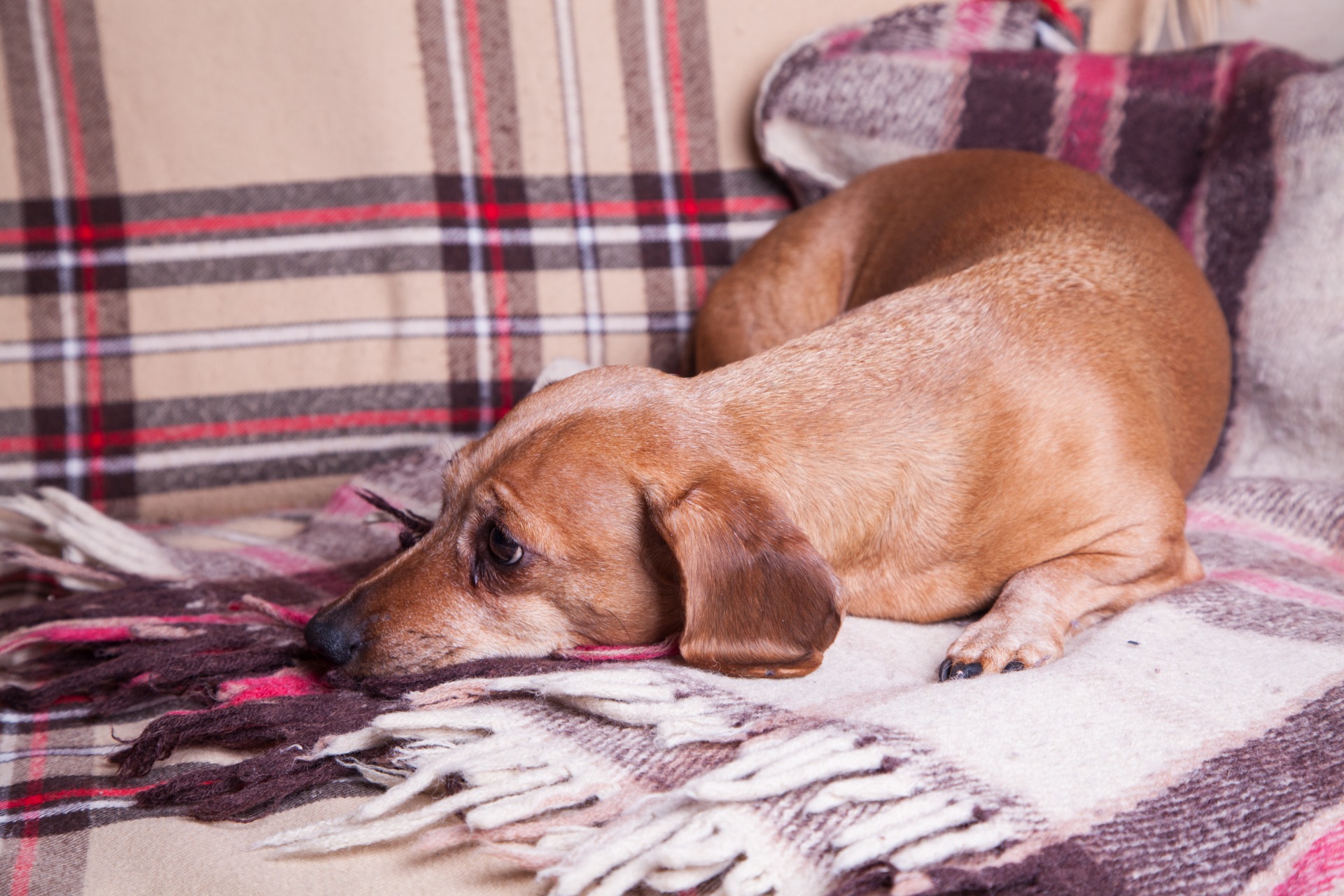
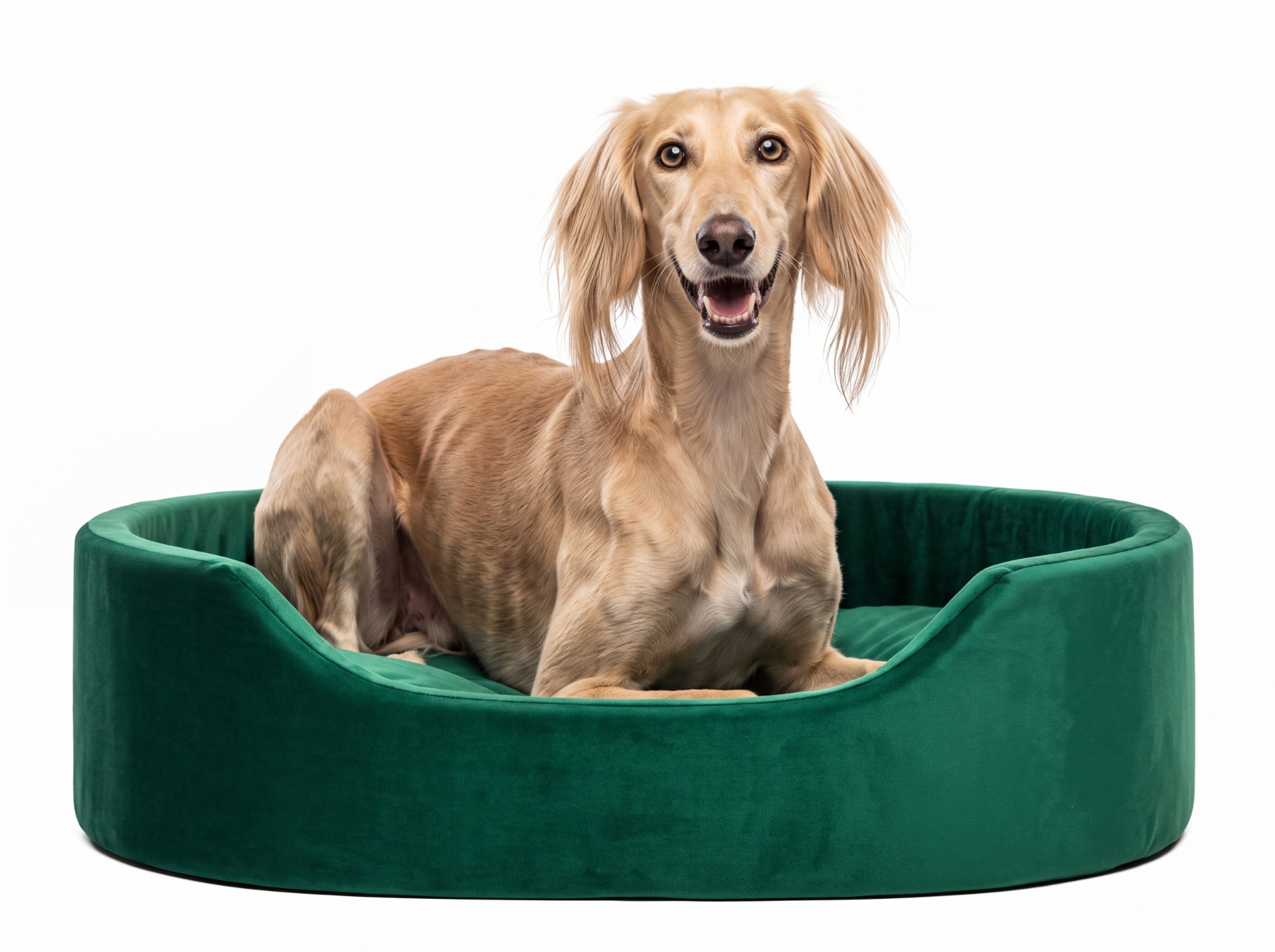
Raised sides suit dogs that curl. Dogs that sleep flat need length more than walls.
Measure the dog before you buy yarn

Weight charts are a rough starting point. Sleeping length is the number that decides whether the bed gets used.
Have the dog lie down the way they actually sleep. Measure from the tip of the nose to the base of the tail, not the tip of the tail. Add 6 to 8 inches for a dog that curls, and 10 to 12 inches for a dog that sprawls. Then measure across the body at the widest point while they are on their side, and add a few inches so hips and elbows are not hanging off. Guides aimed at bought beds use the same idea: nose-to-tail plus about 6 to 12 inches, with sprawlers sized up.
| Sleeping style | Length to crochet | Shape that usually works |
|---|---|---|
| Curler (toy breeds, many cats, seniors who tuck) | Nose-to-tail-base + 6–8 in | Round nest or short rectangle with a 4–6 in rim |
| Side sleeper | Nose-to-tail-base + 8–10 in | Rectangle, low or no rim |
| Sprawler | Nose-to-tail-base + 10–12 in | Long rectangle, no rim |
| Crate bed | 1–2 in smaller than the crate floor | Flat rectangle so nothing sticks out to chew |
A 20-pound dog that curls into a 16-inch circle does not need a 36-inch bed. Extra empty space often gets ignored. A Labrador that stretches to 34 inches needs at least 44 inches of length or the hind legs will hang off and the bed will be abandoned.
Foam thickness matters as much as length. One- and two-inch pads feel fine on a sofa sample and collapse under an adult dog. Three inches is a practical minimum for small and medium dogs. Large and giant dogs do better on 4 inches if you can cut or order it. Buy the pad first and crochet the cover to the pad, not the other way around.
Yarn and fill that survive shedding, claws, and the washer
Acrylic and polyester are the practical fibers for a pet bed. They hold a tight stitch, do not felt, and can be machine washed if the label says so. Wool and untreated cotton are softer in the hand and worse in the wash: wool felts, cotton can shrink, and both hold dander. Fuzzy eyelash and loosely spun chenille look cozy and snag on claws. If you use chenille, pick a dense jumbo yarn and a very tight stitch, not a lacy one.
Three workable setups:
- Super bulky (#6), such as a blanket yarn. Hook about 8–10 mm. Dense single crochet. Slowest of the chunky options, easiest to wash, best stitch definition.
- Jumbo chenille (#7). Hook about 25 mm. A published free pattern in this yarn uses roughly 195 yards for a 24 by 24 inch bed, 235 yards for 24 by 30, 260 yards for 30 by 30, and 390 yards for 30 by 42, at a gauge of 3 stitches and 3 rows to 4 inches. Fast, heavy, and less precise at the seams.
- Worsted (#4) held double. Hook about 6–6.5 mm. Fine for a small dog. A medium or large bed becomes a long project and uses a lot of skeins.
Skip buttons, beads, and long fringe. A chewer can pull them off. Loose ends should be woven in on the inside and buried in the seam, not left as tails.
Fiberfill alone is a poor main cushion for any dog over about 15 pounds. It packs down, shifts, and is hard to dry if it gets wet. Use it only as a thin top layer or for a tiny nest. The structure should be a foam pad you can remove. A waterproof crib pad or PUL layer between foam and cover saves the foam from the first accident. Foam itself is spot-cleaned, not machine washed.
If the dog is still in a heavy chewing phase, a crocheted bed is a poor first bed. Swallowed yarn is a real obstruction risk. A flat washable mat is the safer project until chewing settles.
Free pattern: foam-insert rectangle in single crochet
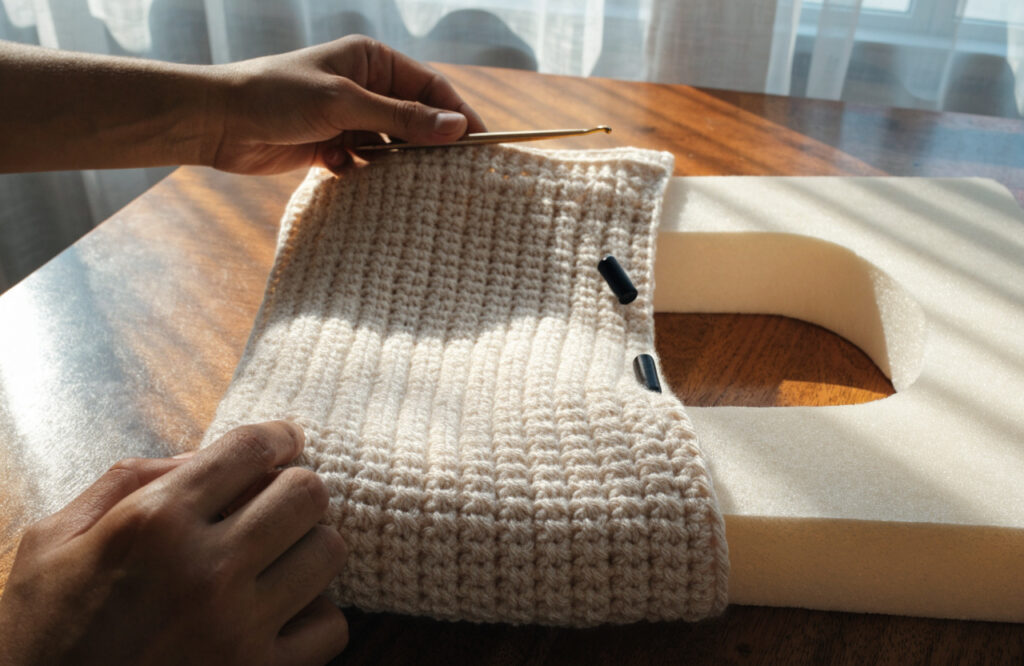
Skill: confident beginner. You need chain, single crochet, and a yarn needle. Terms: US. Finished idea: a snug cover about 1 inch smaller than the foam in each direction, so the fabric stretches tight and does not puddle.
Materials
- Super bulky (#6) machine-washable acrylic or polyester. Estimates, before you add a rim: about 700–900 yards for a 20 by 16 inch pad, 1,100–1,400 yards for 30 by 22, 1,600–2,000 yards for 36 by 28. Buy an extra skein. Jumbo #7 uses far less yardage; use the figures in the previous section as a planning range, then swatch.
- Hook that hits gauge. Start with 8 mm (L) for #6 yarn.
- Foam pad, 3 inches thick, cut to the measured size. A 30 by 72 inch pad can be cut into two beds.
- Yarn needle, scissors, locking stitch markers.
- Optional: waterproof layer cut slightly smaller than the foam.
Gauge
7 single crochet and 8 rows = 4 inches, unblocked. Gauge is a target, not a law. The pad is the pattern. If your swatch is loose, go down a hook size. A loose fabric sags and catches claws.
Panels (make 2)
- Chain loosely until the chain, without stretching, measures the foam width minus 1 inch. Count the chains and write the number down.
- Single crochet in the second chain from the hook and in each chain across. You should have one fewer stitch than you chained.
- Chain 1, turn. The chain-1 does not count as a stitch. Single crochet in each stitch across.
- Repeat step 3 until the panel measures the foam length minus 1 inch, lying flat and unstretched. Fasten off the first panel. Leave a long tail on the second if you want to seam with the working yarn.
Edges should be straight. If the panel bows, the starting chain was tighter than the rows. Redo it looser, or go up a hook size for the chain only.
Seam and insert
- Hold the panels with wrong sides together. The “pretty” side faces out on both.
- Join yarn at a corner. Single crochet through both layers down one short side, across a long side, and up the other short side. Work 2 single crochet in each corner so the corner does not cup.
- Slide the foam in, with the waterproof layer against the side the dog will lie on. The cover should need a gentle stretch. If it is baggy, the panels were too big.
- Single crochet the last side closed, still through both layers. Fasten off. Weave every end to the inside and run the tail back through the seam for an inch so a paw cannot pick it out.
That is a finished flat bed. It is the right stop for sprawlers and for crate mats.
Optional rim for curlers
Do not close the last side yet. After the three-sided seam, single crochet evenly around the open top through both layers for one round, then continue in joined rounds on the top panel only, or on a picked-up edge, until the wall is 4 to 6 inches tall. Keep the stitch count even. A wall taller than 6 inches on a small bed becomes a cave that traps heat and is harder to wash. Sew the wall base down only if it flops inward.
Washable variation
Leave one short end open and overlap the top panel by 4 to 5 inches, like a pillow sham, instead of seaming it. The dog can still dig, so this only works if they do not burrow at the opening. A zipper is possible and often gets chewed. Overlap is the safer removable option.
Round nest if the dog only curls
A nest is a circle with a wall, not a better rectangle.
- Magic ring, 6 single crochet. Do not join. Mark the first stitch.
- Increase 6 stitches every round: 2 single crochet in each stitch (12), then (1 single crochet, 2 single crochet in the next) around (18), then (2 single crochet, 2 in the next) around, adding one plain stitch between increases each round.
- Stop increasing when the circle matches the curled dog plus 2 inches. A 16-inch circle is plenty for many cats and toy dogs.
- Work even, no increases, for 4 to 6 inches of wall.
- Set a round cushion, a stack of cut foam rounds, or a stuffed pillowcase inside. Do not rely on loose fiberfill as the only support.
Bernat’s free pet-bed formula is the same idea at a larger scale: two strands of super bulky, easy skill level, bottoms of about 16, 22, and 30 inches across with a 6-inch side, at 7 single crochet and 8 rows to 4 inches. Use that as a check on yardage if you scale the nest up. A 30-inch circle in blanket yarn is already a large project.
Time, cost, and when a bought bed is the better call
A small #6 rectangle is often a weekend. A jumbo chenille rectangle can be an afternoon because the stitch is enormous. A large bed in worsted yarn is several evenings and easy to abandon.
Yarn for a small bed is often less than a mid-range bought bed. Yarn plus a decent foam pad for a 36-inch bed can meet or beat a store bed on price, and you still have to seam it. Crochet wins when you want a custom color, a crate-exact size, or a gift. It loses when the dog is a determined chewer, when you need a waterproof orthopedic bed this week, or when the dog is over about 80 pounds and you do not want to buy and cut thick foam.
Dark and mid-tone colors hide hair and slobber. White looks clean for a day.
Washing, sagging, and the failures that show up in week two
Wash the cover alone, cold, gentle, inside a mesh bag or pillowcase so the stitches do not catch the machine. Dry low or flat. Heat is what warps acrylic. Foam gets aired and spot-cleaned. If urine soaks the foam, replace the foam. Washing will not restore it.
Common problems and the fix:
- Bed looks lumpy. Panels were larger than the foam, or the foam is too thin. Recut foam larger, or redo the panels 1 inch under the pad size.
- Dog will not lie in it. Usually too small, too enclosed, or placed in a draft. Try it without the rim, against a wall, with a familiar blanket on top for a few nights.
- Claws catch. Stitch is too open. Smaller hook, single crochet only, no mesh or granny gaps.
- Seam splits. You joined through one layer only, or the yarn was jumbo chenille with a thin seam. Seam through both layers with the same yarn, and add a second pass on the corners.
- Smell returns after washing. The cover is clean and the foam is not. The waterproof layer was skipped.
Other free patterns worth using instead of this one
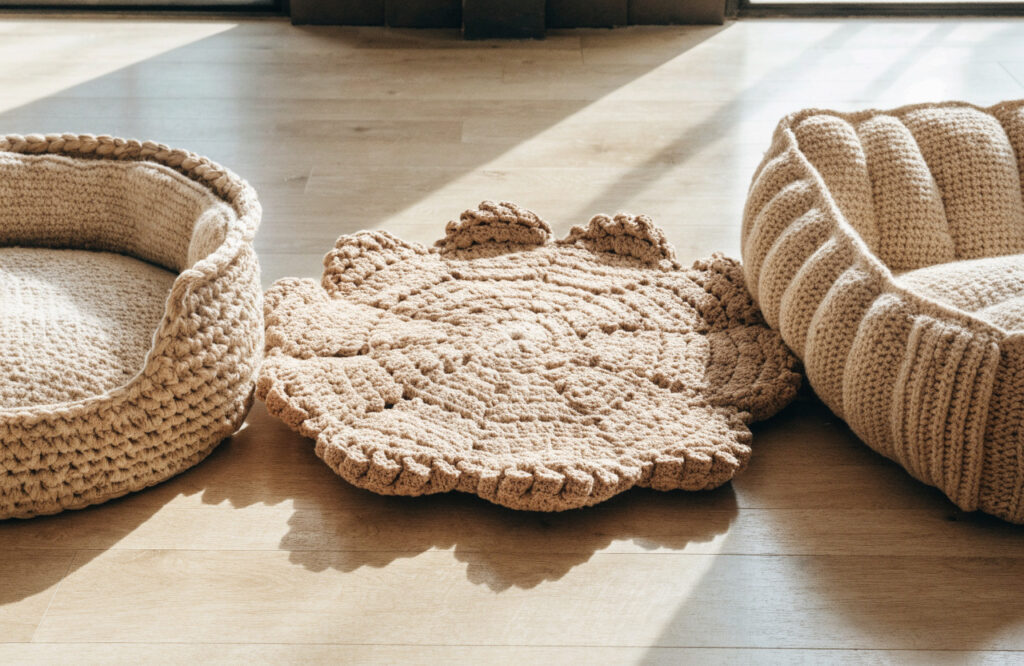
Use this rectangle if you want a durable sleeping pad. Switch patterns if you want a different shape.
- Heart Hook Home’s dog bed is the jumbo-chenille version of the same two-panel idea, free on the blog, with paid ad-free PDFs. Widths are written for 24 and 30 inches, length is custom, hook is 25 mm.
- Yarnspirations’ Bernat crochet pet bed is a free round pattern in three diameters with a fixed side height, worked with two strands of super bulky.
- Small round beds in worsted yarn, often 16 to 19 inches, are realistic for cats and dogs under about 15 pounds. They are a poor plan for a beagle or bigger if the only fill is polyester stuffing.
Read the yarn weight before you fall for a photo. A bed photographed in #7 yarn will not come out the same size in #4 yarn unless you rebuild the stitch count from gauge.
FAQ
Can I crochet the bed in cotton? Yes for a small bed you will wash often, if you accept shrinkage. Buy extra, swatch, wash the swatch, and crochet to the washed gauge. Cotton is heavy in large sizes.
What if I only have worsted yarn? Hold two strands and use a 6–6.5 mm hook, or hold three for a denser fabric. Measure the panel against the foam every few inches. Yardage will be much higher than the super-bulky estimates.
How do I keep the bed from sliding on a wood floor? Sew or fabric-glue a piece of shelf liner to the underside after the bed is finished, or set the bed on a rubber-backed mat. Do not crochet a non-slip yarn into the fabric. It does not stay put once hair packs into the stitches.
Is a crochet bed safe for a puppy? Only with supervision, and not as the sole bed during the chewing months. Offer it as a cover over a mat you can throw away if it is destroyed. Ingestion is the risk, not the stitches themselves.
Can I add a handle? A short chain loop on the outside seam is fine for carrying a small bed. Skip it on a large bed. The seam is not a luggage handle, and a dangling loop is something to chew.