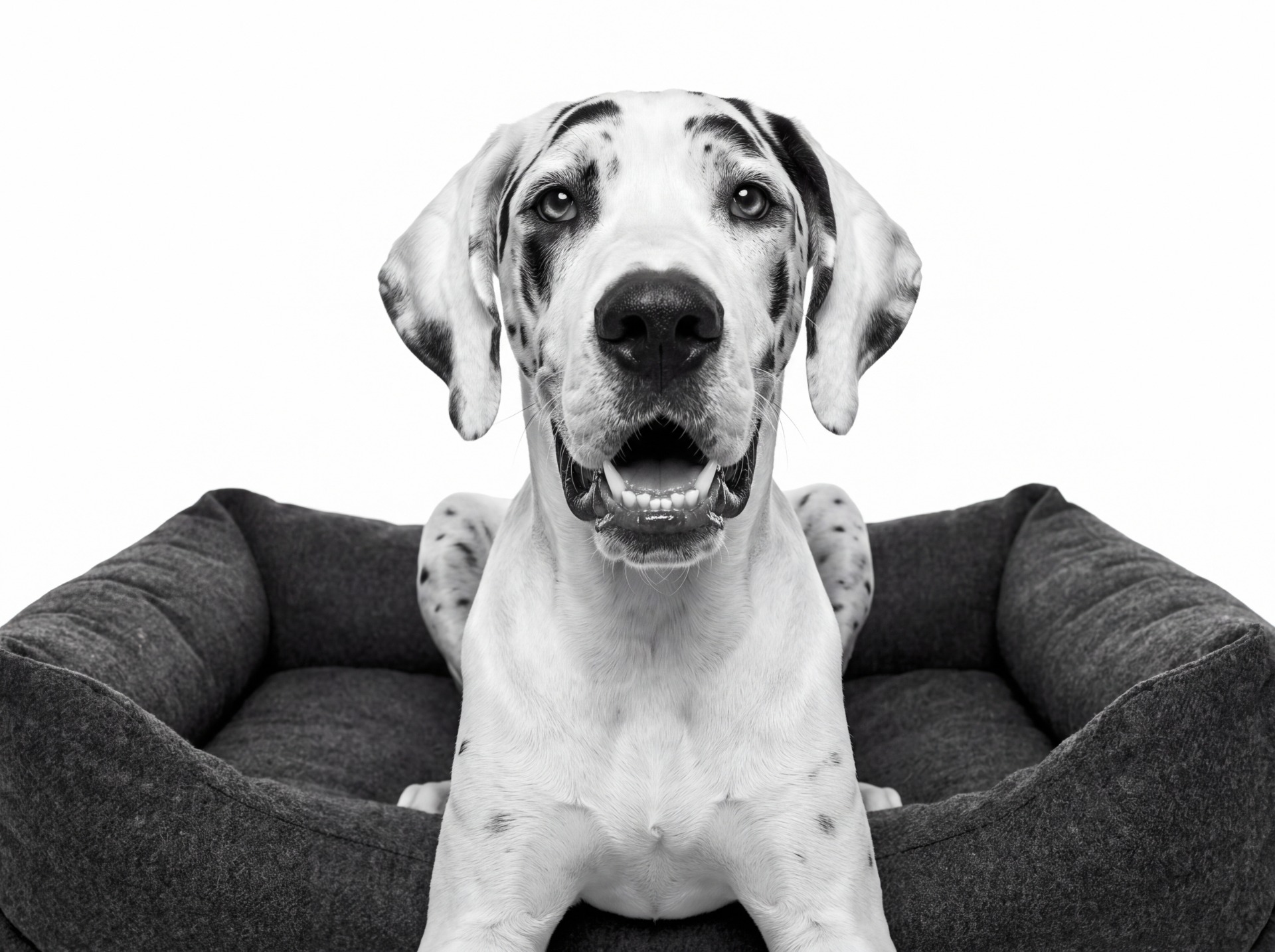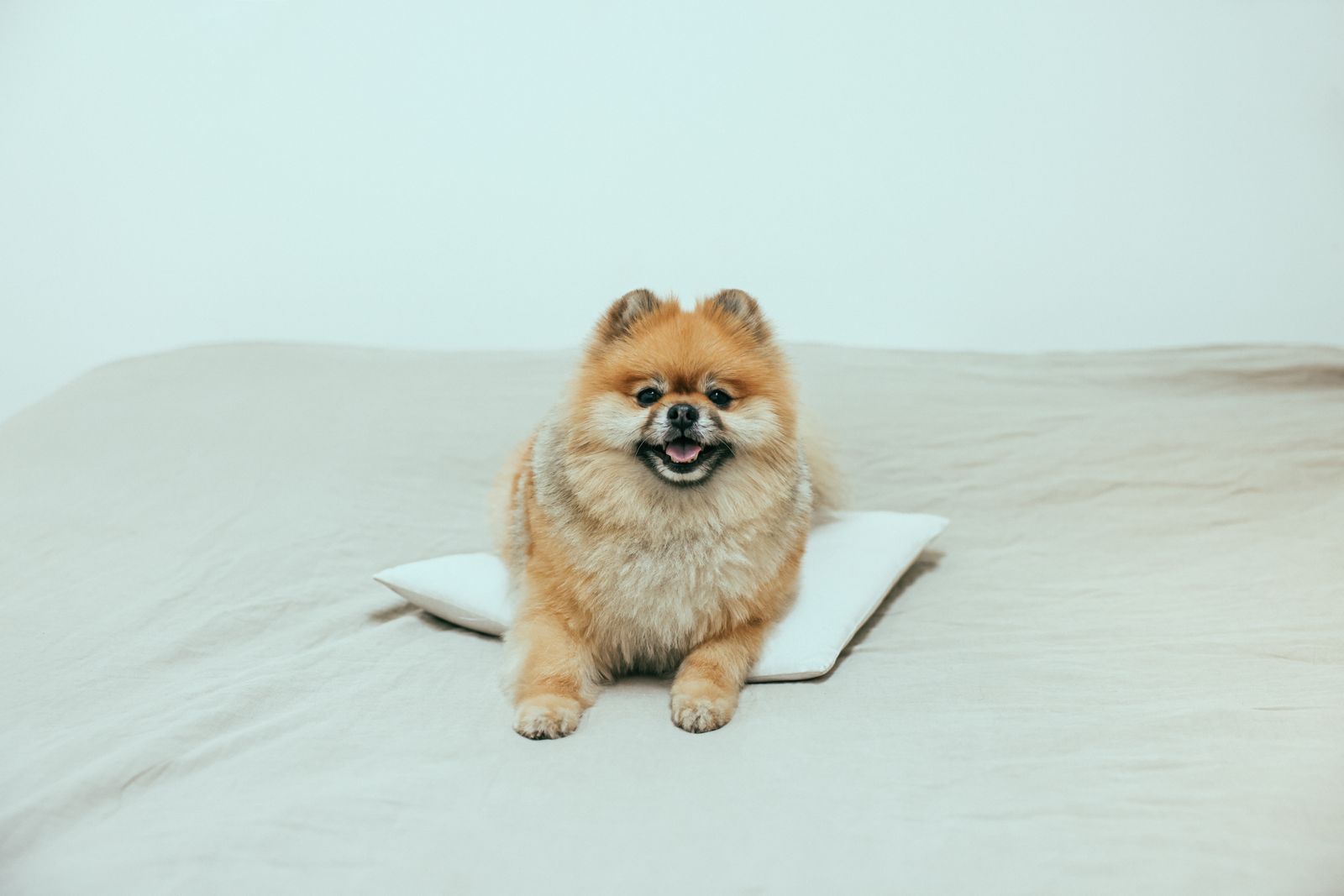

A dog pillow bed is a cushion-style resting place, usually a flat pad, a bolstered rectangle, or a round nest, filled with fiber, shredded foam, or a soft top over a firmer base. It works when the shape matches how your dog actually sleeps and the fill holds the dog off the floor. It fails when the bed is sized to a curled-up pose, the stuffing flattens under the dog’s weight, or the cover cannot be washed without soaking the core. Most dogs rest about 12 to 14 hours a day, so the bed is closer to a mattress decision than a throw pillow.
What “dog pillow bed” usually means
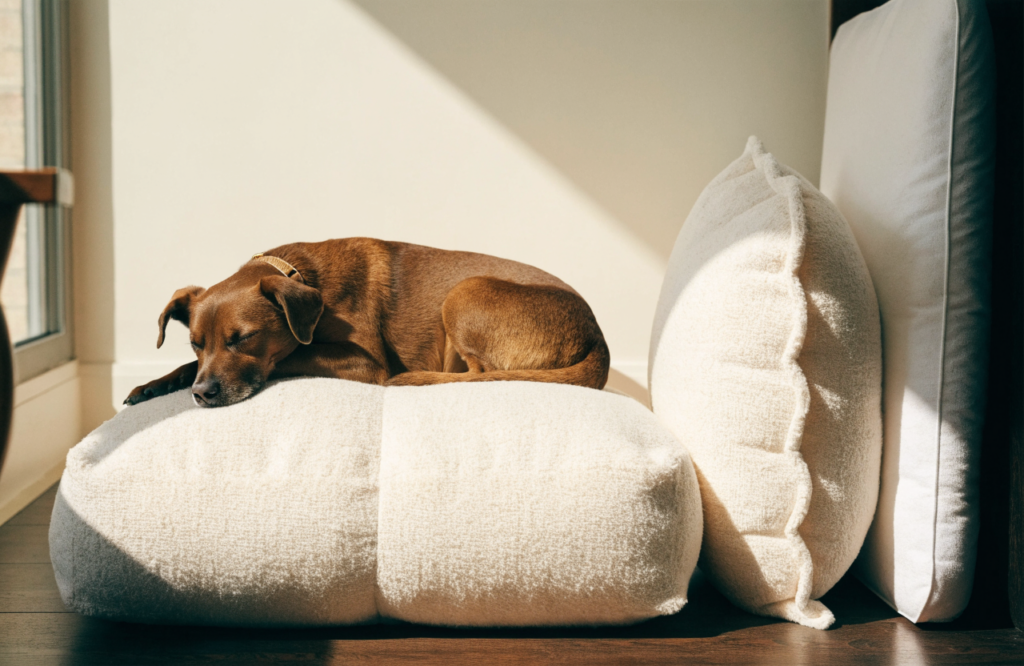
Retailers use the phrase for several different products. Knowing which one you are looking at matters more than the label.
- Flat pillow beds are rectangular or oval cushions with little or no raised edge. They suit dogs that stretch out.
- Bolster pillow beds have a raised rim on one or more sides, so the dog can rest a chin or lean. The rim reduces the usable sleeping area.
- Round or donut pillow beds have a high stuffed wall and a soft center. They suit dogs that curl into a ball or dig a nest.
- Pillow-top beds are mattress-style: a firmer foam base with a softer top layer. These are still sold as pillow beds, but they behave more like a thin mattress than a stuffed cushion.
A soft photo does not tell you which of these you are buying. Check the fill, the interior dimensions, and whether the cover unzips.
Match the shape to the sleep position you actually see
Watch the dog for a few nights before you buy. The position they settle into, not the breed stereotype, is the useful signal.
| Sleep habit | What it looks like | Better pillow style | Often a poor fit |
|---|---|---|---|
| Sprawler | Legs extended, body long | Flat rectangular pillow, oversized | High donut walls that block the stretch |
| Curler | Nose to tail, tight ball | Round bolster or donut | A huge flat pad with no edge to lean on |
| Chin-rester | Head propped on a cushion or sofa arm | Bolster on one or two sides | Fully enclosed high walls if the dog is stiff |
| Nester | Circles, paws the surface, rearranges it | Shredded fill or loose fiber they can push around | A slick solid slab with no give |
| Half on, half off | Body hanging over the edge | Larger flat pillow | The current size, no matter how plush |
A dog that uses more than one position needs room for the largest one. Buying only for the curled pose is the most common reason a new pillow bed ends up as a floor decoration.
Size it to the stretched length, not the weight label

Weight charts are a rough filter. Manufacturers do not share one standard for “medium” or “large,” and a bolster bed’s exterior size overstates the sleeping surface.
Measure the dog lying on one side, nose to the base of the tail, in the longest pose they use. Add about 6 to 12 inches (roughly 15 to 30 cm) so they can turn without hanging off. For a bolster or donut, use the interior sleeping area, not the outer edge. Guides from pet-care publishers consistently treat a slightly oversized bed as safer than one that is too small.
Rough starting ranges, before you add stretch room:
| Dog weight | Typical label | Approximate flat sleeping area |
|---|---|---|
| Under 25 lb (11 kg) | Small | About 18 × 24 to 24 × 30 in |
| 25–50 lb (11–23 kg) | Medium | About 24 × 30 to 30 × 36 in |
| 50–75 lb (23–34 kg) | Large | About 30 × 36 to 36 × 44 in |
| Over 75 lb (34 kg) | XL or giant | About 42 × 48 in and up |
A long, light dog such as a greyhound or dachshund needs length more than a weight chart suggests. A compact, heavy dog needs width and a fill that does not bottom out. If the dog sleeps in a crate, the pillow must also fit the crate floor with the door able to close.
The fill decides support, not the word “pillow”
Polyester fiberfill is the classic pillow stuffing: soft, light, easy to nest in, and usually the cheapest option. It compresses under weight and often flattens or clumps within months, especially under dogs over about 35 to 40 pounds. Shredded foam sits between the two: dogs can push it into a nest, and it holds shape better than loose fiber, but it still shifts and offers uneven support.
Solid foam, including memory foam, is viscoelastic polyurethane. It softens under body heat and pressure, then slowly recovers. That contouring can spread weight across hips, elbows, and shoulders instead of letting bony points press through to the floor. It is also heavier, warmer, and ruined if it gets soaked. “Orthopedic” on a listing is a marketing description, not a regulated standard. A thin, low-density foam bed can carry that word and still collapse.
Density is the useful number when a maker publishes it. Around 3 pounds per cubic foot is a practical minimum for a bed expected to last; large dogs do better with about 4 lb/ft³ or a layered construction (firmer base, softer top). Listings that only say “memory foam” or “orthopedic grade” without thickness or density are not giving you enough to judge.
| Fill | Feel | Holds up under weight | Washability | Better fit |
|---|---|---|---|---|
| Polyester fiberfill | Soft, sinkable | Poor over time | Cover yes; insert often clumps if washed | Small, young, healthy dogs that nest |
| Shredded foam | Soft but adjustable | Moderate | Depends on the product | Curlers who dig a hollow |
| Solid or memory foam, pillow-top | Supportive, less “fluffy” | Better if density and thickness are adequate | Spot-clean the foam; wash only the cover | Medium and large dogs, long sleepers, seniors |
A pillow-top over a real foam base is often the compromise: the dog gets a soft surface, and the base keeps them off the floor. A thick fiber pillow alone does not do that for a heavy dog.
When a soft pillow bed is the wrong product
Choose a supportive foam bed, with a low front edge, if the dog is a senior, weighs enough to flatten cushions, or already shows stiffness getting up. High bolsters on all four sides can make an arthritic dog refuse the bed because climbing in hurts. A three-sided bolster, or a flat pillow-top with one raised end for the head, is easier to enter.
Skip thick warm covers for heavily coated dogs in warm rooms. Short-coated or small dogs often prefer the retained heat of a fiber or plush pillow. Puppies and dogs with accidents need a waterproof liner between cover and fill; fiber and foam both hold odor once urine reaches them. Heavy chewers are a poor match for plush pillow beds. A chew-resistant elevated bed, with a washable pad on top, usually lasts longer than replacing shredded cushions.
Cover, liner, and grip decide whether you can live with it
The features that separate a bed you keep from one you replace are mostly practical.
- A zipper that actually opens all the way, so the cover comes off without tearing seams.
- A waterproof or water-resistant liner between cover and fill. Soft covers alone let drool and accidents through.
- A non-slip base if the bed sits on wood or tile. Sliding beds are awkward for stiff dogs.
- Fabric you can vacuum. Long faux fur looks soft and traps hair, grit, and smell.
- A second cover if you can get one. The insert often outlasts the first cover.
The American Kennel Club notes public-health guidance that dog bedding be washed about weekly to limit dirt, parasites, and odor, then adjusted for how dirty that particular dog gets. A removable cover makes that realistic. Between washes, shake out hair and spot-clean. Do not machine-wash solid foam. Fiber inserts can sometimes be washed, but they clump if the load is too full, detergent is heavy, or they are not dried completely and fluffed. Sun and air help odor; they do not replace a washable cover and a liner.
Mistakes that make a good-looking pillow bed go unused
Buying for the dog as they look standing up, not stretched out, is the first. The second is trusting “large” without measuring the interior. The third is a soft fill under a dog heavy enough to press through it; the bed feels plush in the store and firm as the floor within weeks.
Other recurring problems: no liner, so the core smells even after the cover is clean; a bed placed in a draft or a busy hallway when the dog already sleeps somewhere quieter; and replacing a chewed bed with the same plush style. If the dog ignores a new pillow, try it in the spot they already choose, add a blanket that smells like home, and give it a few days. Forcing the issue rarely works. A bed that is the wrong shape usually never gets adopted.
Replace the bed when the center stays compressed after you fluff it, the dog’s joints meet the floor, the zipper has failed, or the smell remains after the cover is washed and fully dried. Fiber pillows often need replacing within a year of daily use. A denser foam pillow-top can last several years if the core stays dry.
Questions people ask after comparing pillow beds
Is a dog pillow bed the same as an orthopedic bed? No. A pillow bed usually means a soft cushion. An orthopedic-style bed means a surface meant to spread pressure and avoid bottoming out. Some pillow-top beds do both. The word alone does not.
Can a pillow bed go in the washing machine? Wash the cover if the label allows it. Treat solid foam as spot-clean only. Fiber inserts are a maybe: only if the maker says so, the machine has room, and the insert is dried completely.
Do small dogs need memory foam? Not usually. A healthy small dog that curls up is a normal fit for a fiber or shredded-foam pillow, as long as you can wash the cover. Foam becomes more relevant with age, joint stiffness, or a dog that lies in one position for hours.
Why does my dog prefer the couch? Couches offer a raised edge, a familiar smell, and often better support than a flattened pillow. Matching that edge and putting the bed where the dog already rests closes the gap more often than a plusher cover does.
How thick should it be? For fiber, loft is mostly about nest feel and will drop with use. For foam, about 3 to 4 inches can be enough for a small dog; medium and large dogs generally need about 4 to 7 inches of supportive foam so they do not hit the floor. Thickness without density still flattens.