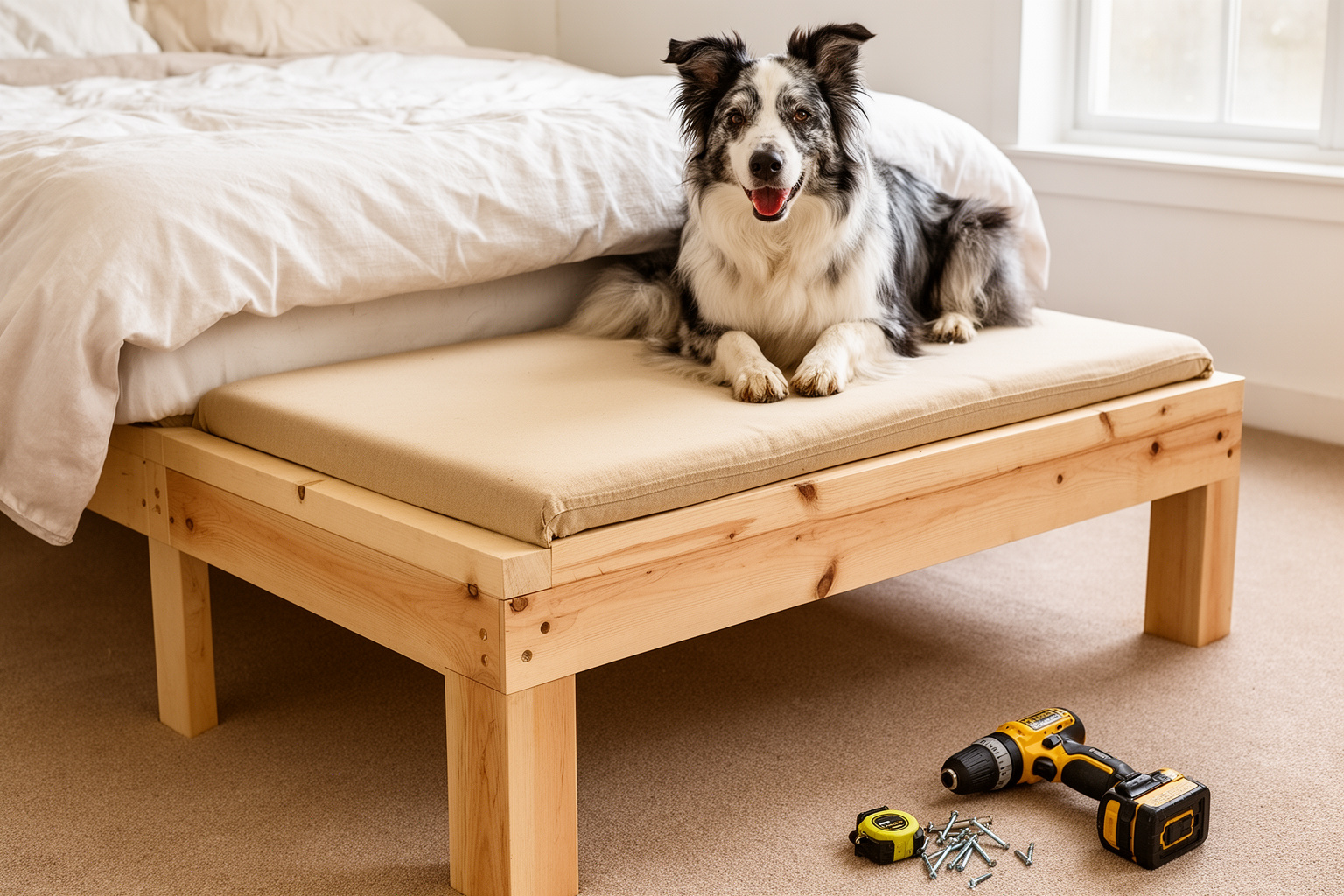

A dog bed extension of a human bed is a raised platform at the foot or side of the mattress, built so the dog’s sleeping surface sits level with yours. The point is proximity without surrendering the whole bed. A floor cushion next to the frame rarely works for dogs that already sleep up high, because the drop feels like a separate room. Height is the project. Get that wrong and the dog either refuses the extension or uses it as a launch pad back onto your pillows.
Most workable versions are a simple wood platform topped with a crib mattress, twin mattress, foam slab, or a covered dog bed. Commercial metal extenders exist and add about 25 inches of length, with a base around 14 inches tall plus the cushion. A DIY version costs less, fits odd bed heights, and can include storage underneath. It also has to be measured to your mattress, not copied from someone else’s plan.
Decide foot or side before you buy lumber
The foot of the bed is the easier build. The platform can be as wide as the mattress and as deep as the dog needs, often 24 to 30 inches for a medium or large dog stretched out. It does not block nightstands, and a step or ramp can sit on one open end. The tradeoff is floor space: a queen mattress plus a 28-inch extension needs that much clear floor past the footboard, or the footboard has to come off.
A side extension keeps the dog next to one person and uses less length in a small room. It is harder to get right. The platform has to follow the mattress edge without colliding with the frame rail, and any gap becomes a place a paw can slip. Side builds also steal the path you use to get out of bed, so plan the open side first.
Measure the dog the way they actually sleep, not standing. Nose to base of tail, plus a few inches, is a better length than shoulder height. Two dogs need enough width to lie without stacking, or one of them will migrate back to you. A single large dog at the foot of a queen is the case this project handles best. A dog whose only goal is to sleep on your chest will still do that; an extension adds space, it does not change preference.
Measure the surface the dog will step onto
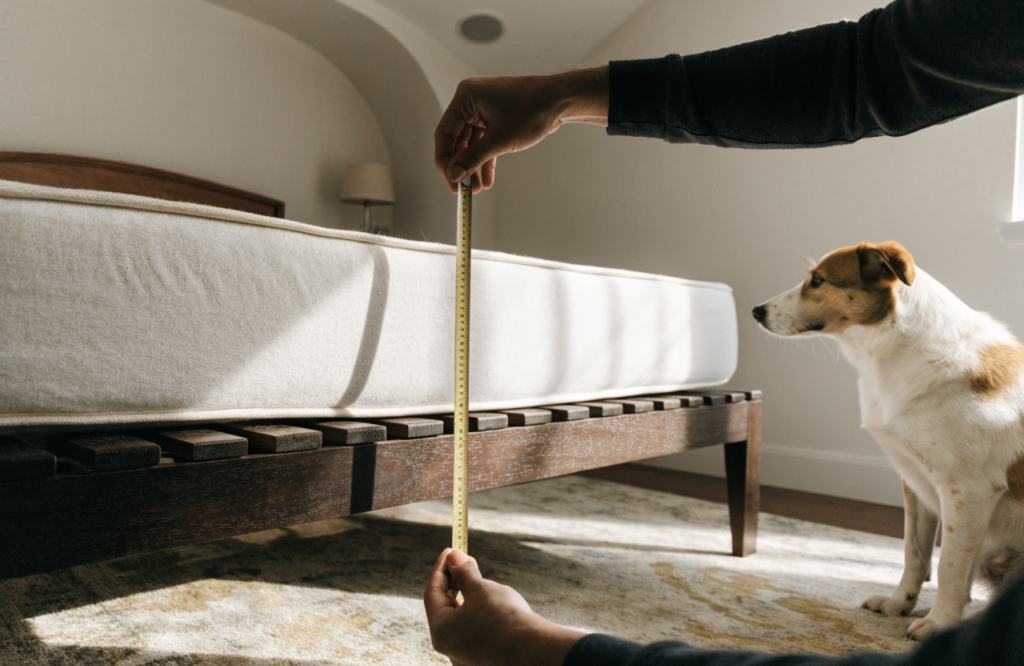
Ignore the catalog height of the bed frame. Measure from the floor to the top of the mattress with the usual sheet, protector, and topper in place, then press down the way a body does. That compressed height is the target for the top of the dog’s cushion, not the bare plywood.
Write down four numbers:
- Floor to top of dressed mattress
- Mattress width at the foot, or length along the side you will extend
- How far the footboard or side rail sticks out past the mattress
- Clearance to the wall, dresser, or door swing
Leg length is what is left after you subtract the platform thickness and the cushion. A 3/4-inch plywood top on a 2×4 frame, plus a 4-inch foam bed, is already close to 6 inches before the legs. If the human mattress sits 24 inches off the floor, the legs are whatever remains after that stack, not a standard 8-inch dog-bed leg.
Recheck after the cushion arrives. Foam compresses. A platform that looked level in the shop can sit an inch high once the dog lies on it, which is usually better than sitting an inch low. A low platform becomes a step the dog uses to reach your duvet.
Three builds, from no tools to a finished platform
| Approach | Best for | Main limit |
|---|---|---|
| Twin or crib mattress on a box spring or bed risers at the foot | Renters, temporary setups, one weekend | Hard to match height exactly; can creep away from the bed |
| Freestanding 2×4 and plywood platform with its own cushion | Most DIY cases | Must be heavy or gripped so it does not walk away |
| Platform fastened to the bed frame | Beds that shift, or a very narrow gap you need to hold closed | Drilling the frame can damage rails and is a poor idea on rentals |
A freestanding platform is the better default. Tie it to the bed with straps or brackets only if it still moves after you add weight and non-slip pads. Metal bed rails and hook-in side rails are easy to weaken with screws. Panel beds with a wooden footboard can take a few brackets on the inside face if you accept the holes.
Commercial foldable metal extenders are a reasonable skip-the-shop option when the bed is a standard height and you only need about two feet of extra length. They are sold for animal use, and the cushion is what makes up the difference between a short metal base and your mattress. They will not fix a tall platform bed or a thick pillow-top unless the foam is ordered to that height.
Build the freestanding foot platform
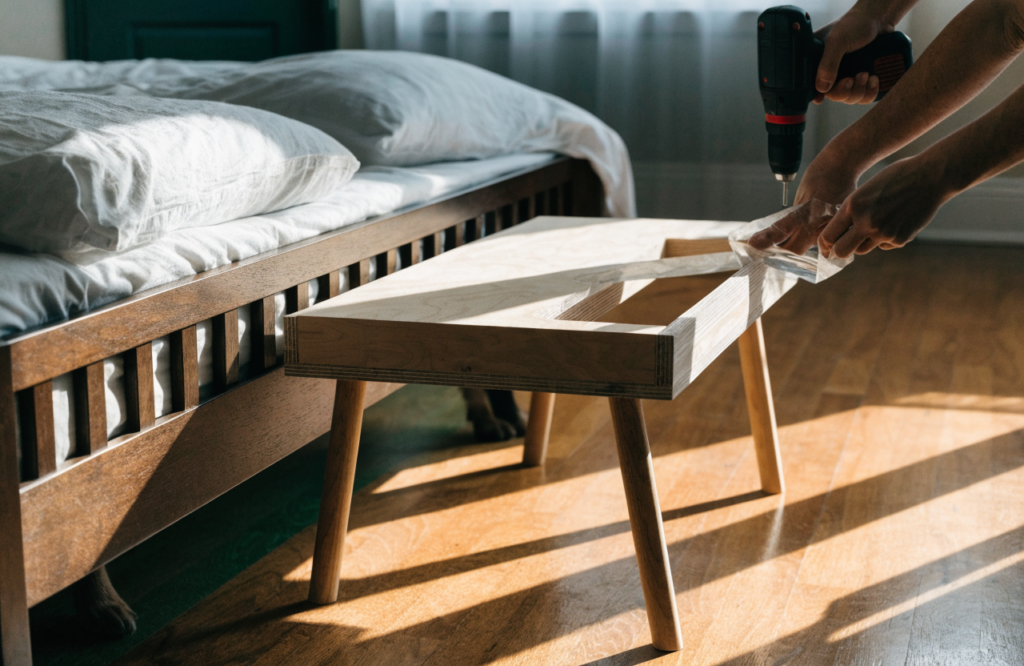
This is the version worth building if you want it to look intentional and hold a 50- to 100-pound dog that jumps. It is not a human guest bed unless you add the center support and decking a real mattress platform needs.
Materials for a typical queen-width foot extension, about 60 inches wide and 28 inches deep:
- Four 2×4 legs, cut to your calculated length
- Two long 2×4 rails and two short 2×4 rails for the top rectangle
- One center 2×4 running the 60-inch direction if the span is over about 48 inches
- 3/4-inch plywood for the deck, cut to the outer frame size
- 2 1/2-inch construction screws, wood glue, and four metal corner brackets
- Non-slip furniture pads or a rubber shelf liner under the legs
- Sandpaper, and paint or a hard finish if the bedroom is carpeted and you care about scuffs
Use straight, dry lumber. A twisted 2×4 makes the whole top rock, and no amount of cushion hides that.
- Cut the top frame to the mattress width and your chosen depth. Dry-fit it on the floor and check square by matching the diagonals.
- Glue and screw the corners. Add brackets on the inside so the joint does not rack when a dog lands on one edge.
- Add the center support on any span a person could sit on. Space is cheap here; a sagging deck is not.
- Cut legs from the leftover height math. Attach each leg inside a corner with two screws and glue, plumb, then add a small block or bracket so the leg cannot kick out.
- Screw the plywood down from the top and countersink the heads. Round the outer corners so they do not catch shins or sheets.
- Set the empty frame in place, then add the cushion and measure again. Trim leg length if the top sits proud of the mattress by more than about half an inch.
Storage underneath is optional and useful. Leave the front open for bins, or add a lower shelf of 1/2-inch plywood if the legs are tall enough. Do not box the underside in solid if you still need to reach straps or adjust leg pads.
Casters only help if the extension must leave the room. Locking casters raise the height, so subtract that from the leg cut, and expect more wobble unless the frame is braced. A split frame with latches can clear a narrow door, but that is a second project, not a requirement for a bed that stays put.
Close the gap and stop the slide
The joint between mattress and extension is where these builds fail. A gap wider than a couple of fingers can catch a paw, and a small dog can drop a leg into it while turning. Footboards make this worse because the board sits between the two sleeping surfaces.
Practical fixes, in order:
- Pull the platform tight to the mattress or to the footboard, then fill whatever remains with a pool noodle in a pillowcase, a rolled towel, or a strip of firm foam. The filler should be trapped, not loose.
- If the footboard is the obstacle and you own the frame, remove it. Many panel beds unbolt. That single change makes a flush extension possible.
- Put rubber shelf liner or a non-slip rug pad on the plywood before the cushion, and pads under the legs. A cushion with a grippy bottom still walks if the frame walks.
- Optional soft straps from the platform to the bed leg keep the two from separating without drilling the rail.
Do not rely on a tucked sheet to bridge an open gap. Sheets shift, and a dog’s weight pulls them in.
Getting up and down is part of the build
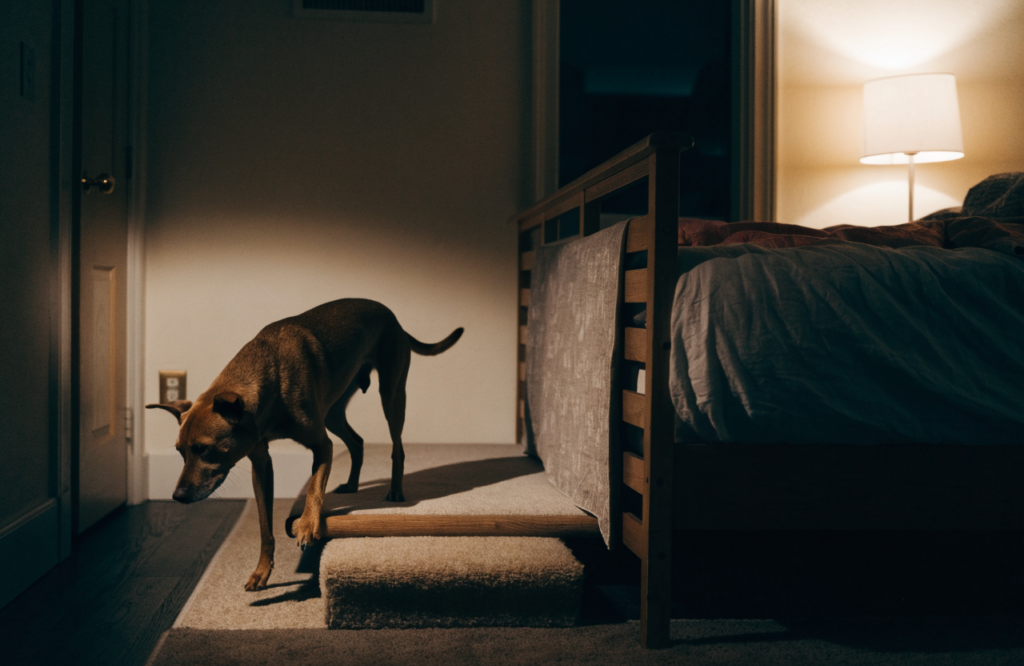
A platform at mattress height is a jump twice a night, often more. Repeated jumping on and off furniture loads joints and is a common concern for necks and backs, especially in long-backed breeds such as dachshunds and corgis, and in older dogs or dogs with arthritis. Veterinary guidance on this point is consistent enough to plan for: reduce the jump rather than wait for hesitation.
Stairs suit many small, agile dogs. Ramps are usually easier on larger dogs and on dogs with existing joint or back trouble. Either should meet the cushion, not stop at the bare frame, and the tread needs grip. A ramp also needs run: a gentle slope takes more floor than three steps. Train with food on the steps before the first bedtime, and do not place the stairs where a person will trip on them in the dark.
If the dog is already reluctant to jump, treat that as a mobility question for a veterinarian, not only a furniture question. An extension will not fix pain, and encouraging one more leap onto a new platform can make it worse.
Bedding that survives a dog and still feels like the bed
Match firmness closer than color. A very soft human mattress next to a thin pad teaches the dog which side is better. A 3- to 5-inch medium foam slab, a crib mattress, or a used twin is enough for most dogs. Waterproof the layer against the plywood. A washable cover matters more than a furniture-grade fabric, because the extension collects the dirt that used to land on your sheets.
Keep human pillows off the extension. They become the new preferred spot and defeat the height match. A single low bolster on the outer edge can stop a small dog from rolling off; on a large open platform it is optional.
Allergens do not stay on the dog’s side if the surfaces touch, but a separate washable bed is still easier to clean than a shared duvet. Wash the cover on the same cycle you would use for a dog that sleeps in the room.
Mistakes that make the extension unused
- Building to frame height and forgetting the mattress topper. The dog faces a step up onto your bed and treats the extension as a stair.
- Leaving a dark gap at the joint. Dogs avoid surfaces that feel unstable under a paw.
- Making it too small. A 20-inch shelf at the foot of a king looks neat and fits a curled small dog, not a sprawled retriever.
- Fastening it so tightly that you cannot pull the bed out to change sheets or vacuum. Freestanding with straps is easier to live with.
- Skipping access. The dog jumps down the near side, lands wrong once, and stops using the platform.
- Assuming the dog will choose the extension because it is “theirs.” Many dogs want contact. The extension works best as overflow for a dog that already crowds the bed, not as a training tool on night one.
When not to build one
Skip the project if the foot of the bed is the only path through the room, if the mattress is already low enough that a thick floor bed feels continuous, or if the dog is small enough to sleep on a defined pad on top of your mattress without displacing anyone. A low platform bed can sometimes take a simpler side bolster instead of a framed extension. And if the goal is a dog sleeping under the bed, that is a different structure: a raised human frame with clearance, not an extension of the sleeping surface.
Frequently asked questions
Can the extension support a person? A 2×4 frame with a center support and 3/4-inch plywood will usually hold an adult sitting at the foot to put on shoes. It is still a dog platform. Do not treat a thin deck without mid-span support as a guest bed.
Should it attach to the bed? Only if it moves after weight and non-slip pads are in place. Straps to a leg are enough for most bedrooms. Screws into metal rails are the option most likely to cause damage.
What if the bed has a footboard? Either remove the footboard or build the platform tall enough to clear it and fill the remaining gap. Building lower than the footboard and hoping the dog will hop over it recreates the jump you were trying to avoid.
How wide should a side extension be? Wide enough for the dog to lie flat without hanging off, commonly 20 to 28 inches, and only on the side you do not need as a walkway. Narrower than the dog’s stretched width, it becomes a perch.