
A quilted dog bed is a cushion or mattress whose cover is stitched in a pattern so the filling stays in channels instead of sliding into one lump. That stitching is useful, but it does not by itself mean the bed will support a dog’s joints or survive daily use. What matters is what sits under the quilting, how thick that layer is under this dog’s weight, and whether the cover can be removed and washed without destroying the loft.
The word “quilted” covers several products: a thin crate pad, a reversible fiber-filled mattress, a bolster bed with a quilted shell, and an orthopedic foam bed wearing a quilted cover. They look similar in photos and behave very differently after a few months. Choosing well means matching the construction to how the dog sleeps, how heavy it is, and how often the bed will need cleaning.
What the quilting is doing
Quilting is a construction method, not a filling. Two or more layers of fabric are stitched through in diamonds, boxes, or channels, usually with batting or loose fiber between them. The stitches hold the fill in place so it cannot all migrate to the edges when a dog circles and lies down.
That solves one real problem. Plain stuffed beds often develop a soft center and firm lumps at the sides. A quilted surface stays more even, which is why quilted pads are common as crate mats and as inserts for plastic dog beds.
Quilting does not add joint support on its own. A 1-inch quilted pad still bottoms out under a heavy dog. The stitches can also compress the fill slightly at every seam, so a heavily quilted thin pad can feel firmer and flatter than an unquilted cushion of the same thickness. Dense stitching is a clue to look at the loft between the seams, not a sign of a better mattress.
Which dogs a quilted bed suits
A quilted bed is a strong everyday choice for a healthy dog that mostly wants a soft, defined place to sleep, especially a dog that curls rather than sprawls. Small and medium dogs put less continuous pressure on fiber fill, so a well-stuffed quilted mattress can stay comfortable for a long time.
It also fits crate training and travel. Quilted pads fold or roll more easily than a solid foam slab, and a removable quilted cover is simpler to wash after a muddy walk than a one-piece plush bed.
It is a weaker primary bed for a senior dog, a dog with arthritis or hip dysplasia, or any dog heavy enough to press a soft center down to the floor. Those dogs usually need a stable foam core. A quilted cover over that foam is fine. A quilted fiber pad alone usually is not.
Hot sleepers are another limit. Polyester fill and a plush quilted top hold warmth. A dog that pants on the bed or moves to the tile at night may do better with a flatter, more breathable surface, or with the quilted side used only in colder months if the bed is reversible.
Quilted cover or quilted fill
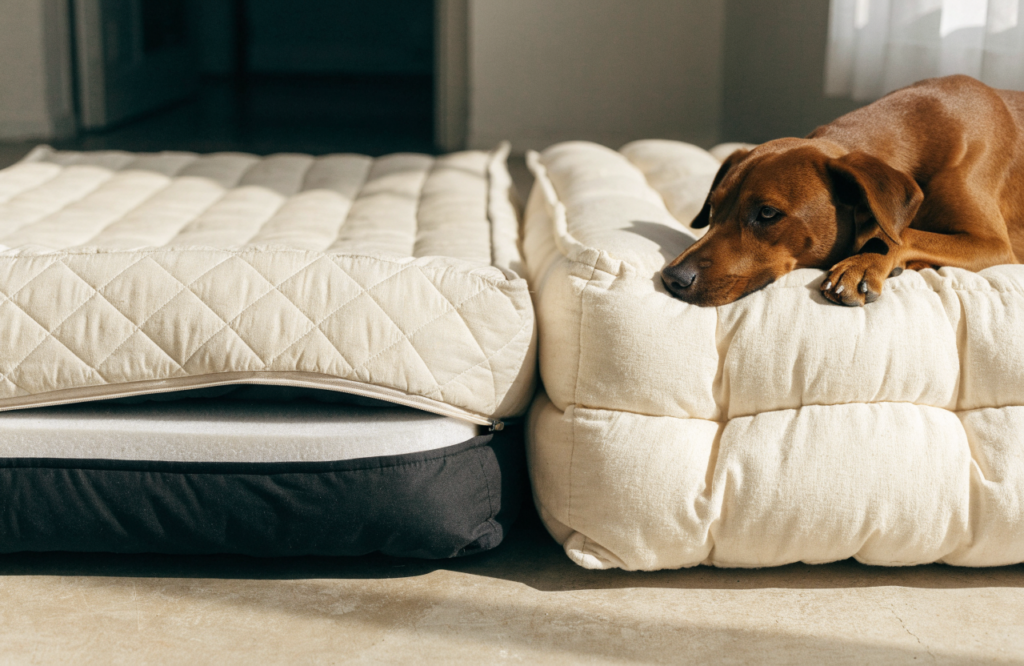
Product photos rarely make this distinction, and it decides whether the bed is mostly a blanket or mostly a mattress.
A quilted cover over foam uses the stitching as the outer shell. Support comes from the foam slab underneath. This is the construction to look for if the listing also says orthopedic, memory foam, or egg-crate foam. The quilting keeps the cover smooth and can add a thin soft layer, but the foam does the work. Confirm the foam is a separate insert and that the cover unzips. “Quilted sofa” listings are often sold with more than one core, so the same outer bed can be fiber, convoluted foam, or memory foam depending on the option selected.
A quilted fiber bed is fill all the way through, usually polyester fiberfill or a denser cluster fiber, held by the stitching. It feels plush and nests when a dog circles. It is lighter, often fully washable, and cheaper. It also compresses. Standard fiberfill clumps and flattens; cluster or ball fiber resists that better because the tufts interlock instead of separating into loose wisps. Either way, fiber is a comfort layer, not a substitute for a foam mattress under a large adult dog.
A quilted crate pad or mattress topper is the thinnest version. It is meant to line a plastic bed, crate tray, or car seat, not to be the only cushion for a dog that spends most of the day on it. If the pad is reversible, one side is often smoother and one side fleecy, which is useful for warm versus cool weather, not evidence of two different support levels.
| Construction | What it feels like | Best used as | Main limit |
|---|---|---|---|
| Quilted cover over solid or egg-crate foam | Even, stable surface with a soft top | Primary bed for medium and large dogs | Foam is usually spot-clean only; cover must come off |
| Quilted fiberfill or cluster fiber | Soft, nestable, light | Curlers, smaller dogs, spare beds | Flattens; little pressure relief |
| Thin quilted crate pad | Light padding over a hard tray | Crate, plastic bed, travel | Bottoms out if used alone |
| Bolster with quilted center | Raised edges, softer middle | Dogs that rest their head on a rim | Interior sleeping area is smaller than the outer size |
How to judge support before buying
Ignore the word orthopedic unless the listing names the core. A quilted cover can sit on anything.
For a foam-core bed, thickness is the first check and density is the one sellers often omit. A thin slab can still bottom out. As a practical screen, look for enough depth that your hand, pressed the way the dog will lie, does not meet the floor. Medium dogs generally need several inches of foam; large dogs need more. Egg-crate foam spreads pressure across the peaks and allows a little airflow, but the valleys reduce the effective thickness, so measure the base under the peaks, not the height of the tallest point.
For a fiber bed, press the center of the product photo’s described loft and read reviews for “flat after a month” rather than “soft.” Cluster fiber and a quilted box pattern hold shape longer than loose polyfill in a single cavity. If the maker sells a refill or says the fill can be shifted by hand, that is a useful maintenance feature, not a flaw.
Non-slip backing matters more than it looks. A quilted bed on hard flooring slides when a stiff dog stands up. A rubberized or dotted base reduces that. On carpet it matters less.
Size by the usable sleeping surface, not the outer footprint. A bolster eats several inches on each side. The dog should be able to lie in its usual position — curled, or on its side with legs extended — without hanging off. Measure from nose to the base of the tail, then add room for the position the dog actually uses at night. A sprawler needs a wider rectangle. A curler can use a round or oval bed if the flat interior is still long enough to stretch occasionally.
Fabric, accidents, and washing
The cover takes the claws, hair, and washing. Cotton and cotton blends breathe and feel less plasticky; canvas and tighter weaves resist abrasion better. Plush and sherpa tops feel warmer and hold hair. A soft face does not tell you whether the seams will split.
For puppies, incontinent seniors, or dogs that come in wet, separate three claims that listings blur together. A washable cover means the outer shell can be cleaned. A water-resistant fabric sheds light moisture. A waterproof liner is a coated inner layer that keeps spills off the fill. Only the liner reliably protects foam or fiber from urine. Seams and zipper tape are the usual leak points, so a covered zipper is worth having.
Wash the cover only as its label allows. Close the zipper first. Mild, fragrance-free detergent is the safer default for a bed a dog sleeps on for hours; scented softener can leave residue and is often a poor match for waterproof coatings. Dry on the setting the label allows, or air dry, and do not put a damp cover back on the insert.
Solid foam should stay out of the washer and dryer unless that exact insert is approved for it. Spot-clean the core and let it dry fully. Fiber-filled beds are more often machine washable, but a soaked fiber cushion is heavy, slow to dry, and prone to mildew if it is reassembled damp. If the bed is too large for a home machine, a laundromat washer is an option only when the care label allows machine washing.
Why quilted beds flatten, and what slows that down
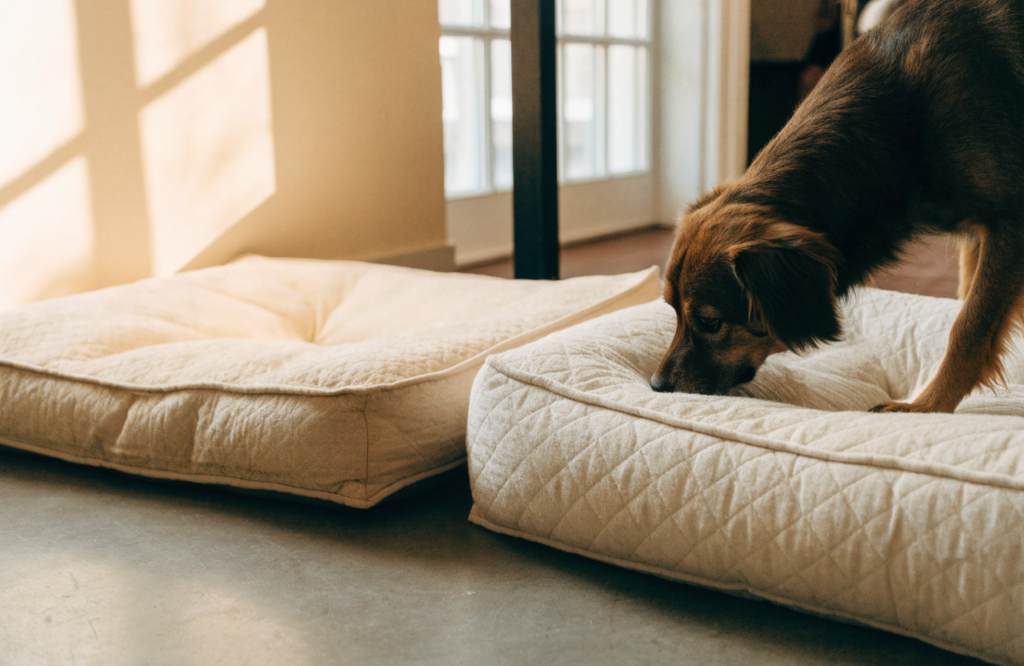
Most early failures are fill collapse, seam stress, or a cover that cannot be cleaned often enough.
Fiberfill packs down where the dog lies every night. Shaking and kneading the channels redistributes some of it. A bed that is quilted into smaller boxes clumps less than one with a few wide channels, because the fill cannot travel as far. Rotating the bed so the same hip spot is not always in the same place spreads wear.
Foam flattens when the slab is too soft for the dog’s weight or when moisture reaches it. A waterproof liner and a spare cover matter more here than a decorative pattern. If the center stays compressed after the dog gets up, and a hand press meets the floor, the core is done even if the quilted cover still looks new.
Chewing is a separate problem. Quilted seams give teeth a ridge to grab, and once the cover opens, fiber or foam is easy to pull out. Loose fill is a blockage risk if swallowed. A heavy chewer needs a chew-resistant bed, not a softer quilted one placed in the same spot. Puppies in a chewing phase are safer with the quilted bed only while supervised, or with a tougher crate pad until the stage passes.
Replace the bed when the middle no longer rebounds, odors survive washing, the liner has cracked, or seams are opening. A new cover can save a sound foam insert. It cannot save fill that has permanently packed down.
When to choose a different bed
Skip a fiber quilted bed as the only bed if the dog is older, stiff getting up, or large enough that soft pads go flat underneath it. Use foam with a washable cover, quilted or not, and a low front edge if stepping up is hard.
Skip thick plush quilting for a dog that overheats. A raised mesh cot or a flatter foam bed with a less insulated cover will sleep cooler.
Skip either style for a determined chewer. Ballistic nylon, coated fabrics, and elevated beds with replaceable parts survive teeth better than stitched channels.
A quilted pad still earns a place in those homes as a washable layer inside a crate or on top of a tougher base, as long as it is not the only thing between a sore dog and the floor.
Frequently asked questions
Is a quilted dog bed the same as an orthopedic bed? No. Orthopedic refers to the support core, usually foam thick enough that the dog does not bottom out. Quilted refers to the stitched cover or shell. A bed can be both, but only if the listing specifies the foam, not just the stitching.
Can a quilted dog bed go in the washing machine? Only the parts the care label allows. Removable covers often can. Solid foam inserts usually cannot. Some fiber-filled beds can, if they fit the machine and are dried completely before reuse.
Why does the bed look lumpy after washing? Fiberfill clumps when it gets wet and agitated. Dry it fully, then break up the clumps by hand through the quilted channels. If the label says not to machine wash the insert, washing is what caused the damage.
Are quilted beds warm? Usually warmer than a bare foam slab or a mesh cot, because the stitching encloses fill and the top is often fleece or plush. A reversible smooth side sleeps cooler than a sherpa side, but it is still not a cooling bed.
What size should I buy? Measure the dog in the position it actually sleeps in, and compare that to the flat interior, not the outer dimensions. Add space for turning. A bolstered bed needs a larger stated size than a flat mattress to give the same sleeping area.