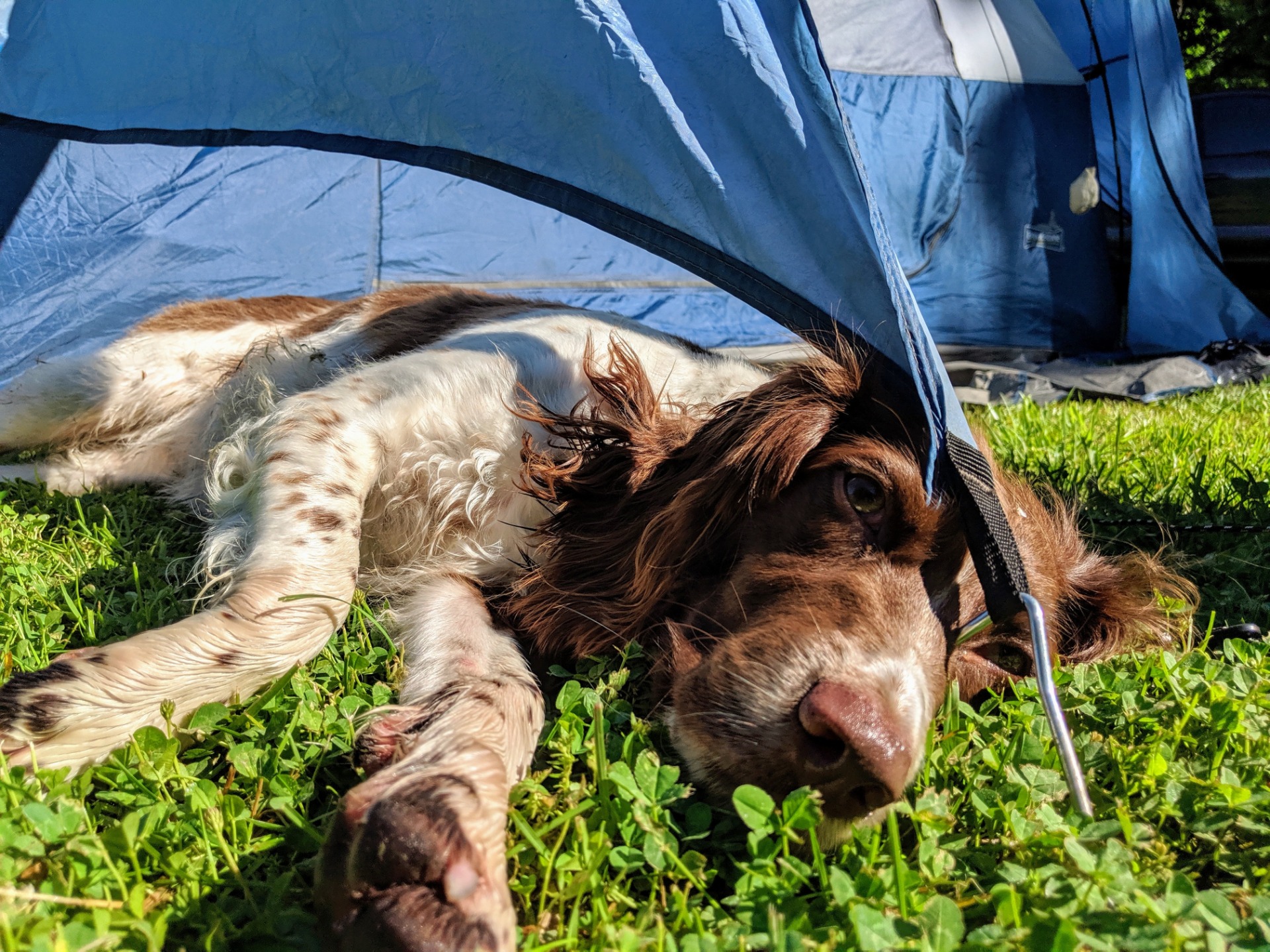
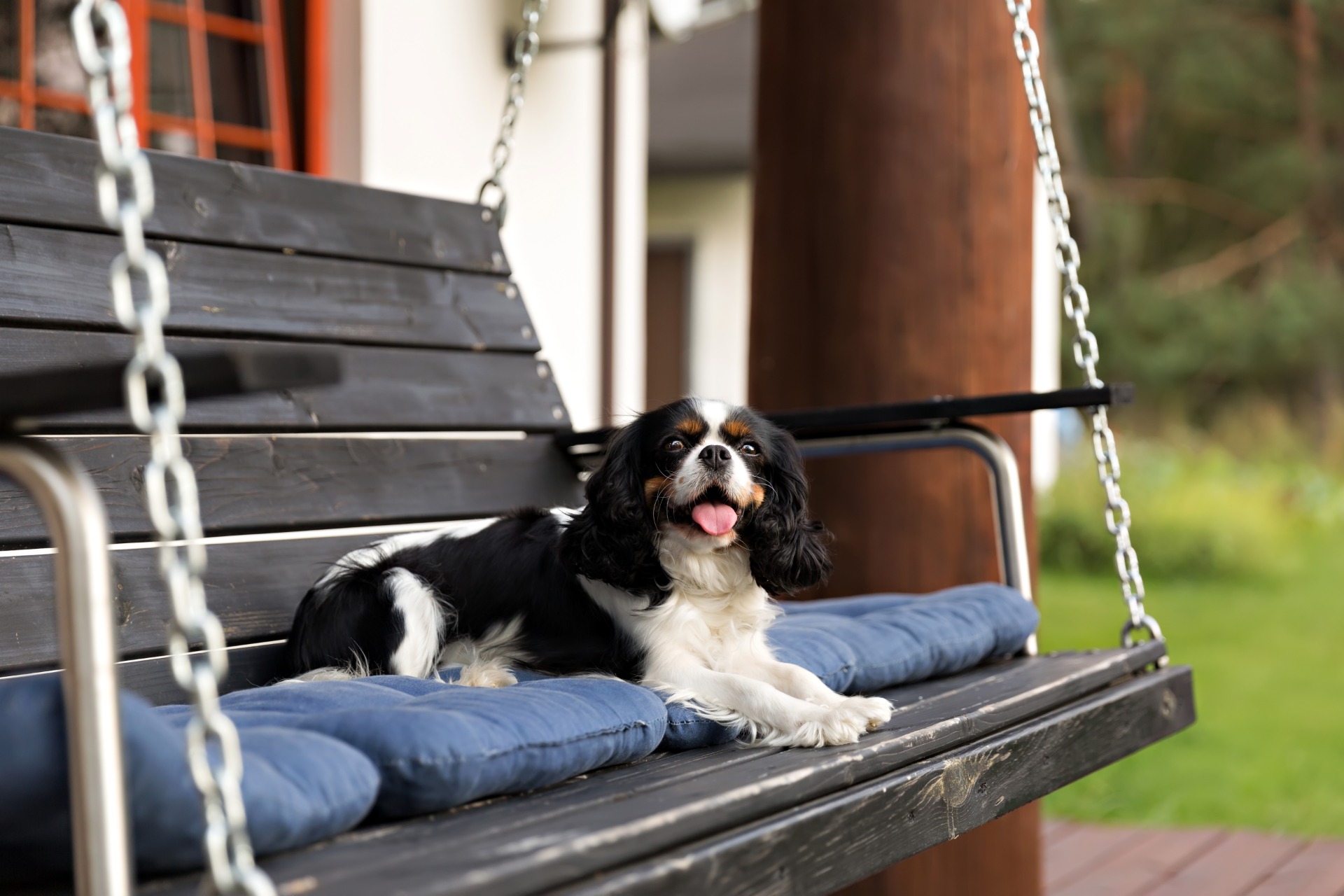
An outdoor dog bed that lasts is a raised frame with a surface water can pass through, not an indoor cushion dragged onto the patio. A mesh or slatted cot a few inches off the ground sheds rain, lets air move underneath, and keeps the dog off hot or damp concrete. Foam pads belong on that frame only when they can come inside or sit under a real roof. The build below covers a PVC cot for most yards, a wood platform when you want something heavier, and the placement details that decide whether either one survives a wet season.
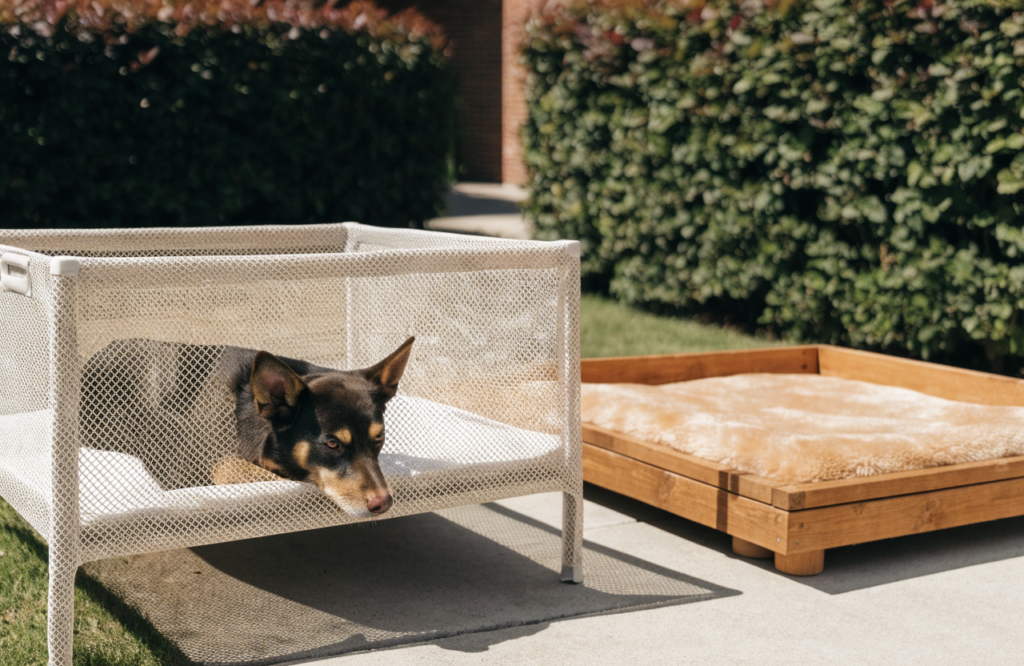
A store-bought raised cot looks like this: a taut open-weave surface, short legs, and nothing underneath that can hold a puddle.
Choose the bed type before you cut anything
Most failed outdoor beds start as the wrong object. Match the design to climate, the dog’s joints, and how hard the dog chews.
Raised mesh cot
This is the default for patios, decks, and covered porches in warm or wet weather. Four legs hold a rectangle of pipe or metal. Outdoor mesh stretches across the top and drains in both directions. Air under the dog is what keeps the surface cooler than a cushion sitting on concrete. Commercial versions use the same idea with HDPE or Textilene-style fabric, which is why those cots dry in minutes instead of holding a damp smell.
Use a mesh cot if the dog naps outside in summer, the yard gets dew or sudden rain, or you want something you can hose off. Skip it as the only bed for a senior dog with thin skin or painful elbows unless you add a thin, removable pad the dog can still step onto easily.
Wood platform with a removable pad
A low wooden frame with slats or spaced deck boards gives a firmer surface and more weight, which matters if the dog is large or the yard is windy. The pad should be a separate piece: an outdoor cushion with a waterproof liner around the foam, or a hose-off mat you can lift. Solid plywood floors are a poor choice. Water sits on them, and a dog that digs will tear the sheet.
This version suits covered porches and dogs that need more give under the joints. It is a bad choice left in the open all winter with the cushion still on it.
Shade canopy over either frame
A canopy is a second project, not a substitute for drainage. A simple arch of thinner pipe or a fabric sail over the cot blocks sun and light rain. It does not stop wind-driven water, and a closed tent traps heat. Leave at least two sides open. If the dog will be outside for hours in strong sun, shade matters more than a thicker mattress.
Size the frame to how the dog sleeps
Measure the dog lying on its side, fully stretched, from nose to the base of the tail. Add about 6 inches for a dog that curls, and 10 to 12 inches for a dog that sprawls. Width should let the dog roll without hanging a shoulder off the edge. When the measurement falls between two sizes, go up. A bed that is slightly large still gets used. A bed that is short gets abandoned.
| Dog, roughly | Sleeping length to plan for | Frame example |
|---|---|---|
| Under 25 lb | 24–30 in | 30 × 20 in |
| 25–50 lb | 30–36 in | 36 × 24 in |
| 50–75 lb | 36–44 in | 42 × 28 in |
| 75–100 lb | 42–48 in | 48 × 30 in |
| Over 100 lb | 48 in and up | 54 × 36 in, with a center support |
Bolsters steal interior space, so do not count the outside of a boxed frame as the sleeping area. Older dogs need the extra length and a low entry. A 6-inch leg height is easy for most adults. Drop to about 4 inches, or add a half-step, if the dog is stiff, short-legged, or recovering from surgery. Tall legs look neat and make cleaning easier, but they are a bad trade if the dog hesitates to jump.
Materials that hold up outside
Frame
Schedule 40 PVC is the easiest outdoor frame. It does not rust, it is light enough to move, and friction-fit joints can come apart for storage. One-inch pipe is enough for small and medium dogs. Use 1¼-inch pipe for dogs over about 70 pounds, and add a center crossbar on anything longer than 42 inches so the mesh does not sag into a hammock.
Wood should be cedar, redwood, or untreated pine sealed on all faces with an exterior finish labeled safe once cured. Modern pressure-treated lumber uses copper-based preservatives rather than the older arsenic formulas, but it is still not a chew toy. Dogs that gnaw deck boards can swallow splinters and copper residue. Do not build the sleeping rails from pressure-treated stock if the dog chews. Keep treated posts, if you use them at all, as legs the dog cannot mouth.
Metal conduit works if you already have it. Cap every cut end and add rubber feet so the frame does not skate on wet tile.
Sleeping surface
Open-weave outdoor fabric is the part that makes the bed outdoor-capable. Look for Textilene, Phifertex, marine mesh, or a heavy shade-cloth rated for sun. These fabrics are woven so water falls through and UV does not destroy them in one summer. A standard drop cloth, an old bedsheet, or indoor canvas will sag, hold water, and mildew.
Cut the fabric 4 to 6 inches larger than the frame on every side so you can wrap and fasten it. Pull it tight before you screw it down. Loose mesh pools in the middle and becomes a sling that stresses the joints.
What not to use
Memory foam and ordinary poly foam left outside are the usual reason a bed starts to smell. A cover labeled waterproof is often only a spray treatment. Dog nails, sun, and washing wear that layer off, the foam gets damp, and it does not dry in the center. If you want a cushion, wrap the foam in a welded vinyl or TPU liner, then a removable outdoor cover, and bring the pad in when rain is forecast.
Skip pallets as the finished bed. The gaps look like drainage, but the blocks and underside stay wet, and unknown pallet stamps can mean chemical treatment. Hay mats down and molds faster than straw. Straw is an outdoor-kennel bedding, not a patio bed, and it belongs in a sheltered box rather than on an open frame.
How to build a PVC raised outdoor dog bed
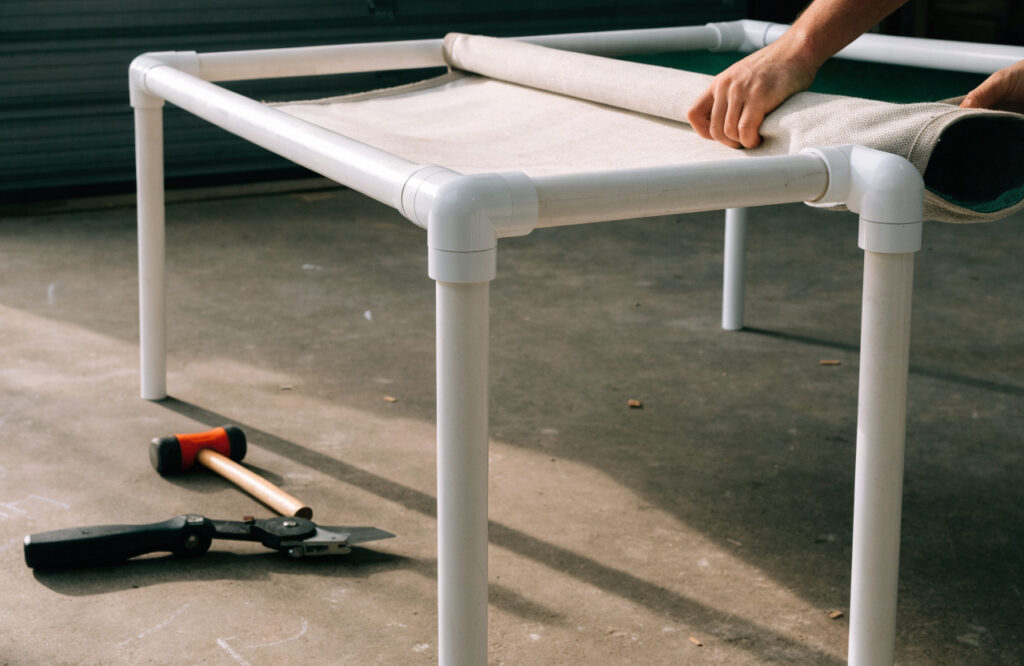
A 36-by-24-inch cot for a medium dog is the pattern. Scale the pipe lengths to your measurements and keep the method the same.
Materials
- About 10 feet of 1-inch Schedule 40 PVC
- Four 1-inch three-way elbow fittings (side-outlet elbows if you can get them; standard tees plus elbows also work)
- Four PVC caps or rubber feet
- Outdoor mesh, roughly 44 by 32 inches
- Eight to twelve washer-head or lath screws, short enough not to spear through the pipe into the sleeping area
- PVC cutter or handsaw, drill, tape measure, file
Cut list for a 36 × 24 in bed, about 6 in off the ground
- Two pipes at 36 inches (long sides)
- Two pipes at 24 inches (short sides)
- Four pipes at 6 inches (legs)
- One pipe at 24 inches (center support, dogs over 50 lb or frames over 40 inches)
- Cut the pipe and file every end so the fittings seat fully. A ridge left by the saw keeps the joint from going home and makes the frame twist.
- Dry-fit the rectangle. Long sides into the corner fittings, short sides between them. Do not glue yet. Set the frame on a flat floor and check that it does not rock. A twisted rectangle will chew through mesh at the corners.
- Add the legs. If the fittings have a downward socket, the legs drop straight in. If you are using standard plumbing fittings, a tee at each corner with a short drop works. Cap the bottoms so the pipe does not dig into soil or scratch a deck.
- Add the center support on larger beds, snapped or screwed to the long sides so it sits just under the mesh.
- Test-fit the dog’s weight. Sit a bag of soil in the middle, or have someone press down, before you attach fabric. Joints that creep apart need a single screw through the fitting into the pipe. Glue only if you never need to collapse the bed. Glued PVC is permanent.
- Wrap the mesh. Start at the middle of one long side, pull across, and fasten the opposite side. Then do the short sides. Work from the center toward the corners so the tension stays even. Screw through a washer or a scrap of webbing so the screw head does not tear the weave.
- Trim the excess, leaving enough wrap that the cut edge is under the frame, not where claws can pick it.
Expect about an hour once the pipe is cut, and a materials cost well below a branded aluminum cot of the same size. The mesh is the piece worth buying properly. Cheap nylon stretches and fails at the screw holes.
How to build a simple wood platform bed
Use this when you want a heavier bed for a porch, or a surface that can hold a thin outdoor pad.
Materials for a 42 × 28 in platform
- Two 8-foot cedar or sealed pine 2×4s
- 1×3 or deck boards for slats, spaced ½ to ¾ inch apart
- Exterior screws, 2½ inch for the frame and 1¼ inch for the slats
- Four short legs, 4 inches, cut from the same stock
- Exterior sealer, sandpaper, drill
- Cut two long rails and two short rails. Assemble a rectangle with the short rails between the long ones, or use pocket holes if you already own a jig. Check the diagonals. Equal diagonals mean the frame is square.
- Screw a leg inside each corner, flush with the top of the rail or set so the slats sit slightly proud. Four inches of clearance is enough to stop splash-back on a porch. On soil that stays wet, go to 6 inches and set the feet on pavers, not bare dirt.
- Lay slats across the short dimension. Leave consistent gaps so rain and hose water fall through. A solid top looks finished and then cups, stains, and smells.
- Sand every edge the dog will touch. Seal all faces, including the underside and the cut ends. End grain is where rot starts.
- If you add a pad, size it to the slat area and keep it removable. A pad screwed down becomes a sponge you cannot dry.
Do not staple indoor upholstery foam to this frame and call it weatherproof. The staple line is a leak path, and the foam will stay wet from the bottom even if the top sheds a shower.
Where to put the bed so rain does not win
Elevation only works if the ground under it drains. A cot sitting in a low spot still ends the day in a puddle, and mosquitoes use the shade underneath.
Put the bed on a deck, pavers, or compacted gravel, not lawn that stays soft after rain. A slight slope away from the house is better than a dead flat slab with a birdbath dip. Four inches of clearance handles ordinary splash. Six to eight inches is safer where water sits after storms. In a flood-prone corner, the bed should not be the dog’s only shelter at all.
Face the open side away from the prevailing wind if you add a canopy. Afternoon sun is the one to block. A west-facing wall without shade turns a mesh cot into a griddle by late day, even though the fabric itself breathes.
An outdoor bed is not a substitute for a dog house in freezing weather or severe storms. Mesh cools a dog. That is the point in July and a problem in January. In cold seasons, use a sheltered box with dry bedding and bring cushions inside.
Mistakes that ruin an outdoor dog bed
- Moving the indoor bed outside. Poly fill and memory foam hold water in the core. The cover can feel dry while the inside grows mold. Once that smell is in the foam, washing the cover does not remove it.
- Trusting a “waterproof” label. Many coatings are durable water repellent. They bead light rain, then soak through at seams and worn spots. For foam, the liner has to be a sealed bag, not a sprayed face fabric.
- Skipping the center support. A 48-inch span of 1-inch PVC bows under a large dog. The mesh sags, the dog slides to the middle, and a fitting eventually cracks.
- Using treated lumber where the dog can chew. Copper-based preservatives replaced arsenic in most residential lumber after the early 2000s, but chewing still means splinters and copper exposure. Cedar or sealed untreated wood is the safer rail.
- Building tall legs for a stiff dog. The bed can be perfect and still go unused if the step up hurts. Height is a medical decision as much as a drainage one.
- Leaving fabric loose. A hammock looks comfortable for an afternoon and then concentrates the dog’s weight on four joints. Tight mesh wears evenly.
- Storing the bed damp. Fold a wet cot into a bin and it mildews in the creases. Dry it in the shade, fully, before it goes away for the season.
Care through the season
Hose the mesh and scrub with mild dish soap when it picks up mud or drool. Skip hot washes and harsh detergent on any coated fabric. Those strip what water resistance the weave still has. Let it dry in open air, not in a closed deck box.
Check screw holes every few weeks. Mesh fails there first, especially if a dog digs before lying down. A patch of webbing under the screw head slows that. PVC left in full sun chalks and becomes brittle over a few summers. Painting is optional. Storing it out of winter weather extends it more than any coating.
Wooden frames need a fresh coat of exterior sealer when water stops beading, often every year or two on a porch and sooner in full weather. Lift the pad after every rain. If the underside is still damp the next morning, the site is wrong or the pad is not actually outdoor-rated.
Replace the mesh when it frays, rather than the whole frame. That is the advantage of a screwed, unglued build.
Frequently asked questions
Can a dog sleep on a DIY outdoor bed all night?
Only if the weather is mild, the bed is dry, and the dog has shelter from wind and rain. A mesh cot is a resting place, not a winter kennel. Dogs left out overnight in cold or storms need an insulated house with dry bedding, not a patio cot.
Is a pallet dog bed a good outdoor project?
Not as the finished bed. Pallet wood is often unknown, the blocks hold moisture, and the surface is hard to seal completely. A purpose-cut cedar frame takes a similar amount of time and is easier to keep dry.
What fabric should a chewer get?
Open mesh will lose to a determined chewer. If the dog destroys beds, use a heavy vinyl-coated polyester or a ballistic outdoor fabric on a wood frame, keep edges wrapped under the rails, and do not leave the dog unsupervised with a new bed. No fabric is chew-proof. A short session of supervised use tells you whether this project will survive.
Do I need a cushion for joint problems?
A raised mesh cot reduces heat and damp, which helps, but it is not orthopedic support. Dogs with arthritis usually do better on a firm, waterproof-lined pad with a low entry, placed on a covered porch and brought in when it is wet. A thick memory-foam bed left in the yard trades joint comfort for mold.
How high should the legs be?
About 4 inches for seniors, short dogs, and easy access. About 6 inches for most adults on a deck. Go higher only on ground that floods, and only if the dog can still get up without a struggle. Airflow matters, but an unused tall bed does not help the dog.