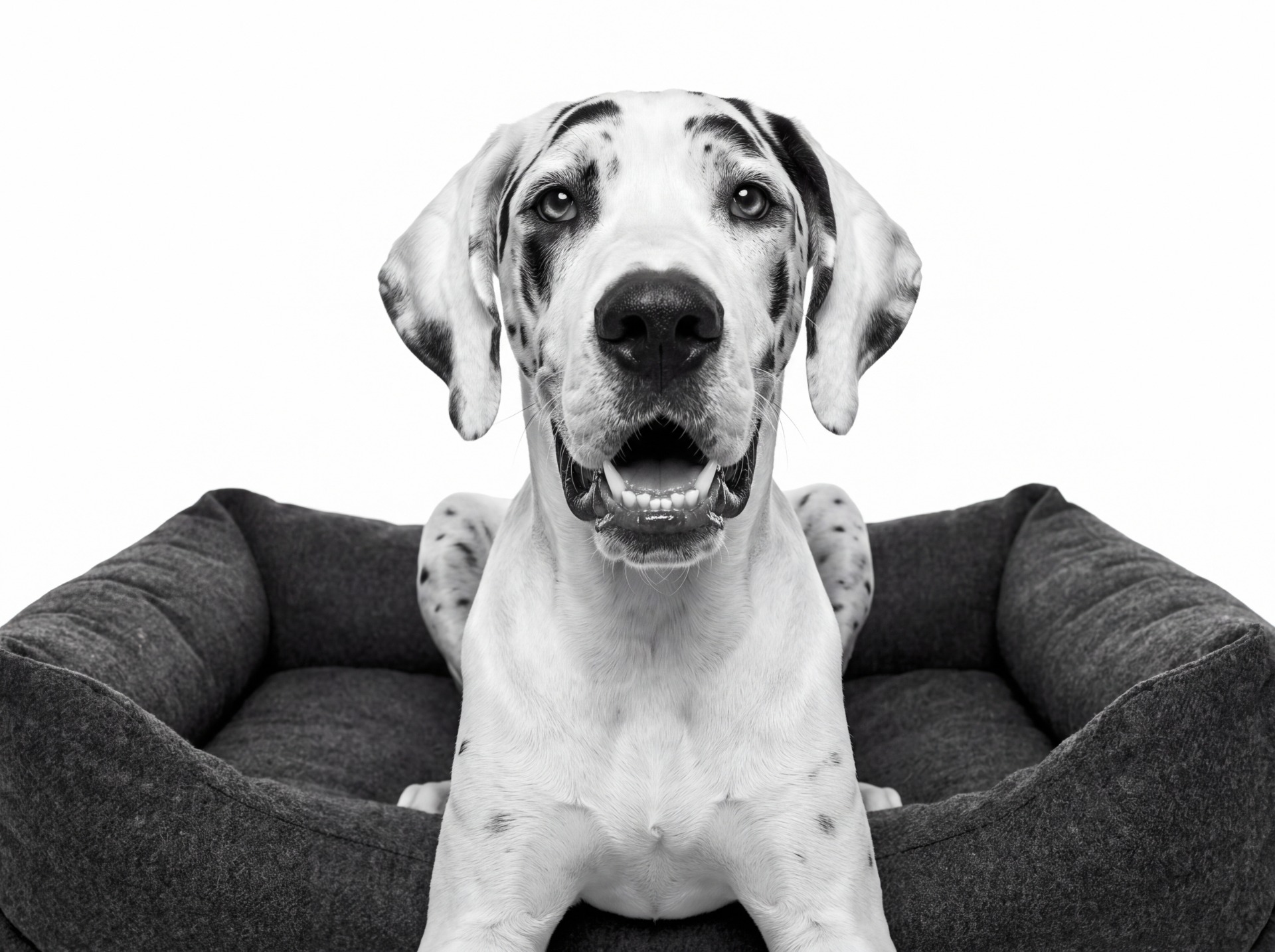
A bolster dog bed helps only when the raised edge matches how the dog already sleeps and the dog can step over it without a hitch in the hips. The padded rim gives chin-resters and leaners a pillow and a boundary; it steals usable floor space from sprawlers and can turn into a curb for a stiff senior. Product photos show the outside of the bed. The measurement that decides fit is the flat area inside the bolsters, which is often several inches smaller than the size on the label.
What the raised edge is actually for

A bolster dog bed is an ordinary sleeping surface with a padded rim along one or more sides. Sofa-style beds usually raise the back and two sides and leave the front open. Wraparound and round “donut” beds enclose most of the circle. The rim is a headrest, a backrest, and a visual boundary. It is not, by itself, joint support.
Owners and bed makers describe three reasons dogs use that edge. Many rest the chin on it the way a person uses a pillow. Others sleep with the spine against the wall of the bed, the same way they wedge themselves against a sofa or a crate corner. A third group, mostly small, short-coated, or anxious dogs, treat the rim as a windbreak: it holds a pocket of warm air and blocks the room. Guides from brands such as Animals Matter frame this as a denning habit. That is a useful description of behavior, not a clinical finding. A dog that already naps in corners is a better candidate than a dog that sprawls in the middle of the floor.
The base does the orthopedic work. A firm foam slab, often 3 to 4 inches or more, spreads weight. The bolster is usually fiberfill, shredded foam, or a softer foam tube. Those materials feel plush and collapse faster than a dense mattress. A bed can have an excellent rim and a worthless base, or the reverse.
Match the shape to the sleep posture
Watch the dog on an unmade blanket for a few nights before buying. Posture predicts the right outline better than breed charts.
Leaners and chin-resters are the clearest fit for a sofa-style bolster. They already push their back into furniture or rest the head on the arm of a couch. A three-sided bed with an open front gives them that edge and still leaves a path in.
Tight curlers often do better in a round donut. The continuous wall meets the body no matter which way they spin, and the nest holds heat. Fiber-filled donuts have little or no foam slab, so they suit small and medium dogs more than a 70-pound dog that needs pressure relief. Brands that sell both styles, including Animals Matter’s comparison of loungers and donuts, separate them this way: foam-based bolsters for leaners and seniors who need a supportive floor, fiber nests for dogs that curl into a ball.
Sprawlers usually lose with a bolster. Legs hang over the rim, the hip sits on the slope instead of the flat center, and the dog ends up half on the floor. A flat orthopedic mat, or a bolster bed one or two sizes larger than the label suggests, is the better default.
Anxious or newly adopted dogs sometimes settle faster with higher walls because the rim blocks sightlines. That is owner-reported, not a treatment for anxiety. If the dog pants, circles, or leaves the bed to sleep on tile, the enclosure is too warm or too small, not “more calming.”
| Sleep habit | Better shape | Skip it if |
|---|---|---|
| Chin on the sofa arm, back against a wall | Three-sided sofa bolster | The front rim is tall and the dog is stiff |
| Nose-to-tail curl, seeks corners | Round donut or deep nest | The dog is heavy and needs a foam slab |
| Side sprawl, legs fully extended | Flat mat, or a very large low-entry bolster | The only option is a snug wraparound |
| Crate sleeper who leans on the bars | Bolster sized to the crate interior | The rim eats the crate’s usable length |
Size the inner sleeping area, not the label

The most common miss is buying to the outer dimensions. A bed sold as 36 inches can leave only about 28 to 30 inches of flat interior once the bolsters are subtracted, according to a sizing guide that flags this as the usual bolster trap. The same guide’s rule is to size up one level from a flat mat and, if the maker does not publish interior inches, subtract roughly 4 to 6 inches per bolstered side.
Measure the dog, then shop the interior:
- With the dog standing relaxed, measure from the tip of the nose to the base of the tail, not the tail tip. Some makers, including Bluewater, use neck-base to tail-base instead. Either is fine if you apply it consistently and then check the interior.
- Add room for movement. Flat-bed guides commonly add 6 to 12 inches to stretched length. Curlers can sit at the low end. Sprawlers need the high end, sometimes more.
- Compare that number to the inner length, not the outer. A Ruggable small bolster, for example, is listed at 28 by 22.5 inches outside for pets up to 25 pounds, while the sherpa mattress inside is 18 by 12.5 inches. The gap is the bolster.
- Check height. The rim should meet the chin when the dog is lying down and still be low enough to step over. Shoulder height while lying down is a practical check.
Crate beds need the same test in reverse. The outer footprint has to fit the crate pan, and the interior still has to hold the dog without forcing the spine into the bars. A bolster that looks generous in a product photo can turn a correctly sized crate into a tight one.
Weight labels are a rough proxy, not a fit. “Large, up to 50 pounds” says nothing about a long-backed dachshund versus a compact staffie of the same weight. When a dog falls between sizes, size up on interior length. Extra flat space is usable. A rim that crowds the shoulders is not.
When the rim helps joints, and when it gets in the way
Head and neck support is the honest joint claim. A dog that rests the chin on a bolster keeps the neck from cranking sideways on the floor. That can make a long nap easier. It does not realign the spine, and it does not treat arthritis.
Pressure relief comes from the base. Guides aimed at dogs with hip dysplasia, including Disabled Dog Care’s bedding notes, treat foam depth and entry height as the constraints that matter: a slab that does not bottom out under a full palm press, commonly discussed as at least 3 to 4 inches of supportive foam, and a way onto the bed that does not require a high step. Some hip-dysplasia buying guides suggest keeping a bolster under about 5 inches if the dog still wants a headrest. Those figures are practical thresholds from bedding guides, not a veterinary dosing standard.
Watch the first week of entries and exits. A useful bolster has one open or lowered side so the dog walks on. A wraparound rim that the dog scrambles over, refuses, or needs a boost to clear is the wrong bed, even if the foam is excellent. Placing a flat orthopedic mat against a wall gives a leaner the boundary without the curb. For a dog with weak hind legs, a low-entry bolster plus a non-slip floor under the bed matters more than a plush photo.
Heat is the other limiter. Memory foam and sherpa hold warmth. Double-coated, brachycephalic, and summer-sleeping dogs often abandon a bolstered bed for tile. Egg-crate foam and a cooler cover fabric breathe more. A waterproof liner protects the foam from accidents, which are common in seniors, but it also traps heat. If the dog already runs warm, skip the liner or choose a bed where it can be removed.
Fill, covers, and the failures that show up after unboxing
Cheap bolster beds fail in predictable ways, and the complaints cluster.
Vacuum packing flattens the rim. Beds ship compressed. Owners on a Fiberfill migrates. Bolsters stuffed only with polyester clumps after washing and after a dog who digs a nest. Shredded foam holds shape longer but can feel lumpy. A removable bolster insert that you can refluff is more useful than a rim sewn shut.
Covers and foam have different jobs. A machine-washable cover is the minimum if the dog sheds or has accidents. Zippers fail when people wash the whole bed or overload the machine. Foam should be spot-cleaned and air-dried. Saturating memory foam breaks it down. Replacement covers are uncommon on budget lines, so a failed zipper often means a new bed.
CertiPUR-US is a foam check, not a bed guarantee. The program is a voluntary industry standard for flexible polyurethane foam. It limits certain emissions, heavy metals, phthalates, and some flame retardants in the foam itself. As explainers of the program note, it does not test the cover, zipper, dyes, adhesives, or how long the bed stays supportive. A CertiPUR-US label is a reasonable screen for the slab. It is not proof the bolster will keep its shape.
Chewers end the experiment. Seams and plush tops fail under a dog that mouths bedding. No standard bolster is chew-proof. A dog that destroys beds needs a tougher flat mat or a crate pad, not a higher thread count.
Price tracks fill and fabric more than the word “bolster.” Chewy’s bolstered roundup lists popular Frisco and Furhaven styles around $38 to $45. A Sam’s Club Members Mark bolster has been listed at $34.98 in medium (24 by 28 inches) and large (30 by 40 inches), with a foam base and shredded-foam rim. Nest Bedding’s bolstered pet bed is reviewed in a $99 to $179 range. A Reddit owner described an Orvis bolster near $300 as a buy-once bed for a non-chewer. Higher price buys denser foam and heavier cloth. It does not fix a bad match to sleep style.
A short trial that tells you if it is the right bed
Put the bed where the dog already sleeps, on a non-slip surface, with the open side facing the usual approach. Do not force the first nap. After a few days of normal use, three signs mean it fits: the dog chooses it over the old spot, the chin or back rests on the rim without the hips sliding off the flat center, and getting in and out looks like a step, not a hop. Sagging in the middle under the dog’s weight, panting on the bed, or sleeping beside it instead of in it means the base, the heat, or the interior size is wrong. Refluff first. If the shape does not return, replace it rather than waiting for the dog to “get used to it.”
Choose a three-sided, low-front bolster if the dog leans and can step in easily, and the interior length covers nose-to-tail plus stretch room. Choose a donut if the dog curls tight, stays under the weight the fiber nest can support, and likes the enclosed feel. Choose a flat orthopedic mat if the dog sprawls, overheats, or has to climb to clear a rim. The rim is a feature for a specific sleeper, not an upgrade for every dog.
Questions owners ask before buying
Are bolster beds good for dogs?
They are good for dogs that rest the head on an edge or sleep against a boundary, provided the base is supportive and the dog can enter without stepping high. They are a poor default for sprawlers and for dogs with hip pain who cannot clear the rim.
Do dogs prefer bolster beds to flat beds?
Preference follows posture. Curlers and leaners often choose the rim. Dogs that stretch on their side usually abandon it for open floor. The same dog may want the bolster in winter and a flat mat in summer.
What size bolster bed does a small dog need?
Use the inner rectangle. Guides aimed at small dogs put dogs under 10 pounds near a 15-by-13-inch interior or larger, and dogs around 15 to 20 pounds closer to 20 by 16 inches. Confirm the listed interior, because outer dimensions include the wall.
Is a bolster bed better than a donut bed?
A sofa bolster with a foam base suits leaners and dogs that need pressure relief plus a headrest. A donut suits tight curlers who want a continuous nest and do not need a thick slab. Many medium and large dogs need the foam more than the circle.
Can a senior dog with arthritis use one?
Yes, if one side is open or low and the foam does not bottom out. If the dog hesitates, slips, or needs help over the edge, switch to a flat mat. New stiffness or night restlessness is a reason to talk to a veterinarian, not only to buy a different bed.